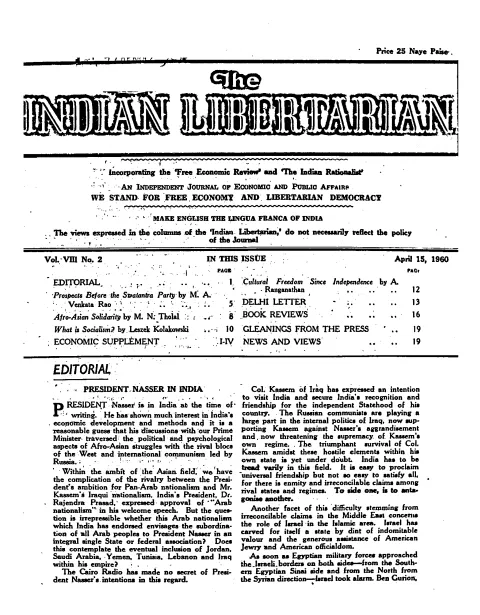
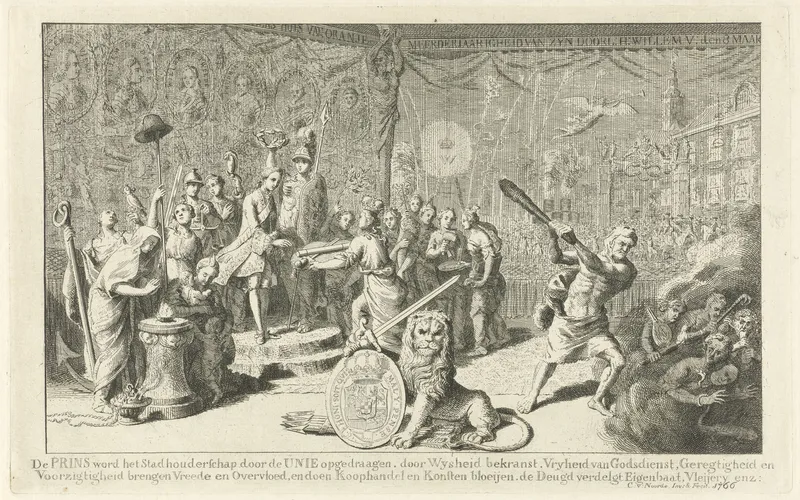
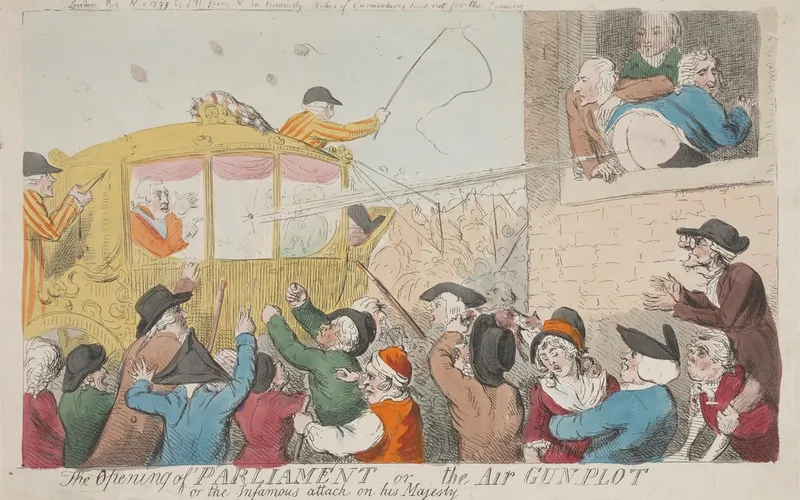
periodical issue
The Indian Libertarian
An Independent Journal of Free Economy and Public Affairs
The Indian Libertarian, Arya Bhavan, Sandhurst Road, Bombay 4 · Bombay · 1959
24 pages
The Indian Libertarian
Summary
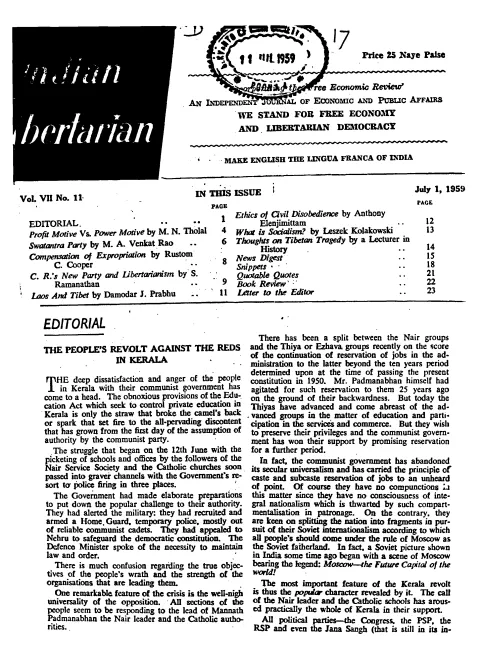
This July 1, 1959 issue of The Indian Libertarian (Vol. VII No. 11), edited by Kusum Lotwala and published from Bombay, gathers editorial commentary and signed essays around the magazine’s classical-liberal and anti-collectivist program. In the rendered pages the issue opens with editorials on the popular revolt against the Communist ministry in Kerala and the constitutional means of contesting it, then runs essays distinguishing the ‘profit motive’ from the ‘power motive’ (M. N. Thakkar), assessing the newly formed Swatantra Party (M. A. Venkat Rao), debating compensation for expropriated property (Kusum C. Cooper), and reading C. Rajagopalachari’s new party through a libertarian lens (S. Ramananthan). A second cluster of pieces turns to Cold War and Asian affairs — Laos and Tibet as illustrations of Communist subversion (Damodar J. Prabhu), the ethics of civil disobedience (Antony Elenjimittam), a translated satirical catechism ‘What Is Socialism?’ by the Polish philosopher Leszek Kolakowski, and an anonymous historical meditation on the Tibetan tragedy — before closing with a News Digest and lighter features.
Key points
-
M. N. Thakkar’s Profit Motive Vs. Power Motive argues the lust for power, not private enterprise, is the more dangerous and corrupting force, citing Napoleon and the French Revolution as cautionary cases.
-
Thakkar also invokes the rise of Hitler and Mussolini to argue that concentrated state power, not the marketplace, is what breeds tyranny in modern society.
-
M. A. Venkata Rao’s essay assesses the newly launched Swatantra Party’s economic and social programme as a viable free-enterprise opposition to Congress rule.
-
Kusum C. Cooper’s Compensation of Expropriation analyses Article 31 of the Constitution and the Fourth Amendment of 1955 governing compensation for acquired property.
-
S. Ramananthan tests C. Rajagopalachari’s new party against libertarian standards, asking how far its programme advances individual freedom and limits state power.
-
Damodar J. Prabhu’s essay on Laos and Tibet reads events in both countries as illustrations of externally directed Communist sabotage and infiltration across Asia.
-
Antony Elenjimittam’s Ethics Of Civil Disobedience traces the moral basis of non-violent resistance through Tolstoi, Thoreau and Gandhi, distinguishing principled disobedience from mere law-breaking.
-
Leszek Kolakowski’s What Is Socialism?, a banned Polish student-paper article reprinted from the New Leader of New York, defines socialism entirely by negation, each clause indicting censorship, informers and show trials.
Essays
Profit Motive Vs. Power Motive
By M. N. Thakkar
M. N. Thakkar contrasts the economic ‘profit motive’ with the political ‘power motive’, arguing in the rendered pages that the lust for power, not private enterprise, is the more dangerous and corrupting force in modern society. He invokes the slide from democracy into dictatorship — citing Napoleon and the French Revolution, and the rise of leaders such as Hitler and Mussolini — to claim that concentrated state power, not the marketplace, breeds tyranny.
- Sets up profit motive (economic) versus power motive (political) as the issue’s framing opposition.
- Argues the appetite for power is more corrupting and dangerous than the pursuit of profit.
- Draws on the French Revolution and 20th-century dictatorships as cautionary cases.
- Defends private enterprise against the charge that the profit motive is the root social evil.
Swatantra Party
By MA Venkata Rao
M. A. Venkat Rao examines the newly launched Swatantra Party, weighing its prospects as an organised opposition to Congress economic policy. In the rendered pages he discusses the party’s social and economic program, its appeal across regions, and the political conditions in India that, in his reading, make a free-enterprise opposition both necessary and viable.
- Assesses the Swatantra Party as a potential free-enterprise opposition to Congress.
- Considers the party’s economic and social platform and its likely base of support.
- Reads the party’s formation as a response to statist drift in Indian policy.
Compensation of Expropriation
By Kusum C. Cooper
Kusum C. Cooper analyses the constitutional question of compensation for expropriated property, working through Article 31 of the Constitution and the Fourth Amendment (1955). In the rendered pages the essay argues over whether and how the state must compensate owners when it acquires private property, and what the law’s evolution means for property rights.
- Centers on compensation for expropriation under Article 31 of the Indian Constitution.
- Discusses the Constitution (Fourth Amendment) Act of 1955.
- Frames property-acquisition law as a test of constitutional protection for owners.
C. R.’s New Party and Liberalisation
By S. Ramanathan
S. Ramananthan reads C. Rajagopalachari’s new party against the standards of libertarianism, asking how far its program advances individual freedom and limits on state power. In the rendered pages the essay situates the party within the contemporary debate over Indian economic policy and the Nehruvian planning consensus.
- Evaluates C. Rajagopalachari’s new party through a libertarian framework.
- Tests the party’s commitment to individual liberty and limited government.
- Sets the discussion against the prevailing planning consensus.
Law And Diet
By Damodar J. Prabhu
Damodar J. Prabhu’s piece, presented under the heading ‘Laos And Tibet — An Illustration of Sabotage’, treats events in Laos and Tibet as case studies in Communist subversion and infiltration. In the rendered pages he argues that ostensibly internal upheavals mask externally directed sabotage aimed at extending Communist control across Asia.
- Frames Laos and Tibet as illustrations of Communist sabotage and infiltration.
- Argues that local disturbances are externally directed.
- Reads Asian flashpoints as part of a wider Cold War contest.
Ethics of Civil Disobedience
By Antony Elenjimittam
Antony Elenjimittam’s ‘Ethics Of Civil Disobedience’ examines the moral basis of non-violent resistance, tracing its lineage through Tolstoi, Henry Thoreau and Mahatma Gandhi. In the rendered pages he distinguishes principled civil disobedience from mere law-breaking and weighs its legitimacy against the frustrations that drive citizens to it.
- Locates civil disobedience in a tradition running from Thoreau and Tolstoi to Gandhi.
- Distinguishes ethical, principled disobedience from ordinary lawlessness.
- Ties the resort to disobedience to frustration with the state.
What is Statesman
By Leszek Kolakowski
Leszek Kolakowski’s ‘What Is Socialism?’ — described as an article the young Polish philosopher wrote for a Polish student newspaper, suppressed for its anti-Soviet character and reprinted from the New Leader of New York — is a satirical catechism defining socialism by negation. In the rendered pages it consists of a long litany of the things a socialist state is ‘not’, each line skewering the repressions and absurdities of really-existing Communist regimes.
- A satirical ‘via negativa’ definition: socialism is described entirely by what it is NOT.
- Each clause indicts a feature of actually-existing Communist rule (censorship, informers, show trials, colonies).
- Framed as a banned Polish student-paper article reprinted from the New Leader, New York.
Thoughts on Tibetan Tragedy by a Lecturer in History
By A Lecturer in History
An unsigned essay, bylined only ‘By a Lecturer in History’, reflects on the Tibetan tragedy in the wake of the 1959 uprising and the flight of the Dalai Lama. In the rendered pages it sets the Chinese suppression of Tibet against the broader history of Sino-Tibetan and Indo-Tibetan relations and the Indian government’s posture toward events on its northern frontier.
- Reflects on the 1959 suppression of Tibet and its historical background.
- Situates events within Sino-Tibetan and Indian-Tibetan relations.
- Raises questions about India’s response to developments on its frontier.
Generated by the v1.5 extraction pipeline. Awaiting editorial review.
Metadata and summary are AI-extracted from the source PDF and reviewed for editorial accuracy. The original work is available via the Read PDF tab above (where present); paragraph-level citation inside the PDF is deferred to a future engagement.