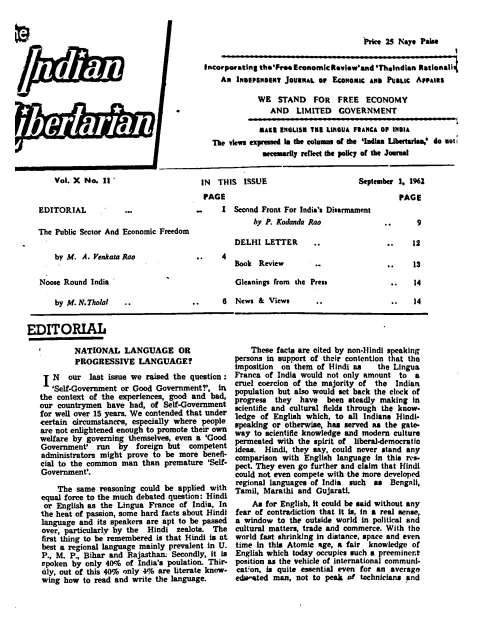
periodical issue
The Indian Libertarian
An Independent Journal of Economic and Public Affairs
By MA Venkata Rao, M. N. Tholal, P Kodanda Rao
The Indian Libertarian, Arya Bhavan, Sandhurst Road, Bombay 4 · Bombay · 1962
16 pages
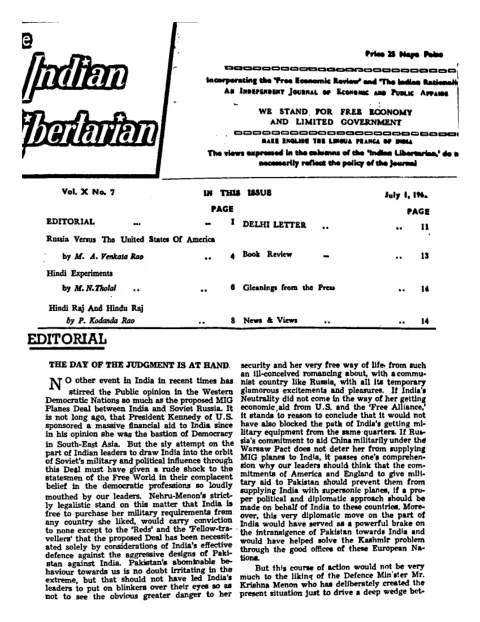
The Indian Libertarian
Summary
This July 1, 1962 issue of The Indian Libertarian (Vol. X No. 7), edited by D. M. Kulkarni in Bombay under the banner ‘We Stand For Free Economy And Limited Government’, is dominated by foreign policy and the national-language controversy. In the rendered pages the editorial, ‘The Day Of The Judgment Is At Hand’, attacks Defence Minister Krishna Menon and the proposed deal to acquire Soviet MIG fighter planes, warning that drawing India into the Soviet orbit betrays its democratic commitments and weakens its position against Pakistan. M. A. Venkata Rao then contrasts the Russian and American systems as rival civilisations, while two essays — M. N. Tholal’s ‘Hindi Experiments’ and P. Kodanda Rao’s ‘Hindi Raj And Hindu Raj’ — dissect the politics of imposing Hindi as the national language, the Sanskritised Hindi of official broadcasting, and the threat of linguistic disintegration. Standing departments (Delhi Letter, Book Review, News & Views, Gleanings from the Press) close the issue.
Key points
-
The editorial ‘The Day Of The Judgment Is At Hand’ condemns the proposed acquisition of Soviet MIG fighter planes and Defence Minister Krishna Menon’s argument that India is free to buy military hardware from any source.
-
It warns that the deal risks drawing India into military dependence on the Soviet Union under the shadow of the Warsaw Pact, and argues a defence understanding with America and Britain would better serve Kashmir policy.
-
M. A. Venkata Rao’s ‘Russia Versus The United States Of America’ frames the Cold War as a clash between two whole civilisations, weighing the systems on civil liberty and invoking the Yalta agreement.
-
M. N. Tholal’s ‘Hindi Experiments’, opening from Nehru’s 13 June press conference, attacks the artificial, heavily Sanskritised Hindi propagated through All India Radio and warns it breeds national disintegration rather than unity.
-
P. Kodanda Rao’s ‘Hindi Raj And Hindu Raj’ equates the imposition of Hindi as sole national language with a broader ‘Hindu Raj’ threatening non-Hindi-speaking minorities, and defends the three-language formula and the continued role of English as safeguards against majoritarian domination.
Essays
Editorial
The editorial, ‘The Day Of The Judgment Is At Hand’, condemns the proposed acquisition of Soviet MIG fighter planes and what it sees as the drift of Indian foreign policy into the Soviet orbit. In the rendered pages it argues that Krishna Menon’s stance — that India is free to buy military hardware from any country — ignores the danger of becoming militarily dependent on Russia under the shadow of the Warsaw Pact, and that a closer defence understanding with America and England would better serve India and help solve the Kashmir problem and Pakistan’s ‘aggressive designs’.
- Attacks the proposed MIG planes deal with the Soviet Union.
- Warns against military dependence on Russia under the Warsaw Pact.
- Criticises Defence Minister Krishna Menon’s reasoning.
- Argues a defence understanding with the West would help on Kashmir and Pakistan.
Russia Versus The United States Of America
By MA Venkata Rao
M. A. Venkata Rao’s ‘Russia Versus The United States Of America’ frames the Cold War as a contest between two whole civilisations rather than merely two states. In the rendered pages he weighs the systems against each other on civil liberty and the meaning of freedom, invoking the Yalta agreement and arguing that the difference between the two worlds is ultimately moral and political, not just military.
- Treats the US-USSR rivalry as a clash of two civilisations.
- Contrasts the systems on civil liberty and the meaning of freedom.
- Invokes the Yalta agreement in reading the post-war order.
Hindi Experiments
By M. N. Tholal
M. N. Tholal’s ‘Hindi Experiments’ opens from the Prime Minister’s press conference of June 13 and criticises the official experiments in promoting Hindi as the national language. In the rendered pages he attacks the artificial, heavily Sanskritised Hindi propagated through All India Radio and official channels, arguing that forced linguistic standardisation breeds national disintegration rather than unity.
- Begins from Nehru’s June 13 press conference on language.
- Criticises the artificial, Sanskritised Hindi of official broadcasting (AIR).
- Argues forced Hindi imposition risks national disintegration.
Hindi Raj And Hindu Raj
By P. Kodanda Rao
P. Kodanda Rao’s ‘Hindi Raj And Hindu Raj’ argues that imposing Hindi as the sole national language amounts to a form of ‘Hindi Raj’ that is bound up with a wider ‘Hindu Raj’, threatening non-Hindi-speaking and minority Indians. In the rendered pages he defends the three-language formula and the continued role of English, treating linguistic pluralism as a safeguard against majoritarian domination.
- Equates the imposition of Hindi (‘Hindi Raj’) with a broader ‘Hindu Raj’.
- Defends the three-language formula and the role of English.
- Frames linguistic pluralism as protection for non-Hindi and minority Indians.
Generated by the v1.5 extraction pipeline. Awaiting editorial review.
Metadata and summary are AI-extracted from the source PDF and reviewed for editorial accuracy. The original work is available via the Read PDF tab above (where present); paragraph-level citation inside the PDF is deferred to a future engagement.