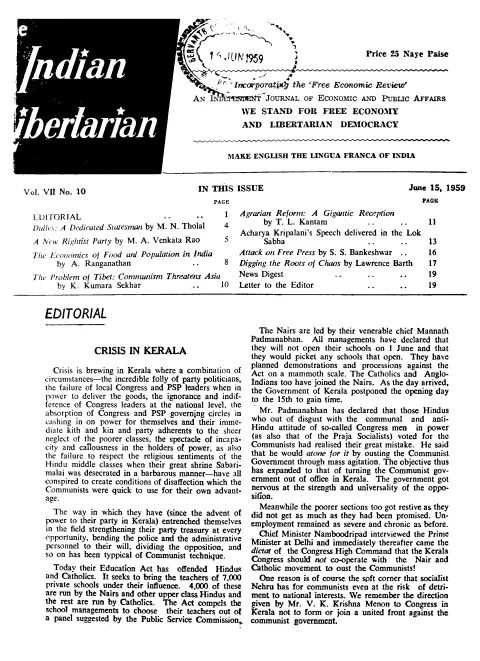
periodical issue
The Indian Libertarian
Independent Journal of Economic and Public Affairs
The Indian Libertarian, Independent Journal of Economic and Public Affairs · Bombay · 1959
24 pages
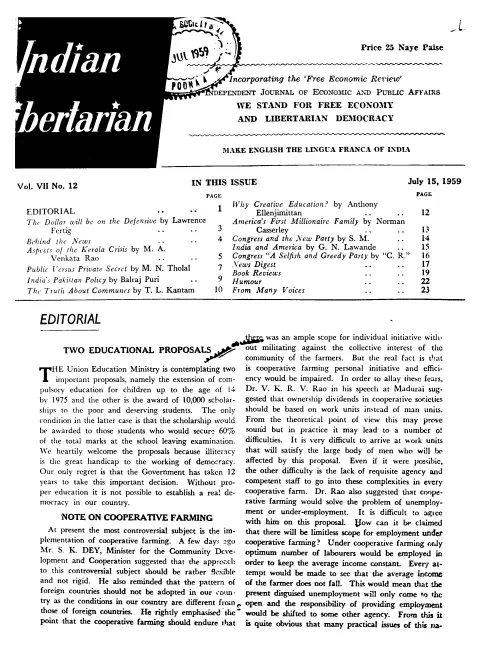
The Indian Libertarian
Summary
This fortnightly issue of The Indian Libertarian (Vol. VII No. 12, July 15, 1959), edited by Kusum Lotwala in Bombay, gathers the journal’s characteristic mix of free-market economics, anti-planning polemic, and political commentary. The lead editorial debates two Union Education Ministry proposals (compulsory schooling to age 14 and a means-tested scholarship scheme) and cooperative farming; subsequent articles range across international monetary policy (Lawrence Fertig on the dollar), the Kerala communist-government crisis, the public-versus-private-sector debate, India’s Pakistan policy, a critique of Chinese communes, education philosophy, and reports on the emerging Swatantra (New) Party. Through the rendered pages the issue argues a consistent classical-liberal line: that state planning, public-sector expansion, and communist models are economically and politically corrosive, while individual initiative and private enterprise are the engines of development.
Key points
-
The 15 July 1959 issue of The Indian Libertarian (Vol. VII, No. 12), edited by Kusum Lotwala, opens by welcoming the Union Education Ministry’s plan to extend compulsory schooling to age 14 by 1975 and fund 10,000 scholarships for poor students.
-
The editorial also weighs cooperative farming as a remedy for disguised rural unemployment, citing Minister S. K. Dey and Dr. V. K. R. V. Rao on whether it can genuinely absorb underemployed labour.
-
Lawrence Fertig predicts the US dollar will move onto the defensive internationally as restored currency convertibility and the recovery of other economies shift global trade balances.
-
M. A. Venkata Rao examines the agitation against Kerala’s elected Communist government, centred on the Kerala Education Act, and weighs the constitutional question of central intervention against a duly elected state government.
-
M. N. Tholal’s ‘Public Versus Private’ argues the expanding public sector produces inefficiency in transport and services, citing bus operations and administrative bloat to press the case for private enterprise.
-
T. L. Kantam’s ‘The Truth About Communes’ traces China’s Great Leap Forward, quoting the party organ Jen-min jih-pao on the progressive abolition of private property, land and livestock under the commune system.
-
Anthony Ellenjimittan’s ‘Why Creative Education?’ warns that education has become a department of the state under communist and fascist patterns alike, praising independent educators Gandhi, Tagore and Sri Aurobindo against schools’ scramble for government recognition.
-
Balraj Puri examines India’s Pakistan policy by weighing emotional reactions against national interest, while Norman Casserley profiles the Astor family’s fur-trade fortune as America’s first millionaire dynasty.
Essays
Editorial: Two Educational Proposals
The editorial ‘Two Educational Proposals’ welcomes the Union Education Ministry’s contemplated extension of compulsory education to age 14 by 1975 and a scheme of 10,000 scholarships for poor and deserving students, while regretting the twelve-year delay and warning that without literacy real democracy is impossible. It then turns to cooperative farming as the most controversial subject, citing Minister S. K. Dey and Dr. V. K. R. V. Rao on whether cooperative farming can absorb disguised unemployment, and doubting that it solves the problem of underemployment.
- Backs compulsory education to age 14 and means-tested scholarships
- Calls illiteracy the great handicap to democracy
- Examines cooperative farming as a remedy for disguised rural unemployment
- Cites S. K. Dey and Dr. V. K. R. V. Rao on the farming debate
The Dollar will be on the Defensive
By Lawrence Fertig
Lawrence Fertig argues that the US dollar, long the world’s strongest currency, will come under defensive pressure as other nations’ economies recover and gold and currency convertibility shift. He frames the looming defensive position of the dollar as a consequence of restored convertibility and changing trade balances among the leading economies.
- Predicts the dollar will move onto the defensive internationally
- Links the shift to restored currency convertibility
- Reads recovery of other economies as the driving cause
Aspects of the Kerala Crisis
By MA Venkata Rao
M. A. Venkata Rao examines the Kerala crisis, where the elected Communist state government’s Education Act and policies provoked a mass agitation. He weighs the constitutional position and the question of central intervention against a duly elected government, treating the episode as a test of Indian democracy’s response to communist rule at the state level.
- Analyses the agitation against Kerala’s Communist government
- Centres on the Kerala Education Act as the flashpoint
- Weighs the constitutional question of central intervention
Public Versus Private Secret
By M. N. Tholal
M. N. Tholal contrasts the public and private sectors, arguing that the public sector’s expansion in transport and services produces inefficiency while private initiative serves the public better. He uses examples such as bus services and a central secretariat to press the case against state monopoly and for private enterprise.
- Defends the private sector over the expanding public sector
- Cites bus services and administrative bloat as evidence
- Argues private initiative serves the public more efficiently
India’s Pakistan Policy
By Balraj Puri
Balraj Puri examines India’s Pakistan policy, arguing for a realistic approach to relations between the two countries and weighing emotional versus national-interest considerations in shaping foreign policy toward Pakistan.
- Assesses India’s policy toward Pakistan
- Distinguishes emotional reactions from national interest
- Argues for a realistic bilateral approach
The Truth About Communes
By T. L. Kantam
T. L. Kantam critiques the Chinese commune system, tracing the ‘Great Leap Forward’ and the communes’ absorption of private property, land, livestock and family ties into collective ownership. Drawing on the party organ Jen-min jih-pao, he reads the communes as the last stage in communizing the whole Chinese economy and warns of the crisis they have brought within China.
- Critiques China’s commune system and the Great Leap Forward
- Describes progressive abolition of private property
- Quotes the party organ Jen-min jih-pao on collectivization
- Reads communes as a crisis within Communist China
Why Creative Education?
By Anthony Ellenjimittan
Anthony Ellenjimittan argues that education in modern times has become a department of government, with both communist and fascist states enforcing uniform educational patterns to mould citizens. He criticises Indian schools’ scramble for government recognition and grants, praises pioneering independent educators such as Gandhi, Tagore and Sri Aurobindo, and invokes Plato, Socrates and Aristotle to call for a creative education that preserves individual freedom rather than serving state ends.
- Warns education has become a department of the state
- Likens government recognition to communist/fascist control
- Praises Gandhi, Tagore and Aurobindo as independent educators
- Calls for creative education preserving individual freedom
America’s First Millionaire Family
By Norman Casserley
Norman Casserley sketches the history of America’s first millionaire family, the Astors, beginning with John Jacob Astor’s fortune built in the fur trade and the move into Manhattan real estate, as an illustrative tale of American wealth.
- Profiles the Astor family as America’s first millionaires
- Traces John Jacob Astor’s fur-trade fortune
- Notes the shift into New York real estate
Congress and the New Party
By S. M.
Writing as ‘S. M.’, this ‘Hindustan Times’ piece discusses the formation of the new Swatantra Party and its relation to the Congress. It weighs Rajagopalachari’s role and whether a credible conservative or free-enterprise opposition can emerge to challenge the dominant Congress, set against Nehru’s leadership.
- Discusses the launch of the new Swatantra Party
- Assesses its prospects against Congress dominance
- Centres on Rajagopalachari’s role
India and America
By G N Lawande
G. N. Lawande reports on a lecture by A. D. Shroff, well-known economist and founder of the Forum of Free Enterprise, on America and India under the Indo-American Society’s auspices. Shroff argues there is no hostility in America toward India, that American investors are willing to invest if a proper climate is created, that capitalism is not in decay in America, and that the saving habit of the American people enables them to face any recession; he praises Radhakrishnan and G. L. Mehta for building goodwill.
- Reports A. D. Shroff’s lecture under the Indo-American Society
- Shroff sees no American hostility toward India
- Argues a proper climate would attract US investment
- Rejects the idea that capitalism is in decay in America
Congress “A Selfish and Greedy Party”
By “C. R.”
Under the byline ‘C. R.’, this piece reproduces a ‘Socialist Programme is Denounced’ commentary in which Rajagopalachari attacks the Congress and its socialist programme, charging it with becoming ‘a selfish and greedy party.’ It frames Rajaji’s denunciation of Congress economic policy and the case for the new opposition.
- Reproduces Rajagopalachari’s denunciation of the Congress
- Brands Congress ‘a selfish and greedy party’
- Attacks the Congress socialist programme
News Digest
The News Digest collects short national news items, including reports of arrests of Kerala communists by the Red government, agitation gathering strength, allegations of nepotism, and a debate over English as a medium of instruction. It functions as the issue’s roundup of current political developments.
- Roundup of short national news items
- Reports on the Kerala agitation and arrests
- Notes a debate over English as medium of instruction
Generated by the v1.5 extraction pipeline. Awaiting editorial review.
Metadata and summary are AI-extracted from the source PDF and reviewed for editorial accuracy. The original work is available via the Read PDF tab above (where present); paragraph-level citation inside the PDF is deferred to a future engagement.