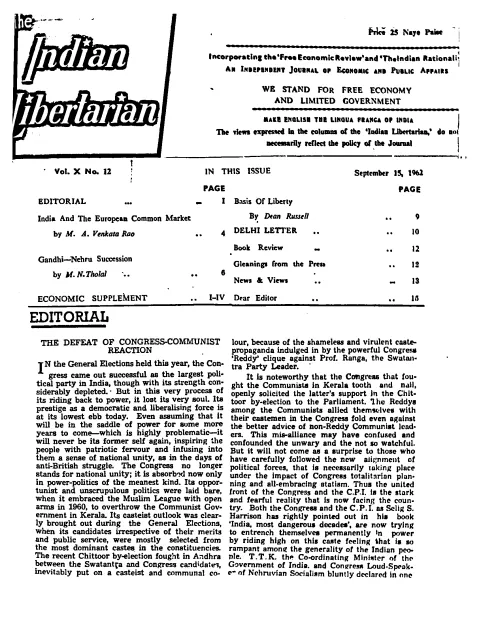
periodical issue
The Indian Libertarian
An Independent Journal of Economic and Public Affairs
By MA Venkata Rao, M. N. Tholal, A Ranganathan
The Indian Libertarian, Independent Journal of Free Economy and Public Affairs · Bombay · 1962
20 pages
The Indian Libertarian
Summary
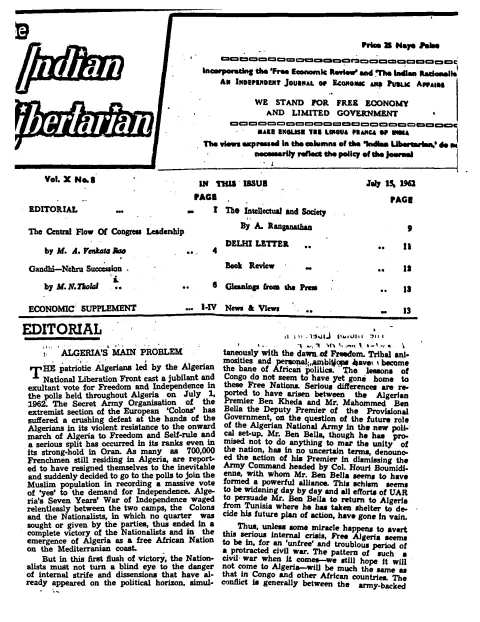
This issue of The Indian Libertarian (Vol. X No. 8, July 15, 1962), edited by Kusum Lotwala in Bombay, now carries the cover slogan ‘We Stand For Free Economy and Limited Government’. Its editorial reads the Algerian National Liberation Front’s referendum victory of July 1962 as a warning that newly independent nations risk internal strife and civil war once the unifying struggle for freedom ends. The issue then turns inward: M. A. Venkata Rao analyses the ‘central flow’ of Congress leadership and the Dravida separatist agitation in Madras; M. N. Tholal weighs the Gandhi-to-Nehru succession and the future of Congress leadership; and A. Ranganathan reflects on the place of the intellectual in society. A four-page Economic Supplement carries Dr. N. Das’s critical survey of ‘State Enterprises in India’, alongside the regular Delhi Letter, book review, press gleanings and news columns. Across the rendered pages the issue argues a limited-government, free-economy line against state enterprise and centralised political power.
Key points
-
The editorial “Algeria’s Main Problem” reads the National Liberation Front’s overwhelming July 1962 referendum victory as a jubilant but precarious moment, warning of post-independence factional splits.
-
The editorial notes the Ben Bella-Ben Khedda rupture and rifts within the army command, drawing the general lesson that newly free nations must guard against post-liberation civil strife.
-
M. A. Venkata Rao examines the “central flow” of Congress leadership after the 1962 elections, addressing the Dravida Kazhagam and Dravida Munnetra Kazhagam separatist agitation in Madras.
-
Venkata Rao frames the questions of Congress leadership succession and regional separatism as tests of the party’s capacity to hold the nation together.
-
M. N. Tholal reflects on Gandhi’s designation of Nehru as his successor, touching on the Poona Pact and the internal dynamics of Congress organisation during the freedom movement.
-
The Economic Supplement carries Dr. N. Das’s critical survey, “State Enterprises in India,” questioning the pricing and profitability of public-sector enterprises under “no-profit-no-loss” policies.
-
Das argues that political and bureaucratic control undermines the efficient running of India’s state enterprises, surveying their growth and performance since independence.
Essays
Editorial: Algeria’s Main Problem
The editorial ‘Algeria’s Main Problem’ interprets the Algerian National Liberation Front’s overwhelming July 1962 referendum vote for freedom and independence as a jubilant but precarious moment. It warns that the end of a seven-year war of independence exposes the new nation to internal strife, factional splits (the Ben Bella-Ben Khedda rupture, the role of the Secret Army Organisation among the European colons), and the danger of a protracted civil war, drawing the general lesson that nationalists must not be blind to post-liberation dissension.
- Reads the July 1962 Algerian referendum as a victory shadowed by danger
- Notes the Ben Bella-Ben Khedda split and army-command rifts
- Warns newly free nations against post-independence civil strife
The Central Flow Of Congress Leadership
By MA Venkata Rao
M. A. Venkata Rao examines the ‘central flow’ of Congress leadership in the wake of the 1962 elections, considering the party’s psychology, its handling of provincial pressures, and the threat posed by the Dravida Kazhagam and Dravida Munnetra Kazhagam separatist agitation in Madras. He treats the question of leadership succession and regional separatism as a test of the Congress’s capacity to hold the nation together.
- Analyses the flow and psychology of Congress leadership
- Addresses the Dravida separatist agitation in Madras
- Frames succession and regionalism as national-unity tests
Gandhi—Nehru Succession
By M. N. Tholal
M. N. Tholal reflects on the Gandhi-to-Nehru succession, recalling Gandhi’s designation of Nehru and the dynamics of leadership within the freedom movement, including a discussion touching on the Poona Pact and Congress organisation. He weighs the question of who or what will succeed the current leadership and what that means for the party’s future.
- Reflects on Gandhi’s choice of Nehru as successor
- Touches on the Poona Pact and Congress organisation
- Raises the open question of the next succession
Economic Supplement
The Economic Supplement carries Dr. N. Das’s ‘State Enterprises In India’, a critical survey of the evolution and performance of public-sector enterprises since independence. It examines their pricing and profitability, questions whether managed or ‘no-profit-no-loss’ policies serve the economy, and argues that political and bureaucratic control undermines the efficient running of state enterprises.
- Surveys the growth of public-sector enterprises in India
- Questions their pricing and profitability policies
- Argues political/bureaucratic control breeds inefficiency
Generated by the v1.5 extraction pipeline. Awaiting editorial review.
Metadata and summary are AI-extracted from the source PDF and reviewed for editorial accuracy. The original work is available via the Read PDF tab above (where present); paragraph-level citation inside the PDF is deferred to a future engagement.