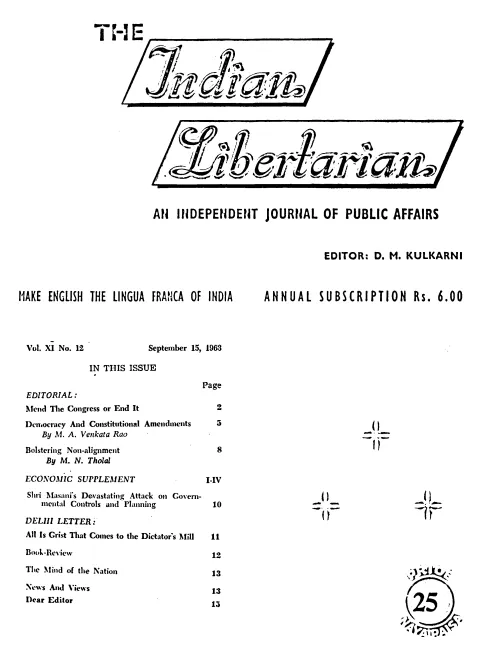
periodical issue
The Indian Libertarian
An Independent Journal of Public Affairs
By MA Venkata Rao, M. N. Tholal, B. Shiva Rao, G N Lawande
Published by D. M. Kulkarni for the Libertarian Social Institute · Bombay · 1963
20 pages
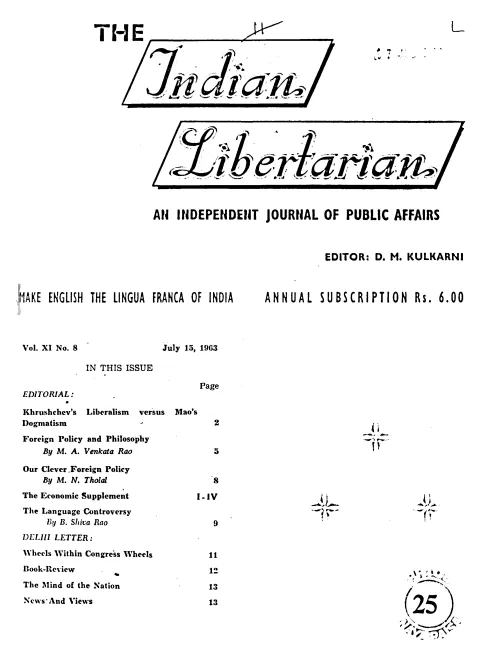
The Indian Libertarian
Summary
This July 15, 1963 issue (Vol. XI No. 8) of The Indian Libertarian, an independent Bombay journal of public affairs edited by D. M. Kulkarni, leads with an editorial reading the Sino-Soviet ideological split as a contest between Khrushchev’s ‘liberalism’ and Mao’s dogmatism, and argues that India’s leaders misread both. The issue’s argumentative center is foreign policy and the defence of liberal-market economics against socialist planning: M. A. Venkata Rao ties foreign policy to underlying philosophy, M. N. Tholal dissects India’s ‘clever’ non-alignment, and B. Shiva Rao surveys the national language controversy. A bound-in four-page Economic Supplement (paginated I-IV) carries G. N. Lawande on taxation and economic growth and a continuation piece by Phillip H. Moore defending business against being made the scapegoat for inflation. Shorter departments — a Delhi Letter, a book review, ‘The Mind of the Nation’, and ‘News and Views’ — round out the issue.
Key points
-
The 15 July 1963 issue, Vol. XI No. 8, edited by D. M. Kulkarni, leads with an editorial reading the Sino-Soviet split as a contest between Khrushchev’s pragmatic liberalism and Mao’s rigid dogmatism.
-
The editorial attributes Soviet shifts to internal economic pressure and the demands of coexistence, casting Mao as committed to permanent revolutionary struggle, and warns Indian leaders overestimate Soviet liberalisation.
-
M. A. Venkata Rao argues that a nation’s foreign policy is inseparable from its underlying philosophy of democracy, criticising India’s non-alignment as philosophically rootless expediency.
-
M. N. Tholal’s ‘Our Clever Foreign Policy’ argues non-alignment has yielded little real advantage and that India overrates its own diplomatic ingenuity in world affairs.
-
G. N. Lawande’s Economic Supplement essay argues the tax burden has risen sharply since independence, choking off the capital formation a growing economy requires for expansion.
-
A companion Economic Supplement piece by Phillip H. Moore argues that business is wrongly scapegoated for inflation actually driven by government monetary and fiscal policy.
-
B. Shiva Rao reviews the national language controversy, recalling the Congress Working Committee’s handling of the Hindi-versus-English dispute and warning against alienating non-Hindi regions.
Essays
Khrushchev’s Liberalism versus Mao’s Dogmatism
The unsigned lead editorial frames the Sino-Soviet rift as a clash between Khrushchev’s pragmatic ‘liberalism’ and Mao’s rigid dogmatism, distinguishing the two communist powers by their rival national experiences and strategies. It argues that Khrushchev, chastened by domestic pressures, has drifted toward a measure of coexistence and economic realism, while Mao clings to revolutionary purity. The editorial warns that India’s leadership misreads this split, mistaking Soviet manoeuvres for genuine liberalisation.
- Reads the Sino-Soviet dispute as Khrushchev’s ‘liberalism’ versus Mao’s ‘dogmatism’.
- Attributes Soviet shifts to internal economic pressure and the demands of coexistence.
- Casts Mao as committed to revolutionary purity and permanent struggle.
- Argues Indian leaders misread the rift and overestimate Soviet liberalisation.
Foreign Policy and Philosophy
By MA Venkata Rao
M. A. Venkata Rao argues that a nation’s foreign policy is inseparable from its underlying philosophy of democracy and freedom. Surveying the moral basis of international conduct, he holds that India’s professed non-alignment lacks a coherent philosophical anchor and that genuine foreign policy must flow from a settled commitment to democratic values rather than expedient manoeuvring.
- Foreign policy must rest on a coherent philosophy of democracy and freedom.
- Criticises non-alignment as philosophically rootless expediency.
- Ties India’s external posture to the moral health of its domestic institutions.
Our Clever Foreign Policy
By M. N. Tholal
M. N. Tholal subjects India’s ‘clever’ foreign policy to sceptical scrutiny, arguing that non-alignment has yielded little real advantage and that India has overestimated its own diplomatic ingenuity. He reads U.S. and Western responses to Nehru’s policy as evidence that the supposed cleverness has not secured India’s strategic interests.
- Questions the practical payoff of India’s non-aligned diplomacy.
- Argues India overrates the cleverness of its own foreign policy.
- Reads Western reactions as exposing the limits of that policy.
The Economic Supplement
By G N Lawande
In the bound-in Economic Supplement, G. N. Lawande examines the relationship between taxation and economic growth, arguing that since independence the tax burden has risen sharply and that excessive taxation of savings and enterprise suppresses the capital formation a growing economy requires. The supplement also carries a continuation of Phillip H. Moore’s piece arguing that business is wrongly made the scapegoat for inflation that is really driven by government monetary and fiscal policy.
- Tax burden has risen steeply since independence, the supplement argues.
- Heavy taxation of savings and enterprise chokes off capital formation.
- A companion piece by Phillip H. Moore blames inflation on government policy, not business.
- Defends private enterprise as the engine of economic growth.
The Language Controversy
By B. Shiva Rao
B. Shiva Rao reviews the national language controversy, tracing the long political contest between the proponents of Hindi and the defenders of English and the regional languages. He recalls the Congress Working Committee’s handling of the question and argues that the matter touches the basic federal balance of the Constitution, warning against any settlement that would alienate the non-Hindi regions.
- Surveys the Hindi-versus-English national language dispute.
- Recalls the Congress Working Committee’s role in the controversy.
- Frames the language question as a constitutional and federal issue.
- Warns against alienating non-Hindi-speaking regions.
Generated by the v1.5 extraction pipeline. Awaiting editorial review.
Metadata and summary are AI-extracted from the source PDF and reviewed for editorial accuracy. The original work is available via the Read PDF tab above (where present); paragraph-level citation inside the PDF is deferred to a future engagement.