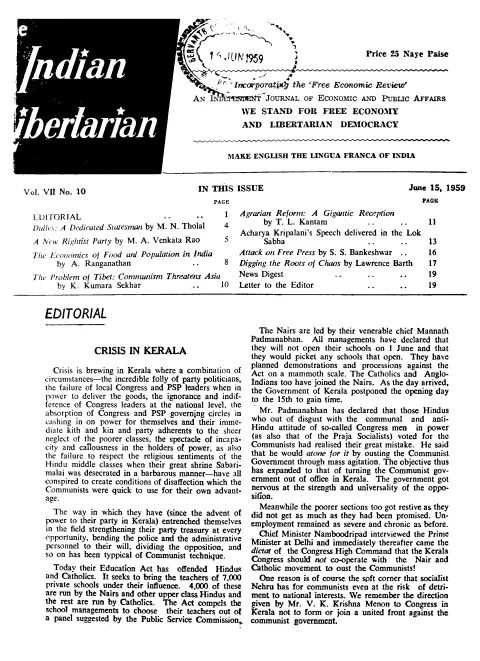
periodical issue
The Indian Libertarian
An Independent Journal of Economic and Public Affairs
By MA Venkata Rao, M. N. Tholal, J. K. Dhairyawan, A Ranganathan
The Indian Libertarian, Edited by Miss Kusum Lotwala; published on the 1st and 15th of each month from Arya Bhuvan, Sandhurst Road, Bombay 4 · Bombay · 1959
20 pages
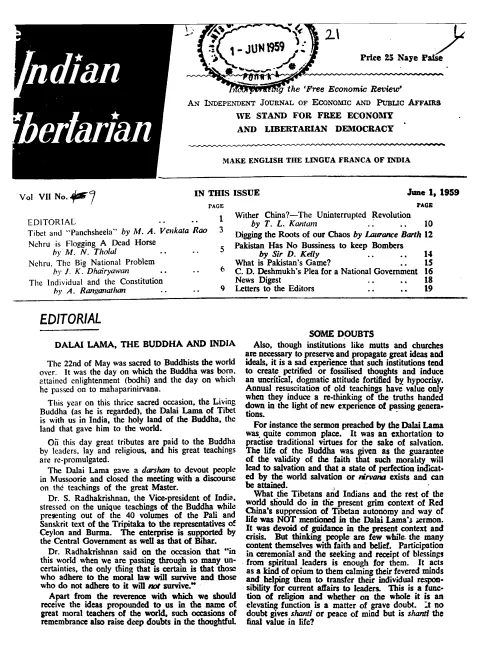
The Indian Libertarian
Summary
This June 1, 1959 issue (Vol. VII No. 9) of The Indian Libertarian, the Bombay ‘Independent Journal of Economic and Public Affairs’ edited by Kusum Lotwala, is dominated by the Tibetan crisis and the collapse of ‘Panchsheela’. The unsigned editorial reflects on the Dalai Lama, the Buddha and India in the wake of China’s suppression of Tibet, and M. A. Venkata Rao argues that the flight of the Dalai Lama exposes the bankruptcy of Nehru’s Five-Principles policy toward China. M. N. Tholal and J. K. Dhairyawan press the critique of Nehru’s leadership, A. Ranganathan reflects on the individual and the Constitution, T. L. Kantam analyses China’s ‘uninterrupted revolution’, Laurance Barth digs at the roots of Indian chaos, and Sir David Kelly and an unsigned piece scrutinise Pakistan. A report on C. D. Deshmukh’s plea for a national government and the standing departments (News Digest, Letters) close the issue.
Key points
-
This 1 June 1959 issue of The Indian Libertarian (Vol. VII No. 9), edited by Kusum Lotwala, is dominated by the Tibetan crisis and the collapse of ‘Panchsheela’.
-
The unsigned editorial, ‘Dalai Lama, the Buddha and India’, notes that the Dalai Lama’s own sermon omitted China’s suppression of Tibet despite tributes paid by leaders including Radhakrishnan.
-
M. A. Venkata Rao’s ‘Tibet and “Panchsheela”’ argues the Tibetan revolt and the Dalai Lama’s flight to India exposed Nehru’s Five Principles of peaceful coexistence with China as an illusion.
-
M. N. Tholal’s ‘Nehru is Flogging A Dead Horse’ charges Nehru with persisting in discredited China and non-alignment policies long after events discredited them.
-
J. K. Dhairyawan’s ‘Nehru, The Big National Problem’ argues the Prime Minister’s personal dominance and characteristic indecision have become obstacles to sound government.
-
T. L. Kantam’s ‘Wither China?—The Uninterrupted Revolution’ traces the Maoist doctrine of permanent revolution and links it to China’s aggressive conduct, including in Tibet.
-
Sir David Kelly’s ‘Pakistan Has No Business to keep Bombers’ argues Pakistan’s bomber force is disproportionate to any legitimate defensive need and destabilises the subcontinent.
-
A. Ranganathan’s ‘The Individual and the Constitution’ measures the constitutional order by how far it actually secures individual freedom against encroachments of the state.
Essays
Editorial: Dalai Lama, the Buddha and India
The unsigned editorial, ‘Dalai Lama, the Buddha and India’, uses the coincidence of Buddha Purnima with the Tibetan crisis to meditate on faith, moral leadership, and the Chinese suppression of Tibet. It notes tributes paid to the Buddha by leaders including Radhakrishnan even as Red China’s crushing of Tibetan autonomy went unmentioned in the Dalai Lama’s own sermon, and questions whether ceremonial religiosity offers any real guidance in a moment of crisis.
- Ties Buddha Purnima observances to the Tibetan crisis.
- Notes the Dalai Lama’s sermon omitted China’s suppression of Tibet.
- Doubts that ceremonial religion gives real moral guidance.
Tibet and “Panchsheela”
By MA Venkata Rao
M. A. Venkata Rao argues that the Tibetan revolt and the Dalai Lama’s flight to India have exposed the emptiness of ‘Panchsheela’, the Five Principles of peaceful coexistence Nehru championed with China. He contends that China’s actions in Tibet prove the principles were never reciprocated, and that India’s faith in Chinese goodwill was a strategic illusion now overtaken by events.
- Reads the Tibet revolt as the death of ‘Panchsheela’.
- Argues China never honoured the Five Principles.
- Casts Nehru’s faith in Chinese goodwill as a strategic illusion.
Nehru is Flogging A Dead Horse
By M. N. Tholal
M. N. Tholal argues that Nehru is ‘flogging a dead horse’ in clinging to his established policies — particularly toward China and non-alignment — long after events have discredited them. The piece reads Nehru’s persistence as obstinacy in the face of obvious failure.
- Charges Nehru with persisting in discredited policies.
- Uses the ‘dead horse’ image for futile statecraft.
- Reads his obstinacy as a failure to learn from events.
Nehru, The Big National Problem
By J. K. Dhairyawan
J. K. Dhairyawan frames Nehru himself as ‘the big national problem’, arguing that the Prime Minister’s outsized personal dominance over Indian politics has become an obstacle to sound government. The piece holds that Nehru’s characteristic indecision and his grip on power together stunt the development of healthy political alternatives.
- Casts Nehru’s personal dominance as India’s core problem.
- Argues his indecision hampers effective government.
- Sees his grip on power stifling political alternatives.
The Individual and the Constitution
By A Ranganathan
A. Ranganathan reflects on the place of the individual within the Indian Constitution, examining the Preamble’s promises of liberty, equality, and fraternity and the guarantee of fundamental rights. He argues that the worth of the constitutional order is measured by how far it actually secures individual freedom against the encroachments of the state.
- Centres the individual in reading the Constitution.
- Examines the Preamble and fundamental rights guarantees.
- Measures the order by its protection of individual freedom.
Wither China?—The Uninterrupted Revolution
By T. L. Kantam
T. L. Kantam, in ‘Wither China?—The Uninterrupted Revolution’, analyses the Chinese Communist doctrine of permanent or uninterrupted revolution, tracing its ideological roots and arguing that it drives China’s aggressive external conduct, including in Tibet. The piece treats the doctrine as a key to understanding Beijing’s behaviour.
- Examines the Maoist doctrine of uninterrupted revolution.
- Links the doctrine to China’s external aggression.
- Reads Tibet as an expression of permanent revolution.
Digging the Roots of our Chaos
By Laurance Barth
Laurance Barth, in ‘Digging the Roots of our Chaos’, argues that India’s disorder stems from a failure to honour the economic and moral base of a free society. He contends that political and social chaos follow from ignoring sound economic foundations and the discipline of individual responsibility.
- Traces Indian chaos to neglected economic foundations.
- Links disorder to a failure of individual responsibility.
- Argues for restoring the moral base of a free society.
Pakistan Has No Business to keep Bombers
By Sir D. Kelly
In a piece by the late Sir David Kelly (a former British diplomat), the argument is made that Pakistan has no business keeping a bomber force, contending that its military build-up is disproportionate to any legitimate defensive need and destabilises the subcontinent.
- Argues Pakistan’s bomber force is unjustified.
- Reads its military build-up as destabilising.
- Written by the late British diplomat Sir David Kelly.
What is Pakistan’s Game?
An unsigned piece, ‘What is Pakistan’s Game?’, probes Pakistan’s strategic intentions toward India, reading its diplomatic and military moves — and its ‘headache’ over Kashmir and Tibet — as part of a calculated game rather than genuine grievance.
- Questions Pakistan’s strategic intentions toward India.
- Reads its moves as calculated rather than principled.
- Connects the analysis to Kashmir and the Tibet situation.
C. D. Deshmukh’s Plea for a National Government
An unsigned report relays C. D. Deshmukh’s plea for an all-party or national government, summarising his call for a ten-year truce of party rivalries, opposition to the nationalisation of banks, and warnings about educational deterioration. It presents Deshmukh’s argument that a broad-based government is needed to meet the national crisis.
- Reports C. D. Deshmukh’s call for a national/all-party government.
- Notes his proposed ten-year truce of party rivalries.
- Conveys his opposition to bank nationalisation.
Generated by the v1.5 extraction pipeline. Awaiting editorial review.
Metadata and summary are AI-extracted from the source PDF and reviewed for editorial accuracy. The original work is available via the Read PDF tab above (where present); paragraph-level citation inside the PDF is deferred to a future engagement.