periodical issue
The Indian Libertarian
Independent Journal of Economic and Public Affairs (Incorporating the 'Free Economic Review')
By J. K. Dhairyawan, M. N. Tholal, C. Rajagopalachari
Edited by Miss K. R. Lotwala for the Libertarian Publishers (Private) Ltd. Printed by J. K. Dhairyawan at The Kanada Press, 100, Parsi Bazar Street, Fort, Bombay, and published by him at the office of the Libertarian Publishers (Private) Ltd. 26 Durgadevi Road, Bombay 4. · Bombay · 1958
33 pages
The Indian Libertarian
Summary
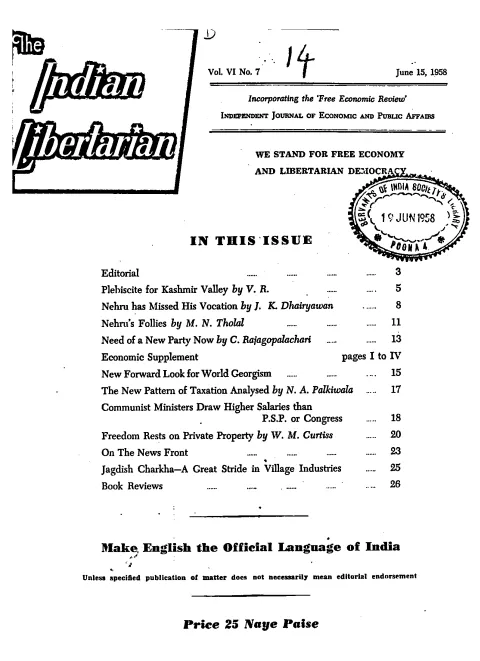
This June 15, 1958 issue (Vol. VI No. 7) of The Indian Libertarian, an ‘Independent Journal of Economic and Public Affairs’ published by the Libertarian Publishers of Bombay, gathers polemical commentary on free-market economics, the Nehru government, and Indian foreign policy. The rendered pages carry an unsigned editorial on national character and Pakistan, V. R.’s argument against a Kashmir-valley plebiscite, J. K. Dhairyawan’s and M. N. Tholal’s critiques of Nehru, C. Rajagopalachari’s call for a new opposition party, and an Economic Supplement essay by Prof. G. N. Lawande attacking the welfare state as a road to serfdom. The issue’s argumentative center is a classical-liberal defence of private enterprise and a sustained critique of Congress economic planning and Nehruvian leadership.
Key points
-
The unsigned editorial diagnoses a ‘mental softness’ in Indian public life and calls for hard-headed understanding of Pakistan and Islam rather than sentimental appeasement of national questions.
-
Writing under the initials V. R., an essay opposes a Kashmir-valley plebiscite, characterising political Islam as ‘fanatically exclusive’ and arguing the vote would be tilted in favour of ‘the aggressor’.
-
J. K. Dhairyawan’s ‘Nehru has Missed His Vocation’ argues the Prime Minister’s talents suited authorship rather than administration, criticising his handling of Pakistan and of corruption in government.
-
M. N. Tholal’s ‘Nehru’s Follies’ presses Nehru’s attitude toward Hinduism, untouchability, and Gandhi’s legacy, framing his ‘follies’ as rooted in a misreading of India’s religious culture.
-
C. Rajagopalachari argues in ‘Need of a New Party Now’ that Congress’s one-party monopoly has bred ‘parrot culture’, calling for a new opposition party and foreshadowing the Swatantra Party he would soon found.
-
Prof. G. N. Lawande’s Economic Supplement essay asks whether India is becoming a ‘welfare or an ill-fare state’, invoking the road-to-serfdom thesis to attack the welfare state as a ‘grand fiction’.
-
Lawande argues welfare-statism is a direct attack on liberty and that genuine economic emancipation requires private enterprise rather than state planning.
Essays
Editorial
The unsigned editorial diagnoses what it calls a ‘mental softness’ in the Indian character and argues that Indians must understand the Pakistani and Islamic mind rather than sentimentalize relations. It contends that the country’s leadership has failed to treat national questions with sufficient firmness, and links domestic weakness to a wider failure to research and confront history honestly.
- Argues Indian public life suffers from ‘mental softness’ and sentimentality
- Calls for hard-headed understanding of Pakistan and Islam rather than appeasement
- Links national weakness to a refusal to study history honestly
Plebiscite for Kashmir Valley
By V. R.
Writing under the initials V. R., this article opposes holding a plebiscite in the Kashmir valley. It surveys Islam as a ‘fanatically exclusive’ political force, the postures of Nasser and Lebanon, and the conduct of Pakistan, and concludes that the scales in any plebiscite would be tilted in favour of ‘the aggressor.’ The author argues India should not concede a vote engineered under conditions favouring Pakistan and warns against cooling relations with Delhi over the issue.
- Opposes a plebiscite in the Kashmir valley
- Characterises political Islam as fanatically exclusive and ties it to Pakistani strategy
- Argues plebiscite conditions would favour ‘the aggressor’
- Discusses Nasser, Lebanon and Pakistan’s regional posture
Nehru has Missed His Vocation
By J. K. Dhairyawan
J. K. Dhairyawan argues that Jawaharlal Nehru has ‘missed his vocation’ — that his gifts suited him to be a writer or thinker rather than an administrator. The piece criticises Nehru’s handling of Pakistan, administration, and corruption, and contends that his temperament has left Indian governance adrift.
- Contends Nehru’s talents suited authorship, not administration
- Criticises Nehru’s record on Pakistan and corruption in administration
- Reads Nehru’s leadership style as a temperamental mismatch with governing
Nehru’s Follies
By M. N. Tholal
M. N. Tholal’s ‘Nehru’s Follies’ presses a critique of Nehru’s record, dwelling on his attitude toward Hinduism, untouchability, and Gandhi’s legacy. The author argues that Nehru’s posture toward India’s religious traditions reflects a deeper political misjudgement.
- Critiques Nehru’s stance toward Hinduism and untouchability
- Invokes Gandhi’s legacy as a measure against which Nehru falls short
- Frames Nehru’s ‘follies’ as rooted in misreading India’s religious culture
Need of a New Party Now
By C. Rajagopalachari
C. Rajagopalachari (Rajaji) argues for the urgent formation of a new opposition party in India. He contends that the Congress monopoly has produced ‘parrot culture’ and that a genuine alternative is needed to discipline government and offer voters a real choice. The piece anticipates the case for a free-enterprise, constitutionalist opposition that Rajaji would soon embody in the Swatantra Party.
- Calls for the immediate creation of a new opposition party
- Attacks one-party Congress dominance as breeding ‘parrot culture’
- Argues an effective opposition is essential to disciplined government
- Foreshadows the founding case for the Swatantra Party
New Forward Look for World Georgism
By G N Lawande
In the Economic Supplement, Prof. G. N. Lawande asks whether India is becoming ‘a welfare or an ill-fare state.’ Drawing on the road-to-serfdom argument, he attacks the welfare state as a ‘grand fiction’ that, by expanding state economic control, erodes liberty and entrenches a vicious circle of dependence. He argues that welfare-statism is a direct attack on liberty and that genuine economic emancipation requires private enterprise rather than planning.
- Frames the welfare state as a ‘grand fiction’ and an ‘ill-fare state’
- Argues welfare-statism is a direct attack on liberty
- Invokes the road-to-serfdom thesis against economic planning
- Holds that real economic emancipation requires private enterprise
Generated by the v1.5 extraction pipeline. Awaiting editorial review.
Metadata and summary are AI-extracted from the source PDF and reviewed for editorial accuracy. The original work is available via the Read PDF tab above (where present); paragraph-level citation inside the PDF is deferred to a future engagement.