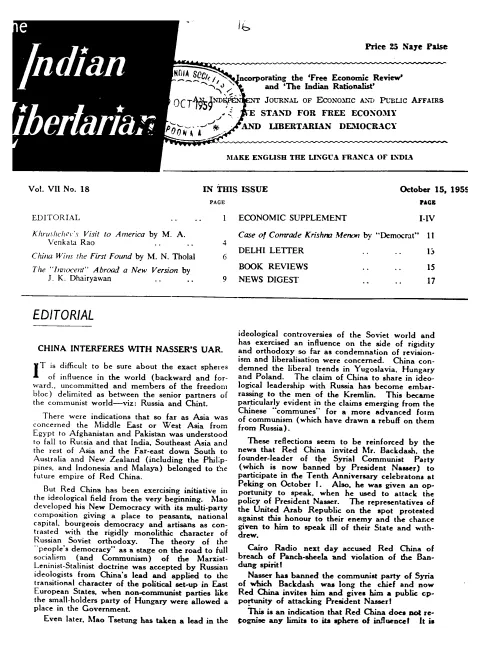
periodical issue
The Indian Libertarian
An Independent Journal of Economic and Public Affairs (Incorporating the 'Free Economic Review' and 'The Indian Rationalist')
By MA Venkata Rao, M. N. Tholal, A Ranganathan
Edited and Published by Miss Kusum Lotwala for the Libertarian Publishers (Private) Ltd., Arya Bhavan, Sandhurst Road, Bombay 4. · Bombay · 1960
24 pages
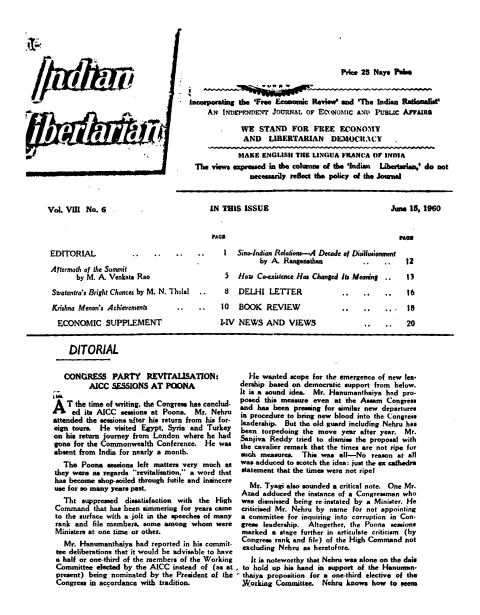
The Indian Libertarian
Summary
The June 15, 1960 issue (Vol. VIII No. 6) of The Indian Libertarian, now subtitled an ‘Independent Journal of Economic and Public Affairs’ incorporating the ‘Free Economic Review’ and ‘The Indian Rationalist,’ opens with an editorial on Congress ‘revitalisation’ at the Poona AICC sessions and Nehru’s role there. It carries M. A. Venkata Rao on the collapse of the Paris summit, M. N. Tholal on the bright prospects of the new Swatantra Party, E. H. Potter’s critical appraisal of V. K. Krishna Menon, and A. Ranganathan on a decade of Sino-Indian disillusionment, alongside an Economic Supplement essay on capital accumulation and economic growth signed ‘Sputnik.’ The issue sustains the journal’s classical-liberal, anti-Communist line, championing the Swatantra alternative and free-enterprise economics against Congress planning and Nehruvian foreign policy.
Key points
-
The editorial, “Congress Party Revitalisation: AICC Sessions at Poona,” reports rank-and-file dissatisfaction with the party High Command and the Hanumanthaiya proposal to broaden the Working Committee.
-
It reads the party’s post-Poona “revitalisation” rhetoric as largely futile and insincere, noting Jawaharlal Nehru’s ambivalent role in the proceedings after his recent foreign tours.
-
M. A. Venkata Rao’s “Aftermath of the Summit” assesses the collapse of the Paris summit between Khrushchev and the Western powers following the U-2 affair, reading it as confirming the unreliability of Soviet coexistence.
-
M. N. Tholal’s “Swatantra’s Bright Chances” surveys the newly formed Swatantra Party’s conference and organisation, engaging its leadership including Rajaji and N. G. Ranga.
-
Tholal frames the newly formed Swatantra Party as a credible free-enterprise alternative to Congress, reporting on its organisational prospects following the party’s founding conference.
-
E. H. Potter’s “Krishna Menon’s Achievements” offers a sharply critical appraisal of Defence Minister V. K. Krishna Menon, questioning his record and treating his prominence as a liability rather than an achievement.
-
A. Ranganathan’s essay traces a decade of Sino-Indian relations from early Panchsheel optimism to disillusionment over Tibet and the frontier, criticising Indian policy toward China as naive.
-
The Economic Supplement essay “Capital Accumulation and Economic Growth,” signed pseudonymously as “Sputnik,” argues capital accumulation is central to developing countries’ growth and weighs saving and investment against state-directed growth.
-
This same piece includes a critique of Marx’s labour theory of value as part of its argument for private enterprise over state direction.
Essays
Editorial
The editorial, ‘Congress Party Revitalisation: AICC Sessions at Poona,’ reviews the Congress party’s attempt at self-renewal at its Poona sessions following Nehru’s foreign tours. It reports dissatisfaction with the party High Command, the Hanumanthaiya proposal to broaden the Working Committee, and Nehru’s manoeuvring, treating the ‘revitalisation’ talk as largely futile and insincere.
- Reviews the Poona AICC sessions and Congress ‘revitalisation’ rhetoric
- Reports rank-and-file dissatisfaction with the party High Command
- Notes the Hanumanthaiya proposal and Nehru’s ambivalent role
- Reads the renewal effort as futile and insincere
Aftermath of the Summit
By MA Venkata Rao
M. A. Venkata Rao’s ‘Aftermath of the Summit’ assesses the collapse of the Paris summit between Khrushchev and the Western powers in the wake of the U-2 affair. He reads the breakdown as confirming the unreliability of Soviet coexistence and a hardening of Cold War lines.
- Analyses the collapse of the Paris summit and the U-2 crisis
- Reads Khrushchev’s conduct as exposing the limits of coexistence
- Sees the failure as a hardening of Cold War divisions
Swatantra’s Bright Chances
By M. N. Tholal
M. N. Tholal’s ‘Swatantra’s Bright Chances’ surveys the prospects of the newly formed Swatantra Party, reporting on its conference and organisation and arguing that the party has a genuine opening as a free-enterprise alternative to Congress. The piece engages the party’s leadership, including Rajaji and N. G. Ranga.
- Assesses the Swatantra Party’s electoral and organisational prospects
- Reports on the party’s conference and General Secretary
- Frames Swatantra as a credible free-enterprise alternative to Congress
Krishna Menon’s Achievements
By Mr. E. H. Potter
E. H. Potter’s ‘Krishna Menon’s Achievements’ is a sharply critical appraisal of Defence Minister V. K. Krishna Menon, questioning his record and reputation and treating his prominence as a liability rather than an achievement.
- Offers a critical assessment of V. K. Krishna Menon
- Questions his record as Defence Minister
- Reads his standing as more liability than achievement
Sino-Indian Relations—A Decade of Disillusionment
By A Ranganathan
A. Ranganathan’s ‘Sino-Indian Relations—a decade of disillusionment’ traces the deterioration of India-China relations over the 1950s, from the Panchsheel optimism to disillusionment over Tibet and the frontier. It treats Indian policy toward China as naive and argues the decade ended in justified disenchantment.
- Traces a decade of Sino-Indian relations to disillusionment
- Contrasts early Panchsheel optimism with the Tibet and border reality
- Criticises Indian policy toward China as naive
Economic Supplement
The Economic Supplement carries an essay, ‘Capital Accumulation and Economic Growth,’ signed with the pseudonym ‘Sputnik.’ It argues that economic development of underdeveloped countries turns on capital accumulation, weighing the role of saving, investment and private enterprise against state-directed growth, and includes a critique of Marx’s labour theory of value.
- Argues capital accumulation is central to development of poor countries
- Weighs saving and investment against state-directed growth
- Includes a critique of Marx’s labour theory of value
- Published pseudonymously under ‘Sputnik’
Generated by the v1.5 extraction pipeline. Awaiting editorial review.
Metadata and summary are AI-extracted from the source PDF and reviewed for editorial accuracy. The original work is available via the Read PDF tab above (where present); paragraph-level citation inside the PDF is deferred to a future engagement.