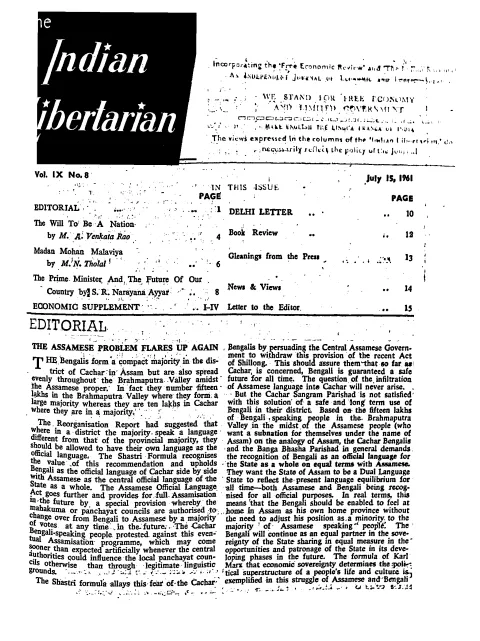
periodical issue
The Indian Libertarian
An Independent Journal of Economic and Public Affairs (Incorporating the 'Free Economic Review' and 'The Indian Rationalist')
By MA Venkata Rao, M. N. Tholal, A Ranganathan
Edited and Published by D. M. Kulkarni, B.A., LL.B. for the Libertarian Publishers (Private) Ltd., Arya Bhuvan, Sandhurst Road, Bombay 4. · Bombay · 1961
20 pages
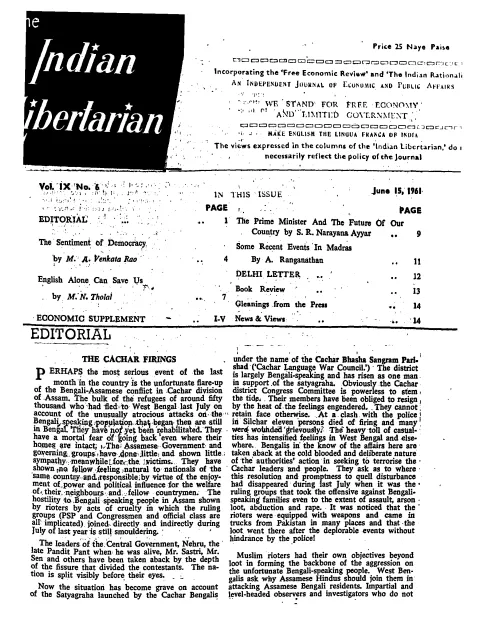
The Indian Libertarian
Summary
The June 15, 1961 issue (Vol. IX No. 6) of The Indian Libertarian, Bombay’s classical-liberal ‘Independent Journal of Economic and Public Affairs’ now flying the slogan ‘We stand for free economy and limited government,’ opens with an editorial on the Cachar firings and the Bengali-language agitation in Assam. It gathers M. A. Venkata Rao on the sentiment of democracy, M. N. Tholal’s argument that English alone can hold India together against Hindi imposition, S. R. Narayana Ayyar on the Prime Minister and national disintegration, and A. Ranganathan on recent events in Madras, plus an Economic Supplement essay by Prof. G. N. Lawande on employment under the Third Plan. The issue presses a free-enterprise, limited-government, anti-imposition line while defending English and constitutional democracy.
Key points
-
The 15 June 1961 issue, Vol. IX No. 6, now carrying the slogan ‘We stand for free economy and limited government’, opens with an editorial on the Cachar firings during the Bengali-language Satyagraha in Assam.
-
The editorial criticises the imposition of Assamese on Bengali-speaking Cachar and frames the resulting violence as a failure of both administration and language policy.
-
M. A. Venkata Rao’s ‘The Sentiment of Democracy’ argues democracy depends on a shared sentiment and culture of liberty rather than formal machinery alone, warning India lacks this deeper temper.
-
M. N. Tholal’s ‘English Alone Can Save Us’ defends English as the only language capable of holding a linguistically divided India together, opposing Hindi imposition in light of the Assam agitation.
-
S. R. Narayana Ayyar’s ‘The Prime Minister And The Future Of Our Country’ charges the Nehru government with presiding over ‘all-round national disintegration’, invoking Tilak as a contrasting model of leadership.
-
A. Ranganathan surveys recent political and economic events in Madras around the Third Five Year Plan and the work of the Forum of Free Enterprise through a free-enterprise lens.
-
Prof. G. N. Lawande’s Economic Supplement essay, ‘Employment In The Third Plan’, questions whether planned development can absorb India’s growing labour force and finds the Plan’s targets inadequate.
Essays
Editorial
The editorial ‘The Cachar Firings’ addresses the violence in the Cachar district of Assam arising from the Bengali-language Satyagraha, in which police firing killed demonstrators. It criticises the handling of the linguistic agitation and the imposition of Assamese on Bengali-speaking areas, treating the episode as a failure of both administration and language policy.
- Addresses the police firings in Cachar during the Bengali-language Satyagraha
- Criticises the imposition of Assamese on Bengali-speaking Cachar
- Frames the violence as an administrative and language-policy failure
The Sentiment of Democracy
By MA Venkata Rao
M. A. Venkata Rao’s ‘The Sentiment of Democracy’ argues that democracy depends less on formal machinery than on a shared sentiment and culture of liberty. Drawing on the English example, he contends that institutions of self-government require an underlying democratic temper to work, and warns that India lacks this deeper sentiment.
- Argues democracy rests on sentiment and culture, not just machinery
- Uses the English experience as a model of the democratic temper
- Warns that India’s institutions lack a deep democratic sentiment
English Alone Can Save Us
By M. N. Tholal
M. N. Tholal’s ‘English Alone Can Save Us’ defends English as the only language capable of holding a linguistically divided India together, against the imposition of Hindi. He surveys the language passions stirred by the Assam agitation and argues that Hindi broadcasts and language nationalism threaten national unity.
- Defends English as India’s essential link language
- Opposes the imposition of Hindi as a national language
- Connects language imposition to the Assam linguistic agitation
The Prime Minister And The Future Of Our Country
By S. R. Narayana Ayyar
S. R. Narayana Ayyar’s ‘The Prime Minister And The Future Of Our Country’ (part II) charges the Nehru government with presiding over an ‘all-round national disintegration.’ Invoking Tilak’s example, it argues that the Prime Minister’s leadership has weakened national cohesion across linguistic, social and economic lines.
- Charges the Nehru government with ‘all-round national disintegration’
- Invokes Tilak as a contrasting example of national leadership
- Argues the Prime Minister has weakened national cohesion
Some Recent Events In Madras
By A Ranganathan
A. Ranganathan’s ‘Some Recent Events In Madras’ surveys political and economic developments in Madras around the Third Five Year Plan, including the work of the Forum of Free Enterprise and municipal politics. It reads the events through a free-enterprise, anti-planning lens.
- Surveys recent political and economic events in Madras
- Engages the Third Five Year Plan and the Forum of Free Enterprise
- Reads developments through a free-enterprise lens
Economic Supplement
By G N Lawande
The Economic Supplement essay, ‘Employment In The Third Plan’ by Prof. G. N. Lawande, examines the employment problem under India’s Third Five Year Plan. It questions whether planned development can absorb the growing labour force and argues that the Plan’s employment targets are inadequate to the scale of unemployment.
- Examines employment generation under the Third Five Year Plan
- Questions whether planning can absorb the growing labour force
- Argues the Plan’s employment targets fall short of the need
Generated by the v1.5 extraction pipeline. Awaiting editorial review.
Metadata and summary are AI-extracted from the source PDF and reviewed for editorial accuracy. The original work is available via the Read PDF tab above (where present); paragraph-level citation inside the PDF is deferred to a future engagement.