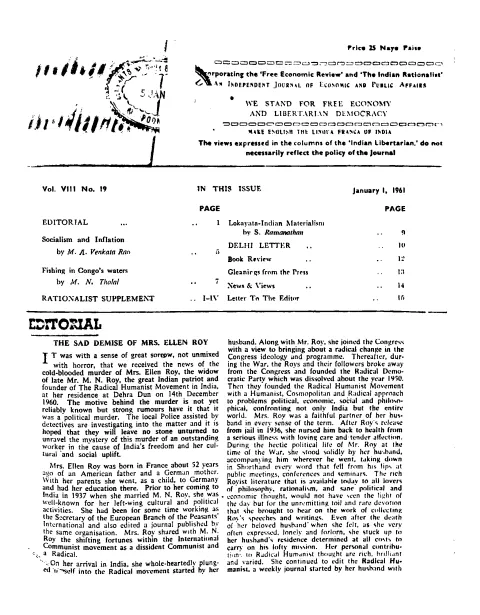
periodical issue
The Indian Libertarian
An Independent Journal of Economic and Public Affairs
By MA Venkata Rao, M. N. Tholal
The Indian Libertarian, Arya Bhuvan, Sandhurst Road, Bombay 4 · Bombay · 1961
20 pages
The Indian Libertarian
Summary
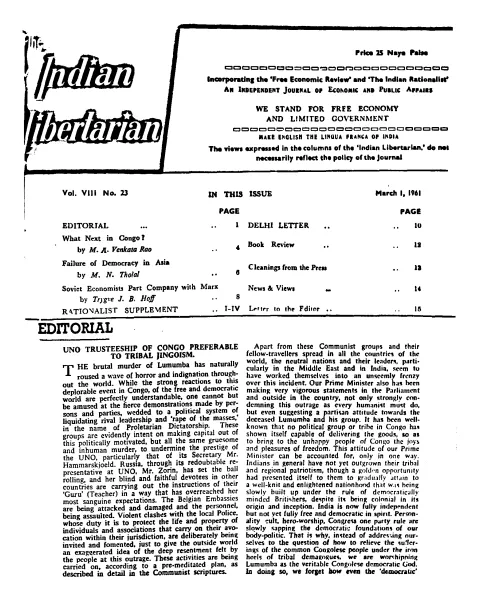
This March 1, 1961 issue (Vol. VIII No. 23) of The Indian Libertarian, the Bombay fortnightly that ‘stands for free economy and limited government,’ opens with an editorial on the murder of Patrice Lumumba and the Congo crisis, arguing that UN trusteeship is preferable to ‘tribal jingoism’ and warning that mere nationalism without freedom, dignity and democracy is not enough. A companion editorial, ‘The Congress in the Doldrums,’ diagnoses a Congress party drained of its members’ loyalty and torn by factional power-struggles. The signed articles in the rendered pages develop the journal’s classical-liberal, anti-communist line: M. A. Venkata Rao on the diplomacy of the Congo crisis, M. N. Tholal on the failure of democracy in Asia, and the Norwegian liberal economist Trygve J. B. Hoff on Soviet economists quietly abandoning Marxian value theory. The issue also carries a four-page Rationalist Supplement opening with S. Ramanathan’s obituary tribute to the Tamil Self-Respect movement figure Sami Chidambaranar.
Key points
-
The 1 March 1961 issue (Vol. VIII, No. 23) of The Indian Libertarian responds to the murder of Patrice Lumumba by arguing UN trusteeship of Congo is preferable to ‘tribal jingoism’ while rejecting the Communist framing of the killing.
-
The lead editorial criticises the Nehru government’s ‘partisan attitude’ toward Lumumba’s faction and insists independence must be harmonised with freedom, dignity, welfare and individual liberty rather than mere nationalism.
-
A companion editorial, ‘The Congress in the Doldrums,’ diagnoses a Congress party drained of its members’ loyalty and consumed by factional power struggles as elections approach.
-
M. A. Venkata Rao’s ‘What Next in Congo?’ faults the Western and Christian powers for excessive legalism over the UN charter while casting Soviet conduct in Africa as aggressive ‘power diplomacy.’
-
M. N. Tholal’s ‘Failure of Democracy in Asia’ argues, against the consensus of a Delhi seminar, that Asian peoples were not prepared to fight for democratic self-government and readily exchanged it for authoritarian rule.
-
The Norwegian economist Trygve J. B. Hoff’s ‘Soviet Economists Part Company with Marx’ credits Marx with identifying pricing as the central problem of a planned economy, then reports Soviet economists themselves retreating from Marx’s rejection of markets.
-
A four-page Rationalist Supplement opens with S. Ramanathan’s obituary of Sami Chidambaranar, a pioneer of the Tamil Self-Respect movement who defied caste by contracting a self-respect marriage to a widow without priests or religious ceremony.
Essays
Editorial
The lead editorial, ‘UNO Trusteeship of Congo Preferable to Tribal Jingoism,’ responds to the murder of Patrice Lumumba with indignation but rejects the Communist and fellow-traveller line that has ‘spread in all the countries of the world.’ It criticises Nehru’s government for very vigorous parliamentary statements and a ‘partisan attitude’ toward Lumumba’s group, arguing India should not outrun its own tribal and regional patriotism by preaching national unity to the Congolese while ‘worshipping’ Lumumba as a ‘Congolese democratic God.’ Independence, the editor insists, must be harmonised with freedom, human dignity, welfare and individual liberty; mere nationalism is not enough. A second editorial, ‘The Congress in the Doldrums,’ argues the once-glorious Congress no longer commands its members’ loyalty and is riven by factional strife as elections approach.
- Condemns Lumumba’s murder while rejecting the Communist/fellow-traveller framing of it
- Criticises the Nehru government’s ‘partisan attitude’ and vigorous parliamentary statements on the Congo
- Argues India is in no position to preach national unity given its own tribal and regional patriotism
- Holds that independence must be harmonised with freedom, dignity, welfare and individual liberty
- Second editorial diagnoses Congress as drained of loyalty and consumed by factional power-struggles
What Next in Congo?
By MA Venkata Rao
M. A. Venkata Rao’s ‘What Next in Congo?’ surveys the diplomatic aftermath of Lumumba’s death, contrasting the conduct of the Belgians, the UN and the major powers. He argues that the Western and Christian powers were too cautious and legalistic in upholding the UN charter while the Communist bloc pursued aggressive ‘power diplomacy,’ and he weighs how India and the non-aligned nations should respond. The piece reflects the journal’s liberal-internationalist suspicion of Soviet intentions in newly decolonised Africa.
- Examines great-power and UN diplomacy in the wake of Lumumba’s killing
- Faults the Western/Christian powers for excessive legalism over the UN charter
- Casts Soviet conduct as aggressive ‘power diplomacy’ in the Congo
- Considers the position of India and the non-aligned nations
Failure of Democracy in Asia
By M. N. Tholal
M. N. Tholal’s ‘Failure of Democracy in Asia’ is a polemical essay arguing that the consensus emerging at a seminar in Delhi misread the prospects of democracy across Asia. Tholal contends that Asian peoples were not prepared to fight for democratic self-government and that, drained of the will to defend liberty, they readily exchanged democratic forms for one-party or authoritarian rule. The essay is pessimistic about the durability of imported democratic institutions where civic courage and the habits of liberty are absent.
- Frames a Delhi seminar’s consensus on Asian democracy as mistaken
- Argues Asian peoples were ‘not prepared to fight’ for democratic self-government
- Links the failure of democracy to an absence of civic courage and the will to defend liberty
- Pessimistic about imported democratic forms taking root in Asia
Soviet Economists Part Company with Marx
By Trygve J. B. Hoff
Trygve J. B. Hoff’s ‘Soviet Economists Part Company with Marx’ argues that Karl Marx rightly singled out pricing as the central problem of a centrally planned economy, but believed that under socialism prices and the market mechanism could be dispensed with. Hoff reports that Soviet economists themselves have begun to abandon this position, quietly reintroducing market-based reasoning and the universal economic problem of valuation that Marxism had denied. The article is a classic exhibit of the journal’s case that economic calculation defeats comprehensive planning.
- Credits Marx with identifying pricing as the central problem of a planned economy
- Notes Marx’s belief that socialism could dispense with prices and the market
- Reports Soviet economists themselves retreating from that position
- Presents the retreat as vindication of the economic-calculation critique of planning
Rationalist Supplement
The Rationalist Supplement opens with S. Ramanathan’s obituary tribute to Sami Chidambaranar, who died at Madras on 17 January. Ramanathan presents him as a pioneer of the Tamil Self-Respect movement and a ‘great scholar in Tamil,’ recounting how Chidambaranar defied caste and custom by contracting a self-respect marriage to a widow without priests or religious ceremony, took the oath that initiated the movement, and toured the Tamil districts as a speaker, writer and patron of progressive Tamil authors alongside Periyar E. V. Ramasami.
- Obituary of Sami Chidambaranar, died Madras 17 January, by S. Ramanathan
- Casts him as a pioneer of the Tamil Self-Respect movement and a leading Tamil scholar
- Recounts his self-respect marriage to a widow, defying caste and religious custom
- Notes his work as orator, writer and patron alongside Periyar E. V. Ramasami
Generated by the v1.5 extraction pipeline. Awaiting editorial review.
Metadata and summary are AI-extracted from the source PDF and reviewed for editorial accuracy. The original work is available via the Read PDF tab above (where present); paragraph-level citation inside the PDF is deferred to a future engagement.