periodical issue
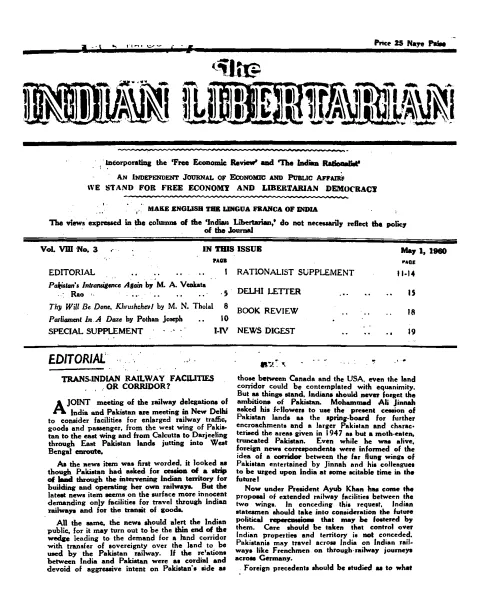
The Indian Libertarian
An Independent Journal of Public Affairs
By MA Venkata Rao, M. N. Tholal, Ludwig von Mises
The Indian Libertarian · Bombay · 1960
24 pages
The Indian Libertarian
Summary
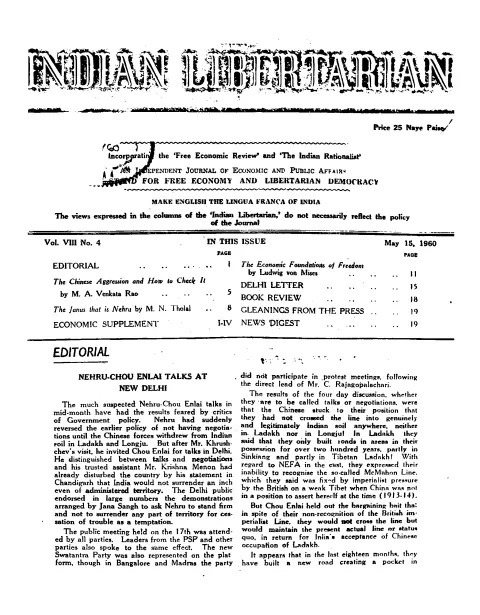
The May 15, 1960 issue (Vol. VIII No. 4) of The Indian Libertarian, the Bombay fortnightly edited by Miss Kusum Lotwala that incorporated the ‘Free Economic Review’ and ‘The Indian Rationalist’ and stood for free economy and libertarian democracy, is dominated by the failure of the Nehru and Chou Enlai talks in New Delhi. The unsigned editorial reports that the four day discussion ended with the Chinese refusing to admit any crossing into Indian soil in Ladakh or Longju, refusing to recognise the McMahon Line as anything but a British imposition on a weak Tibet, and offering to hold the present line only in return for India’s acceptance of the occupation of Ladakh, and it goes on to Chou Enlai’s visit to Nepal and B. P. Koirala’s refusal of a non-aggression treaty, the creation of the States of Maharashtra and Gujerat on the 1st of May, the fall of Dr. Singman Rhee in South Korea and the student revolt against Dr. Menderes in Turkey, Rajaji’s tour of the northern States for the Swatantra Party, and the President’s order retaining English as an associate official language after 1965. M. A. Venkata Rao’s ‘The Chinese Aggression & How to Check It’ calls the Delhi talks a defeat, traces the loss of Tibet to Ambassador Panikkar’s advice that India accept Chinese sovereignty rather than suzerainty, and urges full publicity at the United Nations, military preparation and an open alliance with the United States in place of non-alignment. M. N. Tholal’s ‘The Janus that is Nehru’ takes the stormy Congress Parliamentary Party meeting of 29 April, at which Nehru rebuked Mahavir Tyagi for impertinence, as proof that the Prime Minister claims the powers of a dictator while leading a democratic party. The four page Economic Supplement carries Prof. G. N. Lawande’s ‘Inflation and The Plans’ on deficit financing and the Third Five Year Plan and Robert Eagle’s ‘Entrepreneurs Versus Bureaucrats’ on the impossibility of combining rigid prices with economic change, while Ludwig von Mises’s ‘The Economic Foundations Of Freedom’ argues that there is no personal freedom without economic freedom. A Delhi Letter headed ‘Nehru-Chou Election Pact’ reads the joint communique as an arrangement to keep Nehru in office until the 1962 elections, A. Ranganathan reviews Isaac Mathai’s ‘India Demands English Language’, and Gleanings from the Press and a News Digest close the issue.
Key points
-
The editorial holds that the Delhi talks ended in a double guarantee to Peking, that India will not challenge the occupying forces in military language and that it will not abandon non-alignment even to obtain the help needed to expel them, and calls this a suicidal diplomacy unheard of in the history of the world.
-
The editorial welcomes the birth of Maharashtra and Gujerat on the 1st of May but warns that States large enough to rank with the nations of Europe can slip into intolerant independence, and that fissiparous tendencies will grow unless the Centre is strengthened and local preference in All-India establishments is checked.
-
The editorial reports Rajaji’s tour of Uttar Pradesh, Bihar, the Punjab and Delhi after the Swatantra Party’s Patna Convention of 19 and 20 March, his demand that the Madras Land Ceilings Bill be postponed until after the 1962 general elections, and his intention to have it challenged in the courts once passed.
-
M. A. Venkata Rao argues that the new maps of the Ministry of External Affairs, which place the Karakoram Pass inside Sinkiang, make Indians cartographic defeatists surrendering territory without a fight while the Chinese are cartographic aggressors who follow their maps with occupation.
-
M. A. Venkata Rao contends that the crucial blunder was Ambassador Panikkar’s recommendation that India concede Chinese sovereignty rather than the suzerainty the British had conceded, and that India should now publicise the occupation at the United Nations, prepare for a long campaign and enter a full military alliance with the United States.
-
M. N. Tholal argues that Nehru claims a monopoly of understanding of the Congress Party’s basic objectives, and that in telling dissenting members to resign and calling Mahavir Tyagi’s interruption impertinence he wants the powers of a dictator while functioning as the leader of a democratic party.
-
M. N. Tholal holds that Nehru’s concealment of the Chinese incursions from the President, the Cabinet and Parliament was in itself a betrayal sufficient to bring him down from his pedestal, and that the hypocrisy of Hindu Congress leaders is what makes him what he is.
-
Prof. G. N. Lawande argues that inflation is generated by the deficit financing of central and State expenditure, that the rupee has already lost 29 per cent of its value, and that price stability requires agricultural production raised by incentives to the farmer rather than by cooperative farming and State Trading in Food-Grains.
-
Robert Eagle argues that rigidity and flexibility cannot coexist, that government price supports and production quotas are the antithesis of economic growth, and that intervention to repress change is followed by further intervention to relieve the results of the first.
-
Ludwig von Mises argues that the market economy is a democracy in which every penny gives a right to vote, that the two spheres of economic and non-economic freedom are not independent of each other, and that whoever wants freedom of conscience must abhor socialism.
-
The Delhi Letter argues that all the trump cards are in Chou En-lai’s hands, that it is in his interest and Khrushchev’s that Nehru should remain Prime Minister, and that the communique therefore settles that there will be no further Chinese advance until the 1962 elections.
-
A. Ranganathan judges Rajaji’s ‘Five Fallacies about Hindi’ the best article in Isaac Mathai’s collection and endorses C. D. Deshmukh’s thesis that the development of Indian minds will be impossible without extensive and reinforced resort to English.
Essays
Editorial
The editorial opens with ‘Nehru-Chou Enlai Talks At New Delhi’ and reports that the mid-month talks produced exactly the results feared by critics of Government policy. It notes that Nehru had suddenly reversed the earlier policy of refusing negotiations until Chinese forces withdrew from Ladakh and Longju, that he invited Chou Enlai only after Mr. Khrushchev’s visit, and that Mr. Krishna Menon had already disturbed the country by saying at Chandigarh that India would not surrender an inch even of administered territory. Over four days the Chinese held that they had crossed into genuinely Indian soil nowhere, that the roads in Ladakh lay in areas in their possession for over two hundred years, and that they could not recognise the McMahon Line, fixed by imperialist pressure on a weak Tibet in 1913 and 1914. Chou Enlai offered to maintain the present actual line in return for India’s acceptance of the Chinese occupation of Ladakh, the offer was refused, and the two sides agreed instead that officials should examine the details in Peking between June and September while patrol clashes were avoided. Later sections take up Nepal and China, the split-up of Bombay, the fall of Dr. Singman Rhee, the revolt of citizens in Turkey, C. R.’s tour in the north, and the President’s order on the official language.
- Reads the agreement to suspend patrols as a guarantee that India will never challenge the aggressors militarily, and the refusal to abandon non-alignment as a further guarantee that it will not seek Western help
- Records that Mr. B. P. Koirala stood firm against the Chinese claim to Everest and refused a treaty of non-aggression, and that Chou Enlai complained from Khatmandu that Nehru’s use of the word aggression was an unfriendly act
- Welcomes the new States of Maharashtra and Gujerat, notes the recitations from the Koran and the Zendavesta at ceremonies held by a supposedly secular State, and warns of fissiparous tendencies and of local complaints about appointments in All-India establishments
- Traces Dr. Singman Rhee’s fall to rigged elections and rule by police terror, with over 125 killed and 600 seriously wounded, and sees the same student revolt against Dr. Menderes in Ankara, while noting that in India the minority committed to free institutions is dwindling under the socialist pattern of society
- Reports Rajaji’s northern tour, his demand that the Madras Land Ceilings Bill be postponed and referred to the Supreme Court, and the Swatantra Party’s growth in Kerala, and welcomes the President’s order continuing English as an associate official language after 1965
- Carries boxed extracts headed ‘Remove The Chains’ by P. T. Bauer, ‘A False Liberalism’ by Chads O. Skinner, and a passage by Ludwig Erhard urging the development of medium size enterprises in developing countries
The Chinese Aggression & How to Check It
By M. A. Venkata Rao
M. A. Venkata Rao’s ‘The Chinese Aggression & How to Check It’, subtitled ‘The Failure of the Delhi Nehru-Chou Talks’, argues that the April talks failed as everyone including Nehru expected, and that they may even have given the Chinese an advantage, since the suspension of border patrols until September leaves Peking free to augment its numbers, arrange supply depots and improve communications. He notes the parliamentary disclosure that a further road had been built in the Aksai Chin area over the last eighteen months, and observes that the new maps of the Ministry of External Affairs quietly place the Karakoram Pass inside Sinkiang. Venkata Rao then traces the origin of the disaster to 1949 and 1950, when India should have warned China of its interests in Tibet as a buffer State and secured them by treaty, and closes with a programme of publicity, preparation and alliance.
- Calls Indians cartographic defeatists who surrender territory without a fight while laying the flattering unction to their souls that they are following Panchsheel
- Holds that Ambassador Panikkar suggested acceptance of Chinese sovereignty rather than the suzerainty the British had conceded, that the substitution was afterwards explained as a clerical error, and that Sir Girja Shankar Bajpai and the Dalai Lama’s view of the 1913 and 1914 treaties was jettisoned
- Recalls that Mr. Masani, Mr. Kripalani and Dr. Shyam Prasad Mukerji called in 1951 for the old boundaries to be confirmed before China was allowed into Tibet, and that ten of nineteen speakers criticised Nehru’s surrender
- Urges that India inform the world and the United Nations of the full extent of the occupied territory, since Mr. Eisenhower and Mr. Herter had said coldly that they did not know the rights and wrongs of the border violation
- Describes the Chinese suppression of Tibet as a monstrous genocide, the murder of the culture and economy of a people, and calls for the iniquity to be broadcast to the whole world
- Concludes that India should enter without delay into a full military alliance with the United States and a collective security pact with the South-East Asian nations, since no revival of Bandung and no renewal of the Panchsheel mantram will avail
The Janus that is Nehru
By M. N. Tholal
M. N. Tholal’s ‘The Janus that is Nehru’ begins from the hot exchanges between Nehru and Mahavir Tyagi at the meeting of the Congress Parliamentary Party on 29 April, at which the Prime Minister told members that those who did not have faith in the Party’s basic objectives and policies should resign from it. Tholal answers that whether the objectives are basic at all is a matter of opinion, that the basic objective of the Congress is to maintain the integrity of the country, and that Nehru has for years claimed a monopoly of understanding of both the Party’s objectives and foreign affairs. He reads the uproar that greeted Tyagi’s interruption, and Nehru’s cry of ‘It is impertinence’, as evidence of a Janus mind that wants all the powers and privileges of a dictator while functioning as the leader of a democratic party, and of the moral and political degradation of the Congress Party.
- Recalls that at the Congress session which approved co-operative farming Nehru told Congressmen who did not favour it to resign, and objects that no one should be asked to leave a national organisation over a single resolution
- Argues that the Party is being kept mum and gagged through fear of Nehru and his powers of patronage, since Members of Parliament are his nominees and look to him for appointments and promotions
- Holds that Nehru’s concealment of the Chinese incursions from the President, his Cabinet and Parliament was a great betrayal that should have been enough for his party’s leaders to have no further truck with him
- Recalls an incident of more than forty years earlier in which the young Jawaharlal interrupted his father Motilal Nehru at a public meeting with the word ‘Question’, and observes that Motilal took the impertinence in good part
- Complains that no Hindu member of the Cabinet will differ with Nehru as Maulana Abul Kalam Azad and Rafi Ahmad Kidwai once did, and that Nehru’s flashes of temper were responsible more than anything else for the creation of Pakistan
- Shares its pages with a boxed extract headed ‘Minimum Government’ by C. Rajagopalachari, on the almost total overthrow of the constitutional guarantees by an intoxicated Congress majority
Inflation and The Plans
By Prof. G. N. Lawande, M.A.
Prof. G. N. Lawande’s ‘Inflation and The Plans’, which opens the four page Economic Supplement, argues that after nine years of planning the rulers of India have failed to tackle inflation, that the pressures grew very strong during the Second Five Year Plan, and that the deficit financing proposed for the Third will make them stronger still. He identifies two primary sources of any significant increase in money supply, the deficit financing of central and State expenditure through the Reserve Bank, and new Government Loans taken up by the Bank together with its open market purchases of securities, and holds that the basis of the whole process is spending altogether beyond the capacity of the economy to sustain. Lawande urges the stabilisation of the price level as the precondition of development, and finds the remedy in agricultural production rather than in ideologically inspired agrarian reform.
- Notes that the Government attacks the symptoms rather than the cause, exhorting producers not to hold back produce, consumers to refrain from buying and manufacturers to hold the price line, while tirading against middlemen
- Warns that the value of the rupee has already fallen by 29 per cent and that the Prize Bonds now floated to mop up small savings will lead to more inflation
- Argues that with half the national income derived from agriculture, price stability depends on production raised by up to date and scientific methods rather than by cooperative farming and State Trading in Food-Grains
- Reports that the Food Minister has arranged 17 million tons of American food-grains over four years, including four million tons for a buffer stock, and insists that the aid be properly used and imports made unnecessary by the end of the Third Plan
- Cites Mr. Dandekar, President of the Bombay Chamber of Commerce, on the priority owed to the core of the Plan, namely food, fuel, transport and power, and holds up Japan, France and West Germany as countries that solved their problems by adopting a free market economy
Entrepreneurs Versus Bureaucrats
By Robert Eagle
Robert Eagle’s ‘Entrepreneurs Versus Bureaucrats’ argues from the long record of human change, from caves and tents to the science of specialisation, that any effort to maintain the status quo in economic life is doomed to failure. Because new processes are developed and new products invented while old ones are revised or discarded, prices and wages must themselves change to reflect the more basic changes beneath them. Eagle holds that rigidity and flexibility cannot coexist in harmony, and that into the constant conflict between the forces resisting change and the forces demanding it steps the State, the apparatus of compulsion and coercion, presumably to help both sides and in fact repressing progress.
- Describes the sequence by which the State freezes the pattern of production, then expands credit and creates money to ameliorate the shortages its own controls produced, and likens it to running over a pedestrian and then backing over him
- Observes that price supports make the supported goods more plentiful until production quotas are instituted to make them scarcer, and that the resulting deficiencies are then blamed on free enterprise
- Argues that capital accumulation flows from individual savings and is checked when the value of money is eroded by monetary expansion, and that projects financed by heavy taxation are directed by functionaries whose own savings are not at risk
- Holds that the profits accruing to an entrepreneur under free enterprise reflect the approval the consumers have bestowed on his enterprise, and that artificial increases in the money supply cause misinvestment and maladjustment in labour
- Closes with a section on unchanging basic principles, arguing that it is the existence of immutable laws and changeless values that makes purposeful change, as against purposeless drifting, possible at all
The Economic Foundations Of Freedom
By Ludwig von Mises
Ludwig von Mises’s ‘The Economic Foundations Of Freedom’ opens from the contrast between animals, which are the puppets of their appetites, and man, whose eminence lies in choosing between alternatives and who is therefore a moral person responsible for his conduct. Mises argues that all the teachings of ethics presuppose this moral autonomy and are vain when addressed to slaves, so that freedom is not only a political postulate but a postulate of every religious or secular morality. He then sets out the market economy as the economic foundation of the bourgeois system, in which the consumer is sovereign and businessmen are forced by profit and loss to obey his orders, and traces representative government, freedom of conscience and freedom of the press to the same spiritual movement that created modern capitalism.
- Calls the market economy a democracy in which every penny gives a right to vote, and private property in that sense a public service imposing on owners the responsibility of employing it in the best interests of the sovereign consumers
- Insists that big business brought about the unprecedented improvement in the standard of living of the masses, and that supreme power in economic matters is vested in the consumer rather than in the corporation
- Argues that what keeps the economically backward nations poor is not unfamiliarity with technology but a shortage of capital, since their businessmen and engineers are graduates of the best schools of Europe and America
- Denies the supposed dualism between an economic sphere and a non-economic one, holding that a regime which controls all the factors of production controls every individual’s whole life, including which ideas and doctrines may be propagated
- Asks what chances the reformers would have had if all the printing presses had been operated by Charles V and the Valois kings, and what chances Marx would have had under a system in which the government held all the means of communication, and concludes that whoever wants freedom of conscience must abhor socialism
- Is reprinted from ‘The Freeman’
Delhi Letter: Nehru-Chou Election Pact
The Delhi Letter, headed ‘Nehru-Chou Election Pact’ and filed from our correspondent, answers the superficial observers who say that Nehru has been outwitted by Chou En-lai. It quotes the joint communique at length, notes that Nehru afterwards said the officials would have no authority to discuss or decide anything and did not think their meetings would lead to anything, and asks why he then signed a document mostly devoted to further examination by the two sides. The answer offered is that he signed for the sake of the clause under which every effort should be made to avoid friction and clashes in the border areas during the period of examination. The correspondent argues that the only common ground between Nehru on the one hand and Khrushchev and Chou En-lai on the other is that Nehru should remain Prime Minister of India, and that without that common ground in mind everything between the two Governments would appear senseless.
- Reads Nehru’s declaration that not a blade of grass grew in the occupied areas, and Krishna Menon’s talk of retaining only administered areas, as the language of men who want the aggressors to continue in occupation
- Concludes that the communique settles that there will be no further Chinese advance until the 1962 elections, in accordance with a directive from Khrushchev to go as far as possible without throwing Nehru out of office
- Reports under ‘Defeat For Nehru’ that Dr. Ram Subhag Singh won easily as Secretary of the Congress Parliamentary Party despite Mr. Krishna Menon and two Ministers canvassing against him on the ground that his election would be a vote of no confidence in Nehru, and holds that the myth that Nehru knows best has been exploded
- Records the complaint of Mr. Islam Ahmed, D.I.G. Police, Agra, that during a VIP visit so much of the police was requisitioned that nearly 50 per cent of stations were left with a single constable and a spate of dacoities followed
- Argues that the President’s order makes English the real principal official language of the Union even after 1965, cites a Supreme Court judge’s doubt that judgments could ever be delivered in Hindi, and observes that the Hindi maniacs have suffered a set-back through their own stridency
- Condemns under ‘Mr Nehru’s Bluff And Bluster’ his telling Members of Parliament to listen to him or get out and calling them amazingly incompetent, and his describing the Chinese threat as a comic situation and a tremendous menace within the same hour
Book Review: India Demands English Language
By A. Ranganathan
A. Ranganathan reviews ‘India Demands English Language’, edited by Isaac Mathai and published by Mathai’s publications, Blavatsky Lodge, French Bridge, Bombay-7, at Rs. 3 for 95 pages. He holds that the importance of English as the medium of instruction in the universities and as the language of administration has been stressed by eminent thinkers and patriots, that the present controversy arises from a political bias which treats an educational problem on a political plane, and that the ‘Indian Libertarian’ has always urged the value of English as a vehicle of progress in modern India. Ranganathan notes that he was himself encouraged to write a pamphlet on the subject by Mr. R. B. Lotwala, and works through the contributions of Dr. C. P. Ramaswamy Iyer, Pothan Joseph, General Cariappa, S. N. Moos, K. M. Munshi, Frank Moraes, Mirza Ismail, C. D. Deshmukh and Rajaji.
- Reproduces Dr. C. P. Ramaswamy Iyer’s account of a supplementary question on the Nagas which Mrs. Lakshmi Menon could not follow and Nehru admitted he had not understood himself, and Nehru’s recollection that Bihari students at Banaras Hindu University could not make themselves understood to those from Uttar Pradesh
- Calls Pothan Joseph’s piece delightfully humorous for breaking a lance with a Hindi champion who described Indian lovers of English as Macaulay’s bastards
- Notes that General Cariappa’s matter of fact argument was first published in the 15th November 1957 issue of the Indian Libertarian, and that Munshi warns of the linguistic Balkanization of India
- Judges Frank Moraes’s ‘Lever of progress’ one of the best pieces in the collection and Rajaji’s ‘Five Fallacies about Hindi’ undoubtedly the best, quoting Rajaji’s appeal that the Hindi-speaking people concentrate on the state level and let English continue
- Congratulates Mr. Mathai on his editing, looks forward to the proposed companion volume of documentary evidence, and asks for greater publicity as well as evidence
Gleanings from the Press
Gleanings from the Press reprints De Madariaga writing in ‘Time and Tide’ on the Berlin crisis, which he traces to Khrushchev unilaterally backing out of an agreement freely arrived at with the three Atlantic Powers. De Madariaga argues that to negotiate another agreement on the same subject is to submit in advance to periodical revisions and withdrawals, and that seeking an accommodation amounts to ignoring the ever-advancing forward pressure of Soviet foreign policy, since the free world will have to yield tomorrow not only as it yielded yesterday but because it yielded yesterday. The column adds the journal’s own endorsement of the argument.
- Lists the sequence of retreats from the surrender of the Baltic States and the Bulgarian peace treaty through the imprisonment of the Polish resistance leaders in violation of a Soviet parole to the withdrawal from the Elbe, the rape of Czechoslovakia and the murder of Hungary
- Observes that at every step those who sought an accommodation protested that the withdrawal would be the last, and that the next came and was also called the last
- Agrees that Russia put a minority of Communists into power in East Germany by armed force while Britain, the USA and France made no attempt to influence the elections in their own zones
- Concludes that to give even de facto recognition to Russia’s actions in the satellite States is to encourage her to fresh aggression
News Digest
The News Digest closes the issue with short items, opening under ‘Russo-China Bhai-Bhai’ with Dr. Raghuvira’s press conference in New Delhi on 5 May, at which he showed photographs of strategic roads recently brought by him from China to refute the view that Russia was at odds with China and afraid of Chinese expansionism. The roads led to the Indian borders and to those of Burma and North Viet-Nam and connected China, Tibet and the Soviet Union, and he quoted a Chinese publication describing Ladakh, NEFA, Tibet and Bhutan as the four molar teeth with which China would grind its way to the southern seas.
- Records that 7,326 refugees from the so-called German Democratic Republic sought asylum in the Federal Republic between 8 and 22 April 1960
- Reports that the Government of India will manufacture its own bank note paper at a security paper mill near the Security Printing Press in Nasik, at a cost of only Rs. 10 lakhs
- Details a second Chinese road through north eastern Ladakh entering India over the Qara Tagh Pass from Malik Shah in Sinkiang and running by the Kongka Pass to the Lanak La, parallel to the older Aksaichin road
- Notes that Malaya has decided not to recognise Peking because there are two claimants to mainland China, and that a Cabinet decision to house leaders of political parties arose from the need to provide a bungalow for the Congress President, Mr. N. Sanjiva Reddy
- Quotes Gen. K. M. Cariappa at Coimbatore on 1 May that he believed in peace through strength as the United States and the Soviet Union did, and Nehru in London on 6 May that India’s handling of Goa demonstrated a desire to solve problems peacefully even though it greatly irritates
Generated by the v1.5 extraction pipeline. Awaiting editorial review.
Metadata and summary are AI-extracted from the source PDF and reviewed for editorial accuracy. The original work is available via the Read PDF tab above (where present); paragraph-level citation inside the PDF is deferred to a future engagement.