periodical issue
The Indian Libertarian
An Independent Journal of Economic and Public Affairs
By MA Venkata Rao, M. N. Tholal
Libertarian Publishers (Private) Ltd. · Bombay · 1960
24 pages
The Indian Libertarian
Summary
The May 1, 1960 issue (Vol. VIII No. 3) of The Indian Libertarian, the Bombay fortnightly edited by Miss Kusum Lotwala that incorporated the ‘Free Economic Review’ and ‘The Indian Rationalist’ and stood for free economy and libertarian democracy, is given over to India’s two frontier crises. The unsigned editorial opens with ‘Trans-Indian Railway Facilities or Corridor?’, warning that Pakistan’s request for enlarged rail traffic between its two wings could prove the thin end of a wedge leading to a demand for a land corridor and a transfer of sovereignty, and goes on to the Chinese Note rejecting India’s Ladakh claim ahead of the Nehru and Chou En-lai talks, to B. P. Koirala’s treaty with Peking and the Chinese claim to Mount Everest, to the Afro-Asian Conference on Tibet convened in New Delhi by Jayaprakash Narayan and Acharya Kripalani, and to the World Court’s verdict against the Portuguese claim of a right of way to Dadra and Nagar Haveli. M. A. Venkata Rao’s ‘Pakistan’s Intransigence Again’ argues that the thaw under Ayub Khan is over, that Pakistan is exploiting India’s isolation to press its claims over Kashmir, the canal waters and the division of assets, and that India should abandon non-alignment for a military alliance with the United States. M. N. Tholal’s ‘Thy Will Be Done, Khrushchev!’ reads the airport speeches at Chou En-lai’s arrival as proof that Nehru is bound to Moscow and Peking, and calls for a change of government. Pothan Joseph’s ‘Parliament In A Daze’ tells the parable of a spendthrift heir to describe Nehru’s handling of the public trust over Tibet and the border. A four-page Special Supplement carries Patick M. Boarman’s ‘Philosophy of Neo-Liberalism’ on Ludwig Erhard’s social market economy, while the Rationalist Supplement carries the concluding part of Ronald Fletcher’s ‘A Humanist Looks at Buddhism’, S. Ramanathan’s appeal for life members of the Indian Rationalist Association, and F. A. Ridley’s ‘Agadir and God!’. A Delhi Letter on Rajaji’s triumphant visit and the Jeep Scandal, D. M. Kulkarni’s review of ‘Tibet Fights for Freedom’ and a News Digest close the issue.
Key points
-
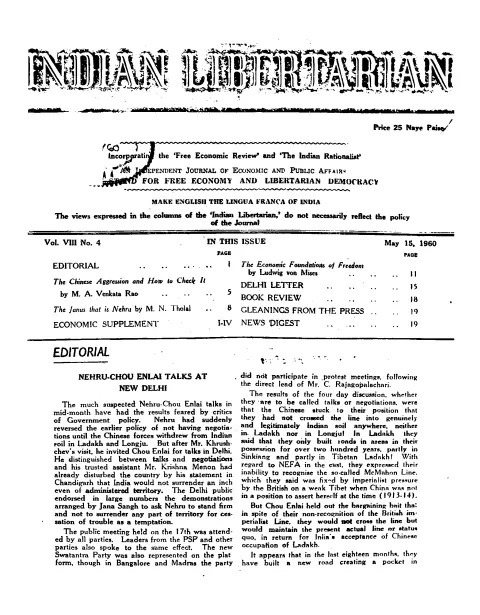
The lead editorial argues that the India and Pakistan railway talks in New Delhi over traffic between Pakistan’s two wings should be watched closely, since facilities for transit could become a demand for a land corridor carrying sovereignty over Indian soil.
-
A further editorial section on the Chinese Note of 3 April, which rejected India’s claim to Ladakh and the Aksai Chin road, urges that India refuse to recognise the occupation, prepare militarily and place American military aid first among its diplomatic aims.
-
The editorial treats B. P. Koirala’s non-aggression treaty with Peking, and the Chinese claim to Mount Everest, as evidence that Nepal is drifting into Chinese influence and that Bhutan and Sikkim will follow.
-
M. A. Venkata Rao contends that President Ayub Khan’s conciliatory period is over, citing renewed border firings, the postponed Canal Waters Agreement, Pakistan’s new financial claims against Morarji Desai and its stamps and maps showing Kashmir and Junagadh as disputed.
-
M. N. Tholal argues that Khrushchev’s characterisation of the border dispute as a small misunderstanding between friends has trapped Nehru, that the Communist powers have an interest in keeping him in office, and that only a change of government will free Indian policy.
-
Pothan Joseph, in a piece reprinted from ‘Swarajya’, likens the public’s trust in Nehru to a wife who signed over her patrimony to a spendthrift husband and only later saw the accounts.
-
The Special Supplement by Patick M. Boarman presents Ludwig Erhard’s social market economy as a third order between central planning and laissez-faire, in which the State builds the legal and monetary framework of competition but does not interfere in market processes.
-
The Rationalist Supplement carries Ronald Fletcher’s humanist critique of Buddhism’s doctrines of nirvana, karma and reincarnation, S. Ramanathan’s appeal for one thousand life members at Rs. 100 each for the Indian Rationalist Association, and F. A. Ridley’s argument that the Agadir earthquake places the blame for an ‘Act of God’ on God.
-
The Delhi Letter reports an apparent attempt on Rajaji’s life at a Swatantra Party meeting in Madras on 17 April, the Jan Sangh procession to the Prime Minister’s House, and the Lok Sabha uproar of 21 April over the out of court settlement in the Jeep Scandal.
Essays
Editorial
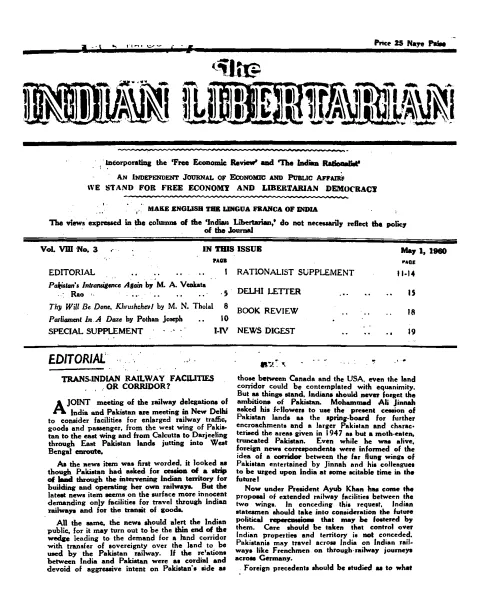
The editorial opens with ‘Trans-Indian Railway Facilities or Corridor?’, prompted by the joint meeting of the Indian and Pakistani railway delegations in New Delhi on enlarged goods and passenger traffic between the west and east wings of Pakistan and from Calcutta to Darjeeling through East Pakistan. It warns that although the latest wording of the news seems innocent, the request may be the thin end of a wedge leading to a demand for a land corridor with a transfer of sovereignty, recalls Jinnah’s description of the 1947 award as a truncated Pakistan and his talk of a corridor between the two wings, and asks for passport and visa safeguards and for timely publicity of the terms. Later sections take up the Chinese Note of 3 April rejecting India’s claim in Ladakh on the ground that Indian patrols were absent after 1950, Nepal’s treaty with China and the Chinese claim to Mount Everest, the Afro-Asian Conference on Tibet in New Delhi, the World Court’s verdict on the Portuguese claim of a right of way, and a second Afro-Asian conference at Konakry in Guinea.
- Argues that transit facilities for Pakistan must not be allowed to become a corridor carrying sovereignty over Indian land
- Urges that India withhold recognition of the Chinese occupation of Ladakh, as it does of Pakistan-held Kashmir and of Goa, while preparing militarily and seeking American aid
- Reads B. P. Koirala’s return from Peking with a treaty of non-aggression and neutrality, and the Chinese claim to Everest, as a failure of Indian policy towards the border states
- Welcomes the Afro-Asian Conference on Tibet convened by Jayaprakash Narayan and Acharya Kripalani, attended by about a hundred delegates from forty countries and blessed by Rajagopalachari from the dais
- Notes the World Court’s finding that Portugal held no sovereignty over Dadra and Nagar Haveli, and criticises the Indian authorities for briefing a foreign expert who had already published a contrary opinion
Pakistan’s Intransigence Again
By M. A. Venkata Rao
M. A. Venkata Rao’s ‘Pakistan’s Intransigence Again’ argues that the springtime of peace which followed the arrival of the military ruler Ayub Khan has been short-lived and that Pakistan has returned to its old hostility just as Chinese pressure on India is at its height, on the eve of the Nehru and Chou En-lai meeting of 20 April. He sets the quarrel in a long historical frame, holding that Hindu society never assimilated Islamic culture nor rose to an integral nationalism, that caste is a form of tribalism, and that a society without social cohesion invites the strong. He then itemises the new intransigence and concludes that the only remedy is to reverse the policy of non-alignment and enter openly into a military alliance with the United States, and with Britain if Britain will join.
- Cites border firings in breach of the recent agreements, announced in the papers while the Prime Minister was telling Parliament there had been none
- Reads Ayub Khan’s offer as an attempt to trade a settlement of all other differences for Kashmir, and Nehru’s refusal as unusual obstinacy on the one question where he has not yielded
- Reports Pakistan’s fresh claims in the financial talks with Morarji Desai, who returned without signing, and the sudden postponement of the Canal Waters Agreement due to be signed in London
- Notes Pakistani stamps and maps presenting Kashmir, Ladakh, Junagadh and Manavadar as unsettled or acceded territory
- Objects that India’s contribution to the Indus scheme has been quoted at anything from Rs. 50 crores to Rs. 200 crores and is now put near Rs. 65 crores, and demands publication of the terms before the country is committed as it was over Berubari
Thy Will Be Done, Khrushchev!
By M. N. Tholal
M. N. Tholal’s ‘Thy Will Be Done, Khrushchev!’ begins from the contrast between the two airport speeches on Chou En-lai’s arrival in New Delhi, Nehru speaking of a bond of friendship imperilled and the Chinese Premier of a friendship lasting thousands of years. Tholal argues that Khrushchev, by insisting during his Indian visit that the dispute was only a small misunderstanding between friends, obliged Nehru to acknowledge the friendship even after the annexation of 15,000 square miles, and that both leaders now defer to Moscow. He draws a parallel with the Gandhi and Jinnah interviews, in which Jinnah demanded a change of heart and Gandhi answered that God alone knows men’s hearts, and holds that it is Nehru’s egoism that now stands between him and his country.
- Contrasts the two airport speeches and reads Chou En-lai’s language as an assertion of unbroken friendship despite the annexation
- Argues that the Communist powers have an interest in keeping Nehru in office, which is in effect the only card he holds
- Reinterprets Nehru’s earlier threats of resignation as messages to Peking and Moscow rather than to the Indian public
- Rejects Chou En-lai’s description of the boundary question as one finger out of ten, observing that the loss of a finger disfigures and can incapacitate a man
- Warns that the border states are the real stake in the Delhi talks and concludes that the country needs a change of government, as Rajaji has been saying plainly
Parliament In A Daze
By Pothan Joseph
Pothan Joseph’s ‘Parliament In A Daze’, reprinted from ‘Swarajya’, is an extended parable. A college contemporary, sole heir to a large fortune and married to a bride who brought a huge dowry, falls among sporting flatterers, speculates with his wife’s patrimony, explains his late nights as board meetings, and promises his doctor to reduce his excesses by a third a year, in the manner of the Russian disarmament plan then being urged at Geneva. Only when the mail brings arrears, threats of foreclosure and hints of eviction does the wife take over the accounts and discover the ruin. Joseph then applies the parable to the relation between Pandit Nehru and the Indian public.
- Traces the sequence from Nehru’s 1954 endorsement of Chinese suzerainty over Tibet and the proclamation of Panch Sheel, through his consent to Chinese road-building in Ladakh, to the encroachments of 1956 kept from Parliament
- Notes that the White Paper now lays the exchanges on the table, including the Peking despatch released on 11 April which rejected India’s claim and declared the watershed principle unacceptable
- Concedes that charges of secrecy can no longer be made, but argues that earlier publication of the facts might have raised resistance enough to stop China from dictating
- Ends with Parliament, called in at last, standing stunned before the problem of retrieving both solvency and security
Philosophy of Neo-Liberalism
By Patick M. Boarman
Patick M. Boarman’s ‘Philosophy of Neo-Liberalism’, the four-page Special Supplement numbered I to IV, argues that the German miracle was no miracle but the predictable result of replacing the planned economy inherited from the Nazis with a social market economy that restored the free play of supply and demand. Boarman sets out the economic philosophy shared by Eucken, Roepke and Erhard, presenting Eucken’s three possible orders, the centrally administered economy, the laissez-faire market economy and the competitive market economy, and locating neo-liberalism in the third. Its novelty, he writes, lies in a fresh appreciation of the positive role of the State in creating the legislative, juridical and monetary framework a market needs, while leaving day-to-day market processes alone.
- Rejects both the planned economy and the mixed economy, on the ground that half-planning frustrates plan and market alike
- Lists Erhard’s ingredients as the abolition of price controls, competition, resistance to pressure groups and special interests, currency stability, rejection of the welfare state and rejection of nineteenth century laissez-faire
- Treats inflation as a forcible and deceitful redistribution of real income towards those able to keep ahead of the cost-of-living index, and currency stability as a basic right a citizen may demand of his government
- Cites German real wages rising 40 per cent between 1950 and 1957, industrial output rising from 80 to 192 by 1956, more than 4 million housing units built, and 6 billion dollars in gold and foreign exchange accumulated by the end of 1957
- Closes the supplement with an unsigned note on free market against socialism, quotations from Frederic Bastiat’s ‘The Law’ and from Wilhelm Roepke, and advertisements for ‘The Freeman’ and for Ralph Borsodi’s ‘The Challenge of Asia’
A Humanist Looks at Buddhism (II)
By Ronald Fletcher
Ronald Fletcher’s ‘A Humanist Looks at Buddhism (II)’, the concluding part of an article begun in the Rationalist Supplement of 1 March 1960, sets out where a humanist can agree with Buddhism and where agreement ends. Fletcher finds common ground in the Buddha’s doubt that a God can be shown to exist or is needed as a guide to morality, in his rejection of the efficacy of priests and ritual, in his account of suffering as rooted in ungoverned desire, and in his insistence that a man must resolve his problems by his own effort. He then presses two criticisms drawn from what he sees as an unwarranted survival of Hinduism inside Buddhism.
- Argues that the later Buddhist description of nirvana as the unity of mind with all-mind smuggles permanence back into a doctrine of universal transience, and amounts to a return of Atman and Brahman
- Finds no grounds for reincarnation or the law of karma, and calls morally repugnant the inference that those who suffer deserve their condition
- Denies that all suffering springs from desire, instancing poverty, disease and political tyranny, and urges practical social and political action to remove such causes
- Holds that the humanist sees life as an adventure containing joy, beauty and creative satisfaction alongside tragedy, and disputes the claim that Eastern contemplation is more profound than Western moral and political philosophy
Building Up a Rationalist Organisation In India
By S. Ramanathan
S. Ramanathan’s ‘Building Up a Rationalist Organisation In India’ reminds members that the last Rationalist convention at Madras resolved to enrol life members at Rs. 100 each and to accumulate the proceeds as a permanent fund, and reports that only Mr. P. J. Sabnis of Nasik has paid. He sketches the movement’s descent from Charvaka and from an earlier Bombay association, records that the present Indian Rationalist Association was founded ten years ago under Sir Ragunath Paranjpye, has held six annual conventions, and ran its own journal for seven years before merging it into the monthly Rationalist Supplement of the ‘Indian Libertarian’.
- Appeals for a minimum of one thousand life members to fund the Association’s propaganda work
- Answers the objection that organisations kill the spirit they exist to promote, citing J. Krishnamurthi’s dissolution of the Church founded for him by Annie Besant and M. N. Roy’s dissolution of the Radical Democratic Party
- Replies that no principle spreads among the people without an organisation, noting that even Krishnamurthi and Roy required a Trust and an Institute to carry their teachings
- Proposes that the collections be funded into a permanent trust rather than spent on day to day administration, and invites discussion in the journal’s columns
Agadir and ‘God’!
By F. A. Ridley
F. A. Ridley’s ‘Agadir and God!’, reprinted from the Freethinker, takes the earthquake that destroyed the Moroccan town of Agadir just before midnight on 29 February as a test of the theist’s position. The shock lasted about twelve seconds and left the town a mass of rubble, with about 12,000 of some 50,000 inhabitants dead and the rest homeless. Ridley observes that a catastrophe with no visible human cause is by convention attributed to God, and argues that on the Creation hypothesis no other assumption is open to a Christian or a Muslim, since a Creator who made the earth knew what would happen there.
- Contrasts the Agadir refugees with those elsewhere in the world, who are the product of political and military conflict
- Argues that responsibility for the catastrophe includes responsibility for its consequences, from the trapped and the orphaned to the rats in the deserted streets
- Concludes that neither the theologians nor the ordinary theists of any creed can escape the attribution
Delhi Letter: Rajaji Triumphs at Delhi
The Delhi Letter, headed ‘Rajaji Triumphs at Delhi’ and filed from our correspondent, opens with the shock in Delhi at what seemed to be an attempt on Rajaji’s life as he arrived to address a Swatantra Party meeting in Madras on 17 April, and reads it as a sign that India has neither democratic traditions nor the intellectual habits a democracy needs. The letter goes on to the Bharatiya Jan Sangh’s mile-long procession to the Prime Minister’s House on Sunday 19 April, and observes that a country whose defence department produces trucks but no modern weapon can hardly supply the sanction behind its slogans.
- Reports the Lok Sabha uproar of 21 April on the Jeep Scandal, after the announcement of an out of court settlement with the London firm whose case was due before the London High Court on 2 May, with questions from Mr. Vajpayee and Mr. Hem Barua
- Notes the disclosure that the firm’s capital was not more than one hundred pounds while the Indian claim was for about a quarter of a million, against a loss to the exchequer of Rs. 30 lakhs
- Quotes the Pakistan armed forces daily ‘Hilal’ on joint defence, and observes that Rajaji’s proposal of a wider South Asian defence is more comprehensive than the Pakistani one
- Records Rajaji’s Delhi visit in the second week of April, his warning to the Press Club of India on 10 April that the Chinese threat is deadly, and his remark that Kashmir could be put in the refrigerator
- Summarises the Afro-Asian Convention contributions of Mr. Purshotamdas Tricumdas on Tibet’s constitutional position and of Mr. Chang Kuo-Sin of the Hong Kong Chinese delegation, and the open letter in which seven Congress MPs told the Swatantra Party that socialism had come to stay
Book Review: Tibet Fights for Freedom
By D. M. Kulkarni, B.A., LL.B.
D. M. Kulkarni reviews ‘Tibet Fights for Freedom’, edited by Raja Hutteesing and published by Oriental Longmans Private Ltd. at Rs. 15.00, a White Book assembling the record of the Tibetan struggle from the first rising of 9 March 1959, through the Dalai Lama’s escape into India on 31 March, to the suppression of the revolt by the end of July, at an estimated cost of about 90,000 lives. Kulkarni treats the Dalai Lama’s Tezpur statement and his Mussoorie press conference of 20 July 1959 as showing that the 1951 agreement, imposed at the point of the bayonet and guaranteeing Tibetan autonomy, was violated by its own authors, and reads the episode as proof that autonomy under a Communist regime is a sham.
- Argues that the Chinese repudiation of their own agreement follows from Lenin’s subordination of morality to the class struggle
- Summarises D. F. Hudson’s chapter on the international aspect, covering Tibet’s de facto independence from 1912 to 1951, the Simla convention of 1913 and the McMahon Line
- Faults the National Indian Government for accepting the British position meekly without the strength to secure Tibetan autonomy, and criticises India’s abstention on the resolution moved by Ireland and Malaya at the United Nations on 21 October 1959
- Quotes Jayaprakash Narayan’s warning that the Afro-Asian nations would pay dearly for the blunder and Rajagopalachari’s description of India’s stand as close to abetment
- Judges the book incoherent in places, being made of newspaper cuttings, but useful as a reference work, and well produced with maps and pictures
News Digest
The News Digest closes the issue with short items, opening with a statement by Mr. C. Rajagopalachari at Madras that corruption could be eliminated if frequent contact between government officials and businessmen were avoided, and that the policy of socialism imposes so many controls that people are driven to the government for everything, so that where there is socialism there is bound to be corruption also.
- Reports Food Minister Patil’s admission in New Delhi on 31 March that his Ministry was almost an empire, with hundreds of departments and thousands of officials he never met
- Notes the Bihar State Family Planning Committee’s decision to establish 70 urban and 140 rural clinics, and the raising of the compensation for surgical family planning in Madras to Rs. 30 in public employment
- Carries the Rawalpindi daily ‘Hilal’ of 15 April criticising India’s attitude to joint defence and its response to the Chinese claim on Mount Everest
- Records more than 2,500 refugees from East Germany arriving in West Berlin over Good Friday and Easter Monday, rising to 5,000 on the evening of 18 April, and attributes the flight to the collectivisation of agriculture
- Details a Madhya Pradesh delegation sent to Toronto in 1954 whose expenses reached Rs. 30,608 against an estimate of Rs. 7,500 a head, with Rs. 11,559 still unrefunded by the Deputy Minister, and ends with a note by Gerald Heard on the social danger of socialism
Generated by the v1.5 extraction pipeline. Awaiting editorial review.
Metadata and summary are AI-extracted from the source PDF and reviewed for editorial accuracy. The original work is available via the Read PDF tab above (where present); paragraph-level citation inside the PDF is deferred to a future engagement.