periodical issue
The Indian Libertarian
Independent Journal of Economic and Public Affairs
By J. K. Dhairyawan, MA Venkata Rao
The Indian Libertarian, Arya Bhuvan, Sandhurst Road, Bombay 4 · Bombay · 1958
20 pages
The Indian Libertarian
Summary
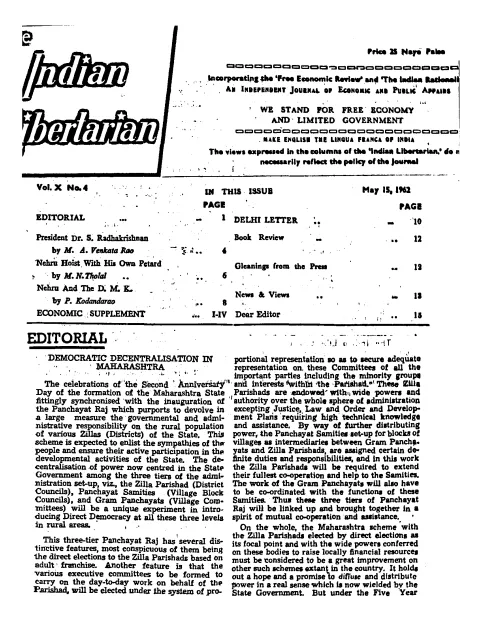
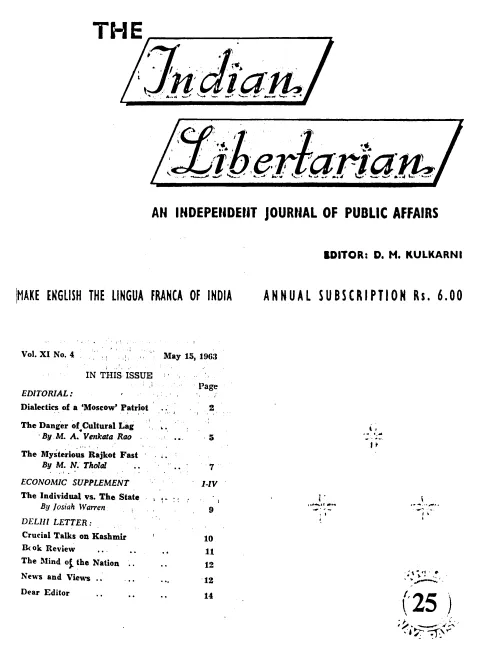
The May 15, 1963 issue (Vol. XI No. 4) of The Indian Libertarian, the Bombay fortnightly ‘Independent Journal of Public Affairs’ edited by D. M. Kulkarni, B.A., LL.B. for Libertarian Publishers (Private) Ltd., priced at 25 naye paise and carrying the cover slogan ‘Make English The Lingua Franca Of India’, is given over to the aftermath of the Chinese invasion and to the Official Languages Bill. The editorial, signed by D. M. Kulkarni, opens with ‘Dialectics of a Moscow Patriot’, reading S. A. Dange’s laboured reply in ‘New Age’ to the Chinese Peoples’ Daily attack on revisionists as proof that the division of the Communist Party of India into pro-China and pro-Moscow wings is a hoax designed to keep the nation off its guard, and goes on to the Pathet Lao attacks on International Commission helicopters as a test case for neutralism in Laos, to Nehru’s assurance that Western arms aid is not linked to Kashmir, to the Compulsory Deposit legislation which it calls anti-social and anti-people, and to a plea that English be declared the sole official language at the Centre and in the States before linguistic regionalism destroys national cohesion. M. A. Venkata Rao’s ‘The Danger Of Cultural Lag’ holds that most of India’s troubles arise from the failure to adapt inherited habits, instancing khadi, prohibition, panchayati raj, caste and the official patronage of sadhus, and proposes an Indianisation Department on the model of the American one together with institutes for the study of international communism. M. N. Tholal’s ‘The Mysterious Rajkot Fast’ revisits Gandhi’s fast unto death of March 1939 and argues that the drama was enacted to bring down Subhas Bose and to excuse Gandhi’s absence from the Tripuri Congress. The four-page Economic Supplement carries Prof. G. N. Lawande’s ‘Population And Economic Growth’, P. Kodanda Rao’s note on the ‘Salt Tax’ and Roman O. Zybenko’s ‘Failure Of Gold Control In Russia’, reprinted from Freedom First. An extract from Josiah Warren’s ‘True Civilization’, ‘The Individual vs. The State’, denies that any government has ever secured person or property, while a Delhi Letter reports the Kashmir talks with Dean Rusk and Duncan Sandys and the Amroha by-election fought against Acharya Kripalani. M. A. Venkata Rao’s review of Harold J. Laksi’s ‘The American Democracy’, Frank Moraes on the character clearance owed to Mr. Malaviya, a News and Views digest and a Dear Editor page carrying a Bangalore memorandum for the retention of English close the issue.
Key points
-
D. M. Kulkarni’s editorial argues that S. A. Dange’s reply in ‘New Age’ to the Chinese attack on revisionists is an essay in hypocrisy, and that the Ranadive and Dange groups are co-operating in a deliberate division of the Communist Party of India meant to keep the nation off its guard during the Sino-Indian conflict.
-
The editorial treats the Pathet Lao attacks on two International Commission helicopters in early May 1963, which wounded three Frenchmen and an Indian Major and later killed a Frenchman, as a warning to India’s non-aligners about the worth of talks with the Chinese Reds.
-
On Kashmir the editorial holds that the Western powers have tired of Pakistan’s blackmail, that Pakistan’s military importance has dwindled in the age of intercontinental missiles, and that India can settle both the Kashmir and the border disputes in her favour if she sheds her pet illusions.
-
The editorial calls the Compulsory Deposit Bill anti-social and anti-people, doubts that the salaries of clerks and the income of farmers were ever meant by the phrase material resources of the community, and argues that the haste of the Bill is itself the best argument for ending the state of emergency.
-
M. A. Venkata Rao contends that India’s problems are problems of cultural lag, and asks for an Indianisation Department on a Central scale with branches in the States, for inter-caste dinners and marriages as a matter of official policy, and for institutes to study the tactics of international communism.
-
M. N. Tholal argues that Gandhi gave the Thakore Saheb of Rajkot only one day’s notice of a fast unto death so that the fast would coincide with the Tripuri Congress, and that the whole episode was contrived to isolate Subhas Bose.
-
Prof. G. N. Lawande holds that the population problem is the most fundamental of India’s economic problems, citing the 1961 census figure of 443 millions and an increase of 77 millions in the decade, and calls for a family planning programme on a war footing but free from coercion and force.
-
Roman O. Zybenko documents the failure of Soviet gold control, describing theft in the artels and state mines, an underground mint in Kharkov and the recent introduction of the death penalty for speculation in gold and foreign currency.
-
The extract from Josiah Warren maintains that every person is by nature his or her own law, that all institutions demanding conformity are therefore false, and that security of person and property cannot exist under any government whatever.
-
A memorandum signed at Bangalore by V. P. Menon, N. Madhava Rau, D. V. Gundappa, P. Kodanda Rao and others asks that English be continued indefinitely as the one official language of the Indian Union, on the ground that the adoption of any single regional language must handicap Indians of other regional languages permanently.
Essays
Dialectics of a ‘Moscow’ Patriot
By D. M. Kulkarni
The editorial, headed ‘Dialectics of a Moscow Patriot’ and signed by the editor D. M. Kulkarni, takes up the lengthy reply that the Indian Communist Party chairman Mr. S. A. Dange published in ‘New Age’ to the editorial ‘Mirror For Revisionists’ in the Peoples’ Daily of China. Kulkarni reads it as confirming the suspicion that the party divided itself into pro-China and pro-Moscow wings by way of a hoax, so as to keep the nation off its guard about the role of saboteurs the Communists are playing in the Sino-Indian conflict, and observes that Dange’s admission that a United Front is itself a form of class struggle gives away the intention to work surreptitiously for a Communist revolution from inside the ranks of the nationalists. The editorial then moves through Laos, Kashmir, the Compulsory Deposit legislation and the language question, and closes with a Food For Thought box quoting Jefferson, John Adams and William Chamberlin.
- Holds that Dange’s group acts as a safety valve to save the Communist Party of India from the extinction threatened by the Chinese invasion, while assigning to Nehru the role Kerensky played on the eve of 1917
- Reads the Pathet Lao attacks on International Commission helicopters as a disappointment for those who believe neutralism can promote world peace, and reports thousands of China-trained guerrillas reinforced by about five hundred North Vietnamese a month
- Argues that the Western powers, long accustomed to treating the sub-continent as one geo-political unit, are now disgusted with Pakistan’s blackmail and offended by her wooing of China and her border pact with Peking
- Disputes the Attorney General’s defence of the Compulsory Deposit Bill before the Lok Sabha, notes his evasive answer to Mr. A. P. Jain on the Supreme Court ruling that money is not property under Article 19, and calls the measure anti-social in a season of inflationary prices
- Declines to compliment Nehru on approving the Madras Government’s decision to make Tamil the official language of the State, and asks that English be declared the sole official language at the Centre and in the States, with Hindi and the regional languages introduced at district level
The Danger Of Cultural Lag
By M. A. VENKATA RAO
M. A. Venkata Rao’s ‘The Danger Of Cultural Lag’ applies the sociologists’ term for the discrepancy between the dynamic and the static elements of social advance to the condition of India after independence, and argues that further delay in adapting inherited forms of life may cost the country its independence itself. He instances the continued patronage of khadi and village industries as a Gandhian vested interest resting on sentiment rather than proved utility, the refusal to rethink prohibition, and the lip service to panchayat raj that has carried the party machine and its corruptions into the remotest villages. He then turns to the want of social cohesion, holding that the emotional unity produced by the Chinese aggression is too frail for the burdens placed on it, and that only the mixing of blood can overcome the barrier of caste and tribe.
- Cites a recent affray between two village groups in Madras State, ended by military police, over which side should wave the towel at the channel headworks to open the irrigation season, and compares it to disputes among Brahmin sects over precedence in receiving prasad
- Objects that Central Ministers finance sadhu samajas and a sadhu train from public funds under a Constitution that forbids the spending of public money on religious propaganda, and under a Prime Minister who preaches secularism
- Recalls that Mr. Hanumanthaiya provoked a riot as chief minister by encouraging untouchable wrestlers to take part in the Dasarah bouts before the Palace
- Proposes an Indianisation Department on a Central scale with branches in the States, modelled on the Americanisation Department in the U.S.A., to consolidate citizenship on the basis of national sentiment
- Asks that government and wealthy people finance impartial institutes to study international communism, and that discussion clubs teaching democratic conventions be started in every town and village
The Mysterious Rajkot Fast
By M. N. Tholal
M. N. Tholal’s ‘The Mysterious Rajkot Fast’ opens by withdrawing his earlier criticism of Sir Maurice Gwyer and the Viceroy, since the Thakore Saheb’s note to Sardar Patel shows that the breach of faith over the Reforms Committee was real and the Gwyer Award justified. Tholal’s main charge stands, however, that the Rajkot drama was enacted to bring down Subhas Bose. He follows the events in order from the Congress Working Committee resolution of December 1938, through Patel’s announcement of 25 January 1939 and Gandhi’s departure for Rajkot on 25 February against his doctors’ orders, to the one day’s notice of a fast unto death given to the Thakore Saheb, the secret message to Lord Linlithgow, and the breaking of the fast on 7 March when none of the submissions had been accepted. The article is marked to be continued.
- Asks why so short a notice was given, and answers that the fast had to synchronise with the Congress session at which Gandhi’s chelas were to deal with Bose
- Suggests that Gandhi’s statement that God willed his absence from Tripuri would be truer if it read that he made every effort to avoid going to Tripuri and to be busy at Rajkot
- Quotes Gandhi’s response to Bose’s victory over Pattabhi Sitaramayya, that the defeat was more his own than Bose’s and that those who feel uncomfortable in the Congress may come out of it
- Reads the resignation of twelve Working Committee members on 22 February 1939, followed by Nehru’s, as the answer of Gandhi’s disciples to that invitation, and calls Nehru’s the funniest of them
- Treats Gandhi’s remark to the Gandhi Seva Sanghis about a heart union with Jawaharlal that no intellectual differences can break as evidence of an identity of interest in which the country was nowhere in the picture
Population And Economic Growth
By Prof. G. N. LAWANDE, M.A.
Prof. G. N. Lawande’s ‘Population And Economic Growth’, the opening article of the four-page Economic Supplement, argues that the population problem is the most fundamental and crucial of India’s economic, social and political problems, and that all talk of economic growth is meaningless until it is solved. He reports the 1961 census figure of 443 millions, an increase of 77 millions or about 21.5 per cent over the decade, unevenly distributed between 34.39 in Assam and 32.94 in West Bengal against 11.73 in Madras, and traces it to a death rate that has fallen from 40 to 27 per thousand while the birth rate has hardly moved. He faults the Planning Commission for never formulating a population policy, calling this an important lacuna in the Five Year Plans.
- Cites Spengler’s estimate that an investment of 4 per cent of national income is needed for every 1 per cent of population growth merely to hold the existing standard of living, and notes that India saves less than 8 per cent
- Quotes the Third Plan Report that national income rose 42 per cent while per capita income rose only 16 per cent because of population, and observes that the first year of the Third Plan produced a real increase of just 2.2 per cent
- Sets Prof. Rostow’s requirement of a saving and investment ratio of 15 to 20 per cent against Indian domestic investment of 8.5 per cent between 1960 and 1962
- Traces the family planning programme through the First, Second and Third Plans, and reports that conventional contraceptives have failed in rural areas because of illiteracy, ignorance and conservatism
- Calls for a cheap, effective, safe and reliable contraceptive and for a programme placed on a war footing, though free from coercion and force
Salt Tax
By P. Kodanda Rao
P. Kodanda Rao’s note on the ‘Salt Tax’ answers the Finance Minister, Mr. Morarji Desai, who refused to levy a tax on salt on the ground, among others, that Mahatma Gandhi and Gopal Krishna Gokhale were opposed to it. Kodanda Rao replies that Gokhale’s opposition was neither absolute nor final, since he pleaded only for a reduction of the duty when the budgets showed surpluses, and quotes his 1904 budget speech in the Imperial Legislative Council to the effect that the soundest policy would be a rising revenue on an expanding consumption under a diminishing scale of duties.
- Notes Gokhale’s further observation that every reduction of duty gives the Government a valuable financial reserve for a sudden emergency
- Cites the late Rt. Hon. Srinivasa Sastri that even Indian non-officials had come to regard the salt tax as an integral part of the tax system, the only dispute being about its incidence
- Concludes that Morarji Desai has Gokhale’s sanction to levy a minimum salt tax in normal times and to increase it in an emergency
- Argues that Gandhi’s opposition was political rather than fiscal, and that those who have violated non-violence cannot quote the Mahatma against the salt tax without making a convenience of him
Failure Of Gold Control In Russia
By ROMAN O. ZYBENKO
Roman O. Zybenko’s ‘Failure Of Gold Control In Russia’, reprinted from Freedom First, sets out the scale of Soviet gold production, an annual average of 15 million ounces between 1946 and 1958 against South Africa’s 17.7 million, and shows from the Soviet press itself that the state monopoly of gold mining is systematically evaded. Drawing on an article by E. Gorelov and A. Krylov in Ekonomicheskaya gazeta of 24 November 1962, he describes how local authorities license private prospectors and voluntary producers who mine without supervision and sell on the black market, and how gold is stolen from the artels, the state mines and the washing mills.
- Reports 50 kilograms of unreceipted gold in the flat of Shumilin, an inspector of the Magadan mine, and a further 13 kilograms taken from two passengers at Magadan airport
- Quotes Pravda Ukrainy on the Kharkov currency trial, at which about six kilograms of gold, 48 gold watches and many diamonds were found hidden in soap, kitchen walls and even in a grave
- Summarises the Izvestia article ‘Dirty Gold’ on a countrywide network running gold from Moscow through Tashkent, Andizhan, Bukhara and Tiflis, its couriers largely the educated children of the directors
- Describes the Leningrad dealer Zuikov, whose museum storeroom held pictures by Aivazovsky and Shishkin, more than a thousand tsarist coins and a gold medallion the size of a saucer, his ingots buried in his daughter’s grave
- Notes an electroplating workshop in Leningrad and a Kharkov group that forged tsarist ten-rouble pieces, and reads the new death penalty for currency and gold speculation as a measure of the problem
The Individual vs. The State
From ‘True Civilization’ by Josiah Warren
The extract ‘The Individual vs. The State’, taken from Josiah Warren’s ‘True Civilization’ and reproduced from ‘Way Out’, School of Living, Ohio, sets the commonplaces that no two persons are alike and that circumstances alter cases against the institutions men constantly form which require uniformity and leave no liberty to differ. Warren holds that every person is by nature constituted to be his or her own law and his own church, that each individual is a system within himself, and that the great social problem must be solved by admitting the inalienable right of supreme individuality and confining all legislation to the regulation of our commerce with each other.
- Calls the requirement of uniformity in thought, feeling or action a madness equalled only by requiring all to possess the same countenance, voice or stature
- Denies that laws and governments have ever secured person and property, arguing that with the world at their control for thousands of years they have shed more blood in the struggle to govern than society could have suffered without any government at all
- Observes that a citizen may be hurried from his home to prison or the gallows on a charge of which he is innocent, and that no security can exist where this may happen
- Objects that rulers claim a right to control the individual’s labour, trade, time and property against his own judgment, and to compel him to lay down his life in wars he has no wish to join
Delhi Letter: Crucial Talks on Kashmir
(From Our Correspondent)
The Delhi Letter, headed ‘Crucial Talks on Kashmir’ and filed from our correspondent, takes it for granted that Prime Minister Nehru’s conversations with the American Secretary of State Dean Rusk and the British Commonwealth Secretary Duncan Sandys are about Kashmir, since no progress could be made in the Indo-Pakistan talks. It cites the Pakistan Foreign Minister Mr. Bhutto’s speech at Karachi University on 16 April, urging the West to make further arms assistance to India conditional on a Kashmir settlement, and Mr. Robert McNamara’s testimony of 8 April that India’s contribution to resolving the differences would be given due consideration. The correspondent concludes that Indian foreign policy has been a total failure and that the country can emerge only by a compromise with Pakistan over Kashmir.
- Reports Pakistani work on motorable roads around Tripura, spurs on the Feni river opposite Sabroom in violation of the 1962 agreement, and Chinese troop concentrations near Sikkim
- Calls the nomination of the Irrigation Minister Hafiz Mohammad Ibrahim against Acharya Kripalani at Amroha a premium on communalism in a constituency 35 per cent Muslim, and quotes Rajaji’s description of the tactic as contemptible strategy
- Summarises the Rajya Sabha debate on the Official Languages Bill, in which the DMK leader Mr. C. N. Annadurai threatened a relentless agitation and warned that the entire South would revolt against the Bill
- Argues that the Bill fails to embody the Prime Minister’s assurance because his favourites are mostly from his own province, and that the deterioration of English is the fault of teachers and of the educational system
- Holds that the use of Hindi as the official language is an injustice to non-Hindi-speaking people and offends the Preamble’s guarantee of equality
Book Review: THE AMERICAN DEMOCRACY: A Commentary And An Interpretation By Harold J. Laksi
By M. A. Venkata Rao
M. A. Venkata Rao reviews ‘The American Democracy: A Commentary And An Interpretation’ by Harold J. Laksi, published by George Allen and Unwin, London, at 761 pages and 35s., and recommends it as essential reading for students of current world politics. He notes that Laski wrote it during the Second World War, while European civilisation was at death grips with Nazi and Fascist totalitarianism, and that by the time he finished America had emerged as the leading world power, so that how that colossus would use its position became a matter of urgent concern for all humanity. Venkata Rao praises the eloquent and racy account of how American man cleared the jungle, conquered nature and built a hospitable open society from sea to sea on the basis of private enterprise.
- Sets the question whether that pace can be maintained, and the contentment of the common man kept up, without an ever increasing measure of equality in the good things of life
- Reports Laski’s socialist conviction that the promise of equality in the Declaration of Independence and the Constitution cannot be fulfilled on the old philosophy of distrust of the State
- Answers that Indian readers can profit from the book without accepting a socialist philosophy now under re-examination in Laski’s own Fabian England
- Calls it full of suggestive counsel for India, more where we disagree than where we agree, and a lesson in nation-building
The Mind of the Nation: Character Clearance
By Frank Moraes in ‘Indian Express’
‘The Mind of the Nation’ reprints Frank Moraes in the ‘Indian Express’ under the heading ‘Character Clearance’, on the reports that Mr. Malaviya’s name figures more than once in the account books of Serajuddin and Co. Moraes writes that the Government owe it to the people to clear a cloud of corruption which may soon enlarge into a thundercloud, and that the question is not one of character assassination, as the Prime Minister calls it, but of character clearance.
- Points to contacts between Serajuddin and Mr. Malaviya from at least 1937, when a deal of Rs. 10,000 took place, down to 1963 and the letter about Shamsuddin’s barter application
- Recalls the resignations of Mr. Shanmukham Chetty and later of Mr. T. T. Krishnamachari, neither guilty of any moral lapse, as the standard of ministerial rectitude Nehru once enforced
- Concludes that those rigid standards no longer hold
News & Views
The ‘News & Views’ digest gathers agency and parliamentary reports from the first week of May 1963. It opens with senior officials in Washington placing fresh emphasis on renewed Chinese attacks, and with Mr. Chester Bowles, Ambassador-designate to India, drawing the Senate Foreign Relations Committee’s attention to the possibility of Peking using an easier invasion route through North Burma, a point he made without naming Burma for diplomatic reasons. It carries Mr. Dean Rusk’s assurance to the Prime Minister that the United States was not making Western military aid contingent on a Kashmir settlement, though he pleaded for a settlement as vital to the defence of the sub-continent.
- Reports Sir Winston Churchill’s message to the Primrose League that for Britain to abandon a nuclear armoury under her own national control would be to embark on a course of great perils
- Records the joint statement of the Tibet Swaraj Committee, signed by Mr. C. Rajagopalachari, Mr. N. G. Ranga, Mr. Nath Pai and seven others, calling for the removal of the ban on the Dalai Lama’s participation in political activity
- Summarises Mr. A. D. Mani in the Rajya Sabha on black-market capitalism ploughing money into the ‘Patriot’ and the ‘Link’, and on a socialist knife that is only marked and not real
- Notes Mr. Rajagopalachari’s demand at Madras for a constitutional amendment on the language question, and Mr. M. S. Gurupadaswamy’s demand that Mr. K. D. Malaviya resign and face a judicial inquiry
- Includes a Conservative Commonwealth Council paper describing the Sino-Indian border as a live boundary like Berlin, the American ascent of Everest on 2 May by the Dyhrenfurth expedition, a Poona report on English as the biggest stumbling block in secondary education, a table of United States economic assistance totalling about Rs. 2,323 crores, and an Air Force analysis that Moscow has admitted the possibility of defeat for the first time since 1926
Dear Editor
By R. K. SRIVASTAVA, Sam Weiner and Esther J. Weiner
The ‘Dear Editor’ page carries three items. R. K. Srivastava of Lakshmi Nivas, Unnao, writes under the heading ‘Monopolists, Ministers And Bachelors, The Only Happy People These Days’ that in a season of rising prices and taxes, adulteration, corruption and unemployment no businessman, lawyer, teacher, officer or doctor can be happy, and that the marriage of children is now managed by incurring colossal debts. Sam Weiner and Esther J. Weiner write to say that they have read I. K. Yajnik’s biography of Mr. Bhavan Lotvala and find his career of struggle for the oppressed and downtrodden truly inspiring. The page closes with a memorandum on the retention of English as the official language of the Indian Union.
- Srivastava holds that monopolist capitalists and ministers, who enjoy wide facilities, are free from these troubles, and adds the bachelor class to the happy sections of society
- Cites Mr. C. B. Gupta, Chief Minister of U.P., as having advocated the bachelor’s life for a critical time when the price index is touching new peaks
- The memorandum argues that the adoption of any single regional language must inflict a severe and inescapable handicap on Indians of other regional languages, and that English should be continued indefinitely as the one all-India language rather than made the victim of tapering toleration
- It answers the constitutional objection by noting that even the Fundamental Rights have been amended, and the objection that English is foreign by quoting Nehru at Hyderabad on 8 December 1955 and at Bhopal on 3 March 1963
- It is signed at Bangalore by V. P. Menon, N. Madhava Rau, N. A. Nikam, K. N. Nagarkatti, C. S. Venkatachar, Mahmood Sheriff, P. Medappa, B. V. Narayana Reddi, Mrs. Indiramma, T. L. Kantam, D. V. Gundappa, V. T. Sreenivasan, K. S. Menon, V. Gopalaswami Aiengar, K. Bhaskara Rao, B. K. Ramadhyani and P. Kodanda Rao, and is followed by a note that Prof. M. A. Venkata Rao reviewed Laski’s ‘American Democracy’ at the Libertarian Social Institute, Bangalore, on 26 April
Generated by the v1.5 extraction pipeline. Awaiting editorial review.
Metadata and summary are AI-extracted from the source PDF and reviewed for editorial accuracy. The original work is available via the Read PDF tab above (where present); paragraph-level citation inside the PDF is deferred to a future engagement.