periodical issue
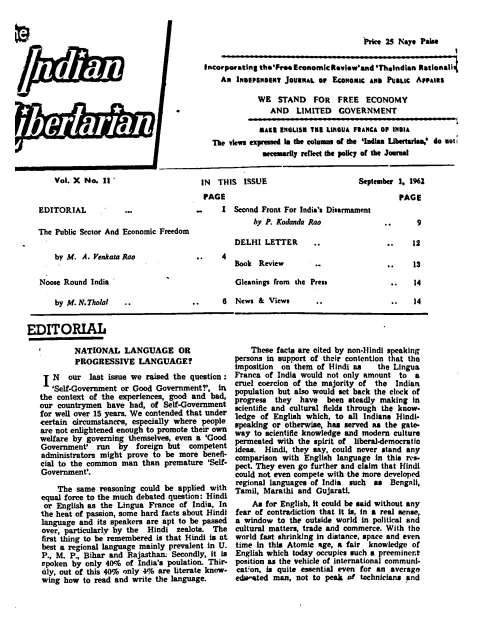
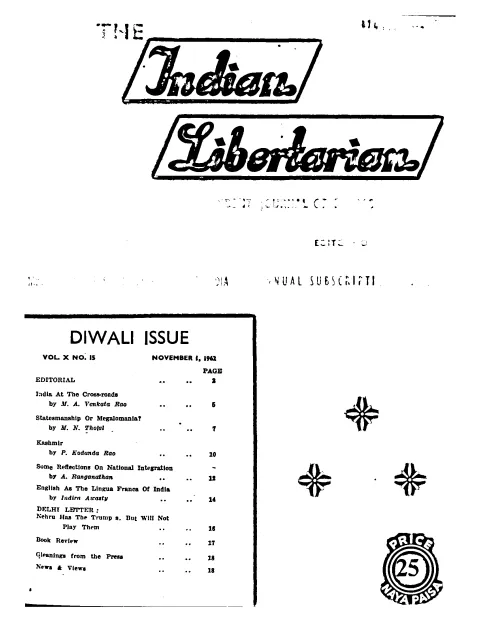
The Indian Libertarian
By MA Venkata Rao, M. N. Tholal, P Kodanda Rao, A Ranganathan
The Indian Libertarian, Libertarian Publishers (Private) Ltd. · Bombay · 1962
20 pages
The Indian Libertarian
Summary
This November 1, 1962 Diwali Issue of The Indian Libertarian (Vol. X No. 15), the Bombay fortnightly of Libertarian Publishers, opens with an unsigned editorial, ‘West Berlin, Simply Non-Negotiable’, which casts the Berlin crisis as a Cold War flashpoint and defends the Western allies’ refusal to concede the city to Soviet pressure. The five bylined essays range across India’s strategic and cultural predicament on the eve of the 1962 border war: M. A. Venkata Rao’s ‘India At The Cross-roads’, M. N. Tholal’s ‘Statesmanship Or Megalomania?’, P. Kodanda Rao on ‘Kashmir’, A. Ranganathan’s ‘Some Reflections On National Integration’, and Indira Awasty’s ‘English As The Lingua Franca Of India’. Together they press a classical-liberal case for free economy, limited government, national unity, and the retention of English as a link language. The full 20-page issue is in the rendered pages.
Key points
-
The unsigned editorial ‘West Berlin, Simply Non-Negotiable’ casts the Berlin crisis as a Cold War flashpoint and defends the Western allies’ refusal to concede the city to Soviet pressure.
-
M. A. Venkata Rao’s ‘India At The Cross-roads’, written as ‘Thoughts on Diwali’, weighs central planning and statism against individual liberty and uses the festival’s light-versus-darkness imagery for India’s national choice.
-
M. N. Tholal’s ‘Statesmanship Or Megalomania?’ draws on members of Ceylon’s House of Parliament to contrast public-spirited restraint with the inflated self-regard of leaders who mistake ambition for national greatness.
-
P. Kodanda Rao’s ‘Kashmir’ reviews the dispute’s reference to the United Nations Security Council and India’s obligations around the promised plebiscite, arguing for a realistic rather than emotional assessment.
-
A. Ranganathan’s ‘Some Reflections On National Integration’ starts from the Official Language Commission’s report and treats integration as a matter of shared institutions and a common link language rather than coercion.
-
Indira Awasty’s ‘English As The Lingua Franca Of India’ defends English’s established role in education, science, and administration as serving national unity without privileging any one region.
-
Awasty’s essay opposes linguistic nationalism as divisive, arguing the difficulty of imposing any single Indian language nationally makes English the pragmatic choice as link language.
Essays
India At The Cross-roads
By MA Venkata Rao
Written as ‘Thoughts on Diwali’, Venkata Rao surveys India at a crossroads and asks what direction the nation should take after fifteen years of independence. He weighs the claims of central planning and statism against individual liberty and free enterprise, arguing that the country’s drift toward socialist controls threatens both prosperity and freedom. He frames Diwali, the festival of lights, as an occasion to choose the path of light—liberty and self-reliance—over the darkness of regimentation.
- Frames India’s choice of direction after fifteen years of independence.
- Weighs central planning and statism against individual liberty.
- Warns that the drift toward socialist controls threatens prosperity and freedom.
- Uses the Diwali metaphor of light versus darkness for the national choice.
Statesmanship Or Megalomania?
By M. N. Tholal
Tholal poses the question of whether the leadership on display—Indian and international—amounts to statesmanship or megalomania. Drawing on members of Ceylon’s House of Parliament, he contrasts genuine statesmanship, which serves the public interest with restraint, against the inflated self-regard of leaders who mistake personal ambition for national greatness. The essay is a sharp critique of charismatic political vanity and its costs to sound governance.
- Asks whether contemporary leadership is statesmanship or megalomania.
- Draws on a Ceylon parliamentary debate for its framing.
- Contrasts public-spirited restraint with inflated self-regard.
- Critiques charismatic vanity as a cost to good governance.
Kashmir
By P. Kodanda Rao
Kodanda Rao reviews the Kashmir question and India’s handling of it at the United Nations Security Council. He recounts the reference of the dispute to the Council, the obligations India undertook, and the diplomatic manoeuvring around the promised plebiscite, arguing for a clear-eyed assessment of India’s position rather than emotional or absolutist postures. The piece reflects the journal’s broader scepticism toward Nehru-era foreign policy.
- Reviews the Kashmir dispute and its reference to the UN Security Council.
- Examines India’s obligations and the promised plebiscite.
- Argues for a realistic rather than emotional assessment of India’s position.
- Reflects the journal’s scepticism toward Nehru-era diplomacy.
Some Reflections On National Integration
By A Ranganathan
Ranganathan offers reflections on national integration, distinguishing a deeper cultural and administrative unity from mere sentiment or slogan. Beginning from the report of the Official Language Commission, he treats integration as a problem to be solved through shared institutions—administration, communications, and a common link language—rather than through coercion or romantic appeals to a single soil. He links the integration question to the controversies over language policy that run through the issue.
- Distinguishes genuine integration from sentiment and slogan.
- Starts from the Official Language Commission’s report.
- Treats integration as a matter of shared institutions and a link language.
- Rejects coercion and nativist romanticism as routes to unity.
English As The Lingua Franca Of India
By Indira Awasty
Awasty argues for retaining English as India’s lingua franca and link language. Surveying the linguistic diversity of the country and the difficulty of imposing any single Indian language as a national medium, she contends that English—already established as an associate language and the vehicle of higher education, science, and administration—best serves national unity without privileging one region over another. The essay is a defence of pragmatic language policy against linguistic nationalism.
- Defends English as India’s link language and lingua franca.
- Stresses the difficulty of imposing any single Indian language nationally.
- Notes English’s established role in education, science, and administration.
- Argues it serves unity without privileging one region.
- Opposes linguistic nationalism as divisive.
Generated by the v1.5 extraction pipeline. Awaiting editorial review.
Metadata and summary are AI-extracted from the source PDF and reviewed for editorial accuracy. The original work is available via the Read PDF tab above (where present); paragraph-level citation inside the PDF is deferred to a future engagement.