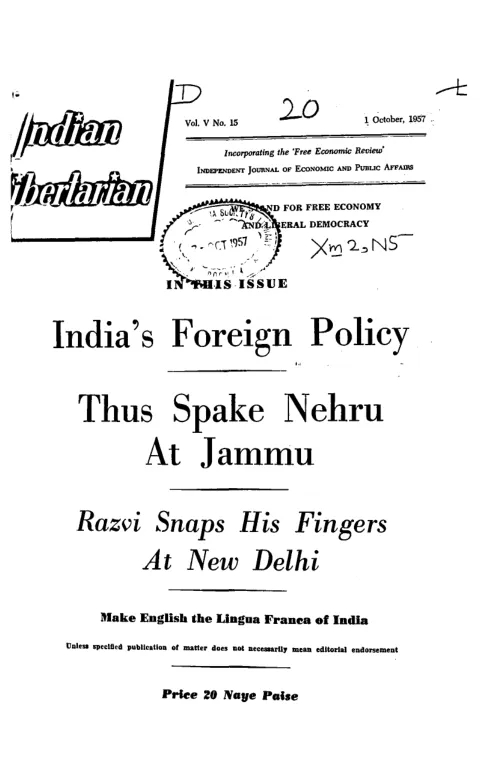
periodical issue
The Indian Libertarian
Independent Journal of Economic and Public Affairs
By MA Venkata Rao, BS Sanyal, J. K. Dhairyawan
The Indian Libertarian, Arya Bhuvan, Sandhurst Road, Bombay 4 · Bombay · 1957
24 pages
The Indian Libertarian
Summary
This issue of The Indian Libertarian (Vol. V No. 15, 1 October 1957), edited by Kusum Lotwala, runs the journal’s classical-liberal line through the foreign-policy and domestic controversies of the day. In the rendered pages the editorial, ‘Goa As Foreign Base’, criticises Indian policy toward Goa and Western bases; M. A. Venkata Rao analyses ‘India’s Foreign Policy’ and its non-alignment; a contributor writing as ‘Lal’ reflects on ‘The Hindu Way of Life’; and B. S. Sanyal reports Nehru’s foreign-policy pronouncements in ‘Thus Spake Nehru at Jammu’. Further items on Razvi, Krishnamachari, and ‘the Semantic Trojan Horse of Nehru Planning’ extend the issue’s critique of Congress policy.
Key points
-
The editorial ‘Goa As Foreign Base’ examines statements by the Prime Minister and Defence Minister on Goa and Western military bases, probing the consistency of India’s stance on foreign bases.
-
M. A. Venkata Rao’s ‘India’s Foreign Policy’ scrutinises the premises of Indian non-alignment, questioning whether professed neutrality between the Western and Communist blocs actually serves the country’s interests.
-
Writing as ‘Lal’, an essay titled ‘The Hindu Way of Life’ reflects on Hinduism as a way of life rather than a narrow creed, engaging Khilafat-era communal memory and Gandhian thought.
-
B. S. Sanyal’s ‘Thus Spake Nehru at Jammu’ reports and dissects Nehru’s foreign-policy address at a National Conference meeting in Jammu, scrutinising his claims on Kashmir, Pakistan and non-alignment.
-
Further items in the issue extend the critique of Congress policy through pieces referencing Razvi, Krishnamachari and what one contributor calls the ‘Semantic Trojan Horse of Nehru Planning’.
Essays
Editorial: Goa As Foreign Base
The editorial, ‘Goa As Foreign Base’, examines the statements of the Prime Minister and Defence Minister on Goa and Western military bases. In the rendered pages it weighs the consistency of India’s stance on foreign bases and clarifies the journal’s view of the Goa question, treating it within the larger frame of Indian sovereignty and foreign policy.
- Responds to government statements on Goa and Western bases.
- Probes the consistency of India’s position on foreign military bases.
- Sets the Goa question within the wider foreign-policy debate.
India’s Foreign Policy
By MA Venkata Rao
M. A. Venkata Rao’s ‘India’s Foreign Policy’ scrutinises the assumptions of Indian non-alignment and the country’s posture between the Western and Communist blocs. In the rendered pages he questions whether India’s professed neutrality serves its interests, and weighs the apologetics of non-alignment against the realities of power politics.
- Examines the premises of Indian non-alignment.
- Questions whether neutrality between the blocs serves India.
- Tests the ‘apologetics of non-alignment’ against power realities.
The Hindu Way of Life
By Lal
Writing as ‘Lal’, this essay, ‘The Hindu Way of Life’, reflects on the meaning of Hinduism as a way of life rather than a creed, taking up questions of Khilafat-era memories, communal relations and Gandhian thought. In the rendered pages it weighs a ‘national-cultural’ conception of Hinduism against communal and political readings of it.
- Treats Hinduism as a way of life rather than a narrow creed.
- Engages communal relations and the legacy of Khilafat-era politics.
- Reflects through Gandhian categories on culture and nationhood.
Thus Spake Nehru at Jammu
By B. S. Sanyal
B. S. Sanyal’s ‘Thus Spake Nehru at Jammu’ reports and dissects Nehru’s foreign-policy address at a National Conference meeting in Jammu. In the rendered pages it scrutinises Nehru’s pronouncements on Kashmir, Pakistan and non-alignment, treating the speech as an occasion to test the coherence of Indian foreign policy.
- Reports Nehru’s foreign-policy speech at Jammu.
- Scrutinises his claims on Kashmir, Pakistan and non-alignment.
- Uses the speech to probe the coherence of Indian policy.
Generated by the v1.5 extraction pipeline. Awaiting editorial review.
Metadata and summary are AI-extracted from the source PDF and reviewed for editorial accuracy. The original work is available via the Read PDF tab above (where present); paragraph-level citation inside the PDF is deferred to a future engagement.