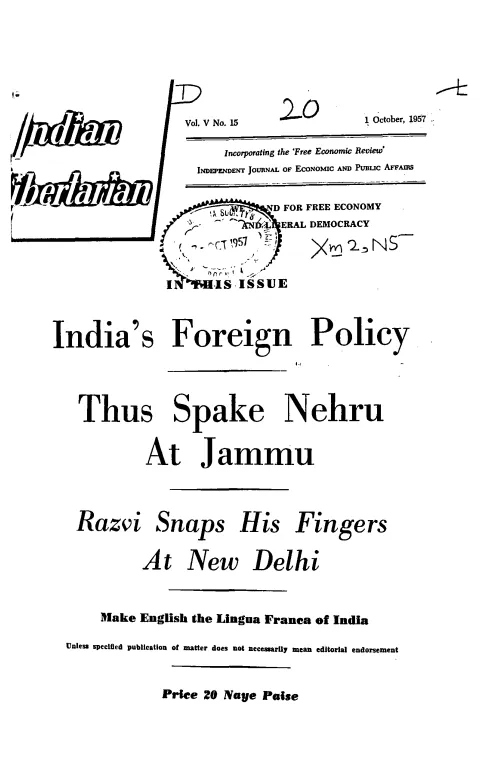
periodical issue
The Indian Libertarian
Independent Journal of Economic and Public Affairs
By MA Venkata Rao, BS Sanyal, J. K. Dhairyawan
The Indian Libertarian, Edited by Miss Kusum Lotwala, published for the Libertarian Social Institute, Arya Bhuvan, Sandhurst Road (West), Bombay 4 · Bombay · 1957
24 pages
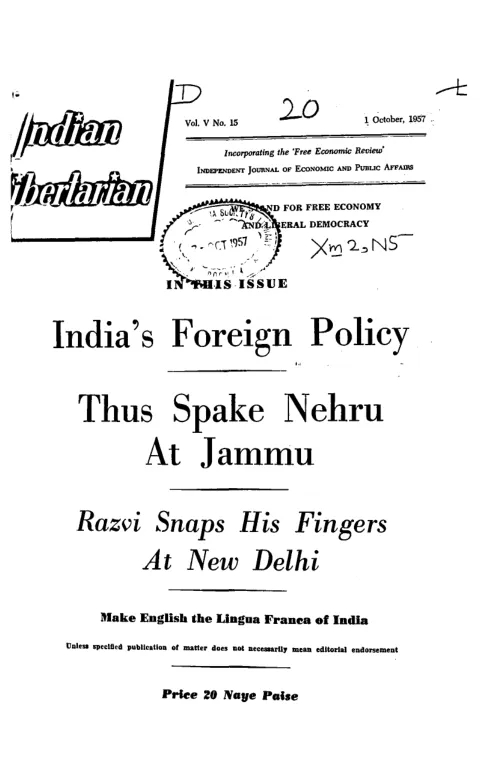
The Indian Libertarian
Summary
The 1 October 1957 issue of The Indian Libertarian (Vol. V No. 15), edited by Miss Kusum Lotwala and issued from the Libertarian Social Institute in Bombay, leads with foreign policy and a critique of Nehru-era planning. The unsigned editorial, ‘Goa As Foreign Base,’ treats the Portuguese enclave of Goa as a security problem and weighs the role of the Western Powers and the Soviet bloc. M. A. Venkata Rao supplies a long essay on India’s foreign policy and non-alignment, ‘Lal’ reflects on the ‘Hindu Way of Life’ and communal relations, and B. S. Sanyal reports on Nehru’s Jammu speech and on the Hyderabad Razakar figure Razvi. Further pieces by J. K. Dhairyawan and Sanyal turn to T. T. Krishnamachari and Nehru’s critics, and a four-page inserted supplement from the Research Department of the R. L. Foundation reviews Spencer Heath’s ‘Citadel, Market and Altar.’ The masthead carries the journal’s standing slogan, ‘We Stand For Free Economy And Liberal Democracy.‘
Key points
-
The unsigned editorial “Goa as Foreign Base” treats the Portuguese enclave as a security problem, weighing the roles of the Western Powers and the Soviet bloc.
-
M. A. Venkata Rao’s essay on India’s foreign policy examines the reception of Indian non-alignment abroad and questions whether the posture genuinely serves security and economic interests or merely flatters domestic opinion.
-
Venkata Rao comments on Krishna Menon’s part in shaping India’s foreign policy and raises the question of foreign aid and the “apologetics” of non-alignment.
-
Writing under the name “Lal,” a contributor reflects on the “Hindu Way of Life,” recalling the Khilafat movement and Maulana Mohamed Ali to distinguish genuine tolerance from communalism.
-
B. S. Sanyal’s report “Thus Spake Nehru at Jammu” scrutinises the prime minister’s National Conference address, noting the gap between its rhetoric and the unresolved Kashmir question.
-
Further pieces by J. K. Dhairyawan and Sanyal turn to T. T. Krishnamachari and Nehru’s critics, extending the issue’s running critique of Congress leadership.
-
A four-page inserted supplement from the Research Department of the R. L. Foundation reviews Spencer Heath’s “Citadel, Market and Altar,” bringing an American libertarian text before Indian readers.
Essays
India’s Foreign Aid
By MA Venkata Rao
Printed under the running title ‘India’s Foreign Policy,’ M. A. Venkata Rao’s essay examines India’s posture of non-alignment between the Western and Soviet blocs in the rendered pages. He surveys the reception of Indian neutralism abroad, the question of foreign aid and apologetics for non-alignment, and the role of Mr. Krishna Menon, weighing whether India’s stance genuinely serves its security and economic interests or merely flatters domestic opinion.
- Assesses India’s non-alignment between the Western and Soviet blocs
- Discusses how Indian neutralism is received abroad
- Raises the question of foreign aid and the ‘apologetics’ of non-alignment
- Comments on Mr. Krishna Menon’s part in India’s foreign policy
The Hindu Way of Life
By Lal
Writing under the name ‘Lal,’ the author reflects on the ‘Hindu Way of Life’ and on communal relations in India, drawing on the history of the Khilafat agitation and the figure of Maulana Mohamed Ali. The piece contrasts genuine tolerance with communalism and invokes Gandhi’s example in arguing how Hindu-Muslim relations ought to be conceived.
- Reflects on the meaning of the ‘Hindu Way of Life’
- Recalls the Khilafat movement and Maulana Mohamed Ali
- Distinguishes tolerance from communalism
- Invokes Gandhi on Hindu-Muslim relations
Thus Spake Nehru at Jammu
By B. S. Sanyal
B. S. Sanyal reports on Prime Minister Nehru’s address to a National Conference session at Jammu (‘Thus Spake Nehru At Jammu’), drawing out its implications for Kashmir and for relations with Pakistan. Sanyal scrutinizes Nehru’s claims and self-congratulation, noting the gap between the speech’s rhetoric and the unresolved Kashmir question.
- Reports Nehru’s National Conference speech at Jammu
- Examines its bearing on Kashmir and on Pakistan
- Criticizes Nehru’s self-justification in the address
Generated by the v1.5 extraction pipeline. Awaiting editorial review.
Metadata and summary are AI-extracted from the source PDF and reviewed for editorial accuracy. The original work is available via the Read PDF tab above (where present); paragraph-level citation inside the PDF is deferred to a future engagement.