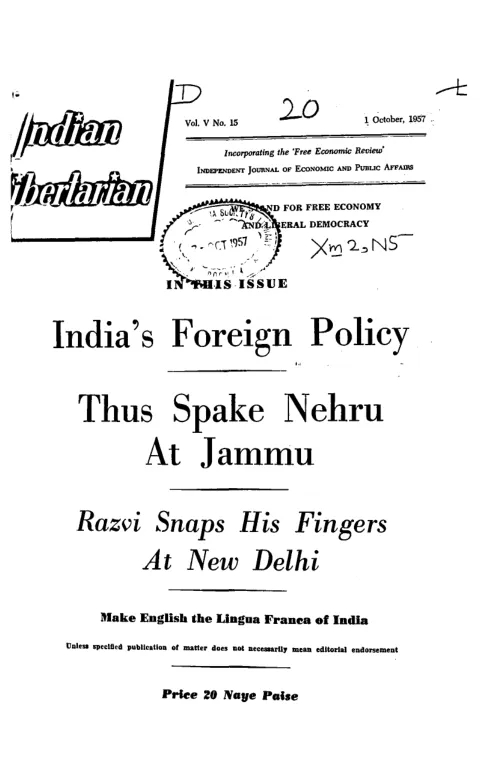
periodical issue
The Indian Libertarian
Independent Journal of Free Economy and Public Affairs
By MA Venkata Rao, M. N. Tholal, J. K. Dhairyawan
The Indian Libertarian, Edited by Miss Kusum Lotwala, published for the Libertarian Social Institute, Arya Bhuvan, Sandhurst Road, Bombay 4 · Bombay · 1959
24 pages
The Indian Libertarian
Summary
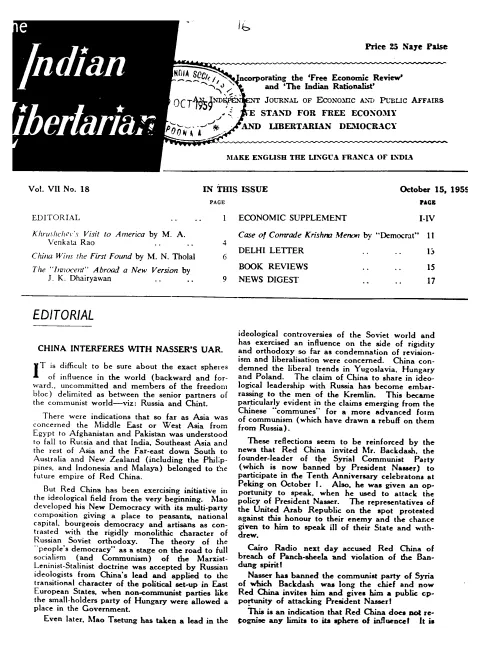
The 15 October 1959 issue of The Indian Libertarian (Vol. VII No. 18), edited by Miss Kusum Lotwala for the Libertarian Social Institute, Bombay, is dominated by the Cold War and by the deteriorating Sino-Indian frontier. The unsigned editorial, ‘China Interferes With Nasser’s UAR,’ reads Red China’s reach into the Middle East against the rivalries of the Communist bloc. M. A. Venkata Rao analyses Khrushchev’s visit to America, M. N. Tholal argues that ‘China Wins the First Round’ in its border confrontation with India, and J. K. Dhairyawan offers a Mark Twain-flavoured ‘Innocent Abroad’ reading of the Khrushchev tour. A signed piece by ‘Democrat’ makes the ‘Case of Comrade Krishna Menon,’ criticising the Defence Minister over the China crisis, and an inserted four-page Economic Supplement carries Prof. G. N. Lawande on Marx’s theory of value and surplus-value. The masthead slogan reads ‘We Stand For Free Economy And Libertarian Democracy.‘
Key points
-
The 15 October 1959 issue of The Indian Libertarian (Vol. VII No. 18), edited by Miss Kusum Lotwala for the Libertarian Social Institute, is dominated by the Cold War and the deteriorating Sino-Indian frontier.
-
The unsigned editorial, ‘China Interferes With Nasser’s UAR’, reads Red China’s reach into the Middle East against the rivalries of the wider Communist bloc.
-
M. A. Venkata Rao analyses Khrushchev’s 1959 visit to America, weighing the prospects for US-Soviet coexistence against the longer arc of Soviet conduct since 1917.
-
M. N. Tholal’s ‘China Wins the First Round’ opens with a Dickensian allusion to argue India lost the opening exchange in its frontier confrontation with China over disputed territory.
-
J. K. Dhairyawan’s ‘The “Innocent” Abroad — A New Version’ borrows Mark Twain’s conceit to cast Khrushchev’s American tour as a propaganda contest between the United States and the USSR.
-
Writing as ‘Democrat’, ‘Case of Comrade Krishna Menon’ indicts the Defence Minister over his handling of the Service Chiefs amid the deteriorating China frontier situation.
-
Prof. G. N. Lawande’s Economic Supplement essay addresses Marx’s theory of value and surplus-value across four inserted pages of the issue.
-
The masthead of this issue carries the slogan ‘We Stand For Free Economy And Libertarian Democracy’, a variant of the journal’s usual formula.
Essays
Khrushchev’s Visit to America
By MA Venkata Rao
M. A. Venkata Rao examines Khrushchev’s 1959 visit to the United States and its implications for the Cold War. He weighs the Soviet leader’s overtures, the prospects for coexistence between the American and Soviet blocs, and what the visit signals about the balance of power and the contest of ideologies, reading the episode against the longer arc of Soviet conduct since 1917.
- Analyses Khrushchev’s visit to America and its Cold War significance
- Weighs the prospects for US-Soviet coexistence
- Reads the visit against the history of Soviet conduct
- Considers the contest of ideologies between the blocs
China Wins the First Round
By M. N. Tholal
Opening with a comic allusion to Dickens’s Pickwick Papers, M. N. Tholal argues in ‘China Wins the First Round’ that India has already lost the opening exchange in its frontier confrontation with China. He reviews the preliminary skirmishes and the tens of thousands of square miles at stake, contending that New Delhi’s handling of the dispute has left India at a disadvantage.
- Argues India has lost the first round of the border confrontation with China
- Opens with a Dickensian (Pickwick Papers) framing device
- Reviews the preliminary frontier skirmishes and the territory at stake
- Criticises New Delhi’s handling of the dispute
The “Innocent” Abroad a New Version
By J. K. Dhairyawan
J. K. Dhairyawan’s ‘The “Innocent” Abroad — A New Version’ borrows Mark Twain’s conceit to comment on Khrushchev’s American tour, casting the Soviet leader as a wily traveller rather than a naive one. The piece tracks the propaganda contest between the United States and the USSR that the visit dramatised.
- Uses Mark Twain’s ‘Innocents Abroad’ as a framing device
- Comments satirically on Khrushchev’s American tour
- Tracks the US-USSR propaganda contest
- Reads the visit as a battle for the possession of minds
Case of Comrade Krishna Menon
By Democrat
Writing under the name ‘Democrat,’ the author makes the ‘Case of Comrade Krishna Menon,’ indicting the Defence Minister over the conduct of the Service Chiefs and the deteriorating security situation on the China frontier. The piece treats Menon’s handling of defence as evidence of the dangers of his political sympathies.
- Indicts Defence Minister Krishna Menon over the China crisis
- Questions his handling of the Service Chiefs and defence policy
- Reads his conduct against his political sympathies
Generated by the v1.5 extraction pipeline. Awaiting editorial review.
Metadata and summary are AI-extracted from the source PDF and reviewed for editorial accuracy. The original work is available via the Read PDF tab above (where present); paragraph-level citation inside the PDF is deferred to a future engagement.