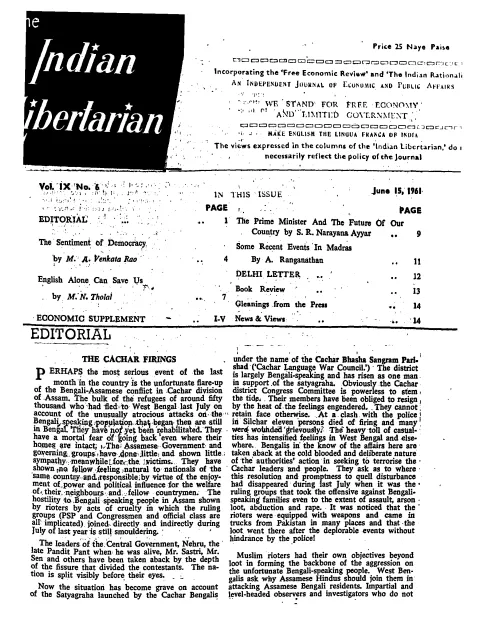
periodical issue
The Indian Libertarian
Independent Journal of Free Economy and Public Affairs
By MA Venkata Rao, M. N. Tholal
The Indian Libertarian, Arya Bhuvan, Sandhurst Road, Bombay 4 · Bombay · 1961
24 pages
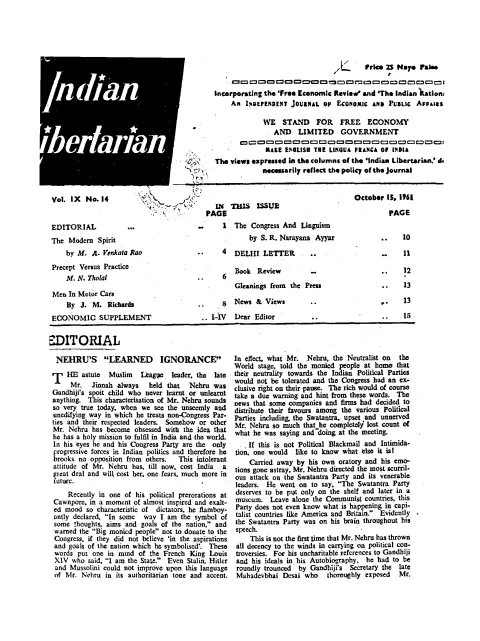
The Indian Libertarian
Summary
This October 15, 1961 issue of The Indian Libertarian (Vol. IX No. 14), the Bombay fortnightly ‘Independent Journal of Free Economy and Public Affairs’ now edited by D. M. Kulkarni, leads with a sharply anti-Nehru editorial and follows with signed essays on modernity, secular practice, the social cost of the motor car, and the Congress and language politics. In the rendered pages the editorial ‘Nehru’s Learned Ignorance’ attacks Nehru’s self-symbolisation and his attack on the Swatantra Party; M. A. Venkata Rao reflects on ‘The Modern Spirit’ and the clash of tradition and Western modernism; M. N. Tholal in ‘Precept Versus Practice’ scrutinises the National Integration Conference’s school-prayer proposal against the Constitution’s secular guarantees; J. M. Richards weighs the high civilisational price of letting motor cars dominate; and S. R. Narayana Ayyar examines ‘The Congress And Linguism’. The issue’s stance is classical-liberal and limited-government, hostile to statism, centralisation, and what it casts as Nehruvian authoritarian rhetoric.
Key points
-
The 15 October 1961 issue (Vol. IX, No. 14), now edited by D. M. Kulkarni, leads with the editorial ‘Nehru’s Learned Ignorance,’ quoting his Cawnpore declaration ‘I am the symbol of some thoughts, aims and goals of the nation.’
-
The editorial likens Nehru’s self-symbolisation to Louis XIV’s ‘I am the State’ and condemns his attack on the Swatantra Party at the National Integration meeting as political blackmail and intimidation.
-
M. A. Venkata Rao’s ‘The Modern Spirit’ takes Nehru’s description of steel plants and irrigation projects as ‘temples’ as a starting point for examining the clash between traditional Indian society and Western modernism.
-
M. N. Tholal’s ‘Precept Versus Practice’ objects that the National Integration Conference’s proposal for a common school prayer defeats the Constitution’s Preamble guarantees of justice, equality of status and equality of opportunity.
-
J. M. Richards’s ‘Men in Motor Cars’ itemises the price of motor-car dominance: towns ripped apart by new roads, the high cost of road building, and time lost to traffic congestion and the search for parking.
-
S. R. Narayana Ayyar’s ‘The Congress and Linguism’ connects the language-politics question to Third Plan economic policy, citing planners’ proposal to raise roughly Rupees seventeen hundred ten crores in taxes and the resulting burden on the common man.
Essays
Editorial
The editorial ‘Nehru’s “Learned Ignorance”’ opens from the late Muslim League leader Jinnah’s quip that Nehru was Gandhiji’s spoilt child, and argues that Nehru is obsessed with a holy mission to fulfil himself in India and the world, brooking no opposition. In the rendered pages it fastens on Nehru’s Cawnpore peroration in which he declared ‘I am the symbol of some thoughts, aims and goals of the nation,’ likening this to Louis XIV’s ‘I am the State,’ and condemns his scurrilous attack on the Swatantra Party at the National Integration meeting as political blackmail and intimidation.
- Opens from Jinnah’s characterisation of Nehru as Gandhiji’s spoilt child.
- Argues Nehru is obsessed with a self-appointed holy mission and brooks no opposition.
- Quotes Nehru’s Cawnpore declaration ‘I am the symbol of some thoughts, aims and goals of the nation.’
- Likens Nehru’s self-symbolisation to Louis XIV’s ‘I am the State.’
- Condemns Nehru’s attack on the Swatantra Party as political blackmail and intimidation.
The Modern Spirit
By MA Venkata Rao
M. A. Venkata Rao’s ‘The Modern Spirit’ takes Nehru’s description of steel plants and irrigation projects as ‘temples’ as a starting point for a meditation on modernism, an attitude and outlook sourced in the West and sweeping before it traditional societies only half awake like India. In the rendered pages he frames the clash of old and new, traditional and modern, as the defining cultural conflict of such societies.
- Begins from Nehru’s image of steel plants and irrigation projects as modern temples.
- Defines modernism as an attitude and outlook with its sources in the West.
- Argues modernism sweeps before it traditional societies only ‘half awake’ like India.
- Frames the clash of old and new, traditional and modern, as the central cultural conflict.
Precept Versus Practice
By M. N. Tholal
M. N. Tholal’s ‘Precept Versus Practice’ examines the National Integration Conference, just concluded in New Delhi, which urged that the day’s work in all Indian schools should begin with a prayer common to all India. In the rendered pages Tholal objects that such measures tend to defeat the ‘Justice, social, economic and political’ and ‘equality of status and of opportunity’ guaranteed by the Constitution’s Preamble, contrasting professed precept with actual practice.
- Reports on the National Integration Conference’s session in New Delhi.
- Notes the proposal that all Indian schools begin the day with a common prayer.
- Argues such measures defeat the Preamble’s guarantees of justice and equality.
- Invokes the Preamble’s ‘equality of status and of opportunity’ against the proposal.
- Contrasts official precept with practice.
Men In Motor Cars
By J. M. Richards
J. M. Richards’s ‘Men In Motor Cars’ argues that civilisation is at last becoming fully aware of the high price paid for letting motor-cars become a dominant element. In the rendered pages Richards itemises that price: the ripping apart of towns and cities by new motor roads, the huge cost of road building, the waste of time and nervous energy from traffic congestion, and the frustration of never finding anywhere to park.
- Argues society is finally aware of the high price of motor-car dominance.
- Cites the destruction of towns and cities by new motor roads.
- Notes the huge cost of road building.
- Points to wasted time and nervous energy from traffic congestion.
- Highlights the frustration of finding nowhere to park.
The Congress And Linguism
By S. R. Narayana Ayyar
S. R. Narayana Ayyar’s ‘The Congress And Linguism’ addresses the Congress party’s handling of language politics. In the rendered pages the discussion engages economic planning and taxation under the Third Plan alongside the linguistic question, citing the burden of taxes on the common man and the planners’ proposals to raise large sums over and above existing levies.
- Addresses the Congress party’s stance on linguism and language politics.
- Connects the linguistic question to Third Plan economic policy.
- Cites planners’ proposal to raise roughly 1710 crores by way of taxes during the Third Plan.
- Notes the burden of taxation and deficit financing on the common man.
Generated by the v1.5 extraction pipeline. Awaiting editorial review.
Metadata and summary are AI-extracted from the source PDF and reviewed for editorial accuracy. The original work is available via the Read PDF tab above (where present); paragraph-level citation inside the PDF is deferred to a future engagement.