periodical issue
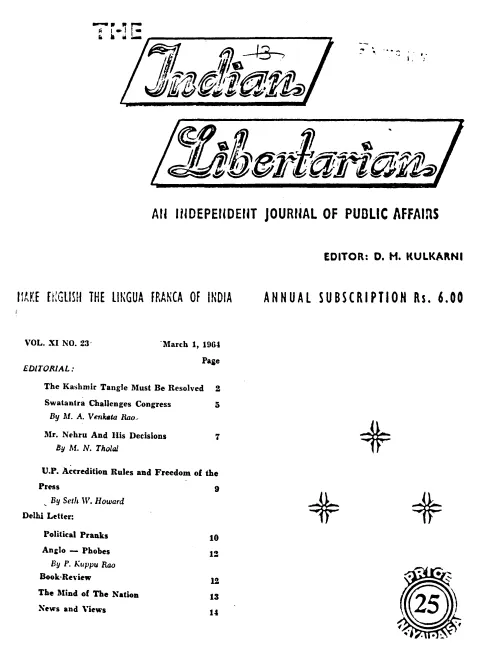
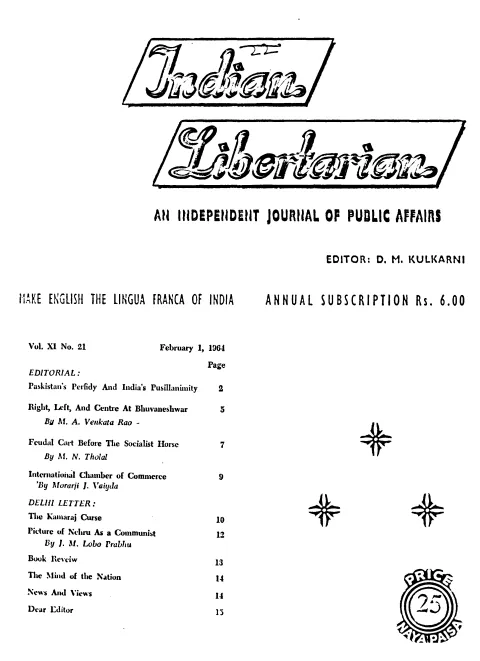
The Indian Libertarian
An Independent Journal of Public Affairs
By MA Venkata Rao, M. N. Tholal, C. Rajagopalachari
The Libertarian Publishers (Private) Ltd., First floor, Arya Bhuvan, Sandhurst Road West, Bombay 4 · Bombay · 1963
16 pages
The Indian Libertarian
Summary
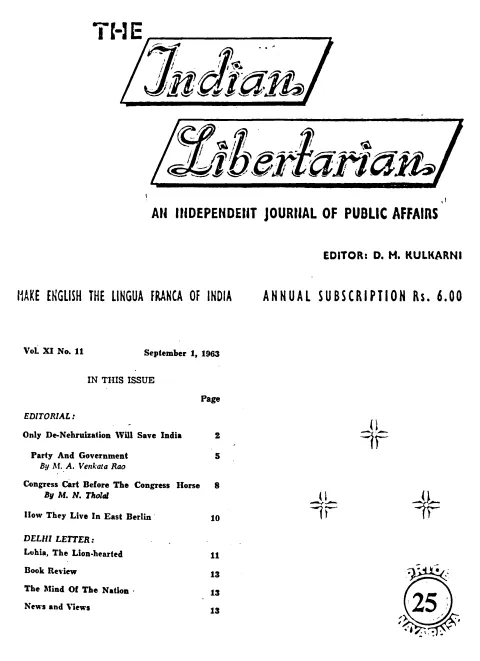
This September 1, 1963 issue (Vol. XI No. 11) of The Indian Libertarian, the Bombay classical-liberal fortnightly edited by D. M. Kulkarni, is dominated by Congress-party politics and the crisis of one-man rule. Its editorial argues that only ‘de-Nehruization’ can save India; M. A. Venkata Rao analyses the relationship of party and government; M. N. Tholal dissects the Congress’s reorganisation muddle; and a Delhi Letter profiles the socialist firebrand Ram Manohar Lohia. Shorter pieces report on life in East Berlin, Rajaji’s ‘Permit-Licence-Yug’ critique of controls, a review of Ernest Barker on government, and a column on the persistence of Stalinism. The issue’s argumentative center is a liberal critique of personalised, over-centralised Congress rule and the permit-licence economy.
Key points
-
The editorial ‘Only De-Nehruization Will Save India’ argues the concentration of power around Nehru has hollowed out Congress and Indian governance, reading the Kamaraj Plan and resulting resignations as symptoms rather than cures.
-
M. A. Venkata Rao’s ‘Party And Government’, occasioned by the Kamaraj Plan, argues that fusing a single ruling party with the machinery of the State converts government office into an instrument of patronage rather than service.
-
M. N. Tholal’s ‘Congress Cart Before The Congress Horse’ responds to Kamaraj’s AICC-adopted resignation proposal, arguing it inverts the proper party-government relationship and leaves the real concentration of power untouched.
-
C. Rajagopalachari’s column ‘Permit-Licence-Yug’ attacks the controls-and-permits regime of the planned economy, coining the phrase to cast licensing as the defining affliction stifling enterprise and breeding corruption.
-
Elsewhere, a short reportage sketch, ‘How They Live In East Berlin’, contrasts regimented scarcity in the Communist East with conditions in the West.
-
A Delhi Letter, ‘Lohia, The Lion-hearted’, profiles socialist leader Ram Manohar Lohia’s combative parliamentary clashes with Nehru while noting Lohia’s own ideological excesses alongside his courage.
-
The Book Review treats Ernest Barker’s ‘Reflections on Government’ as a liberal study of representative, constitutional government, aligning it with the journal’s constitutionalist outlook.
-
The column ‘The Mind Of The Nation’, subtitled ‘Stalinism Still Remains’, argues that despite formal de-Stalinisation the underlying apparatus and habits of Stalinist rule persist because the system, not the man, was the problem.
Essays
Editorial: Only De-Nehruization Will Save India
The editorial ‘Only De-Nehruization Will Save India’ argues that the concentration of power around Nehru and his hand-picked lieutenants has hollowed out the Congress organisation and Indian governance. It surveys the ‘sinister implications’ of the Kamaraj Plan and resignations, contending that genuine renewal requires dismantling Nehru’s personalised control rather than reshuffling ministers, and links the crisis to the wider failure of socialist planning.
- Argues India’s malaise stems from over-centralised, personalised Nehru rule.
- Reads the Kamaraj Plan and resignations as symptoms, not cures.
- Calls for ‘de-Nehruization’ as the real path to renewal.
- Connects the political crisis to the failure of socialist planning.
- Signed editorially ‘D. M. Kulkarni’ at its close.
Party And Government
By MA Venkata Rao
M. A. Venkata Rao’s ‘Party And Government’, occasioned by the Kamaraj Plan and the relationship between Congress chief ministers and the central organisation, examines how the fusion of ruling party and State apparatus corrupts both. He argues that when a single party monopolises government, the machinery of office becomes an instrument of patronage and power rather than service, and that liberal constitutional norms require a clear separation of party from government.
- Prompted by the Kamaraj Plan and the role of Congress chief ministers.
- Argues the fusion of party and government breeds patronage and corruption.
- Defends a clear separation of party from the machinery of the State.
- Treats one-party dominance as a structural danger to liberty.
Congress Cart Before The Congress Horse
By M. N. Tholal
M. N. Tholal’s ‘Congress Cart Before The Congress Horse’ responds to K. Kamaraj’s proposal, taken up by the AICC, that senior leaders quit office for organisational work. Tholal argues the scheme inverts the proper relationship between party and government, treats a loosely drafted resolution as a remedy for deeper rot, and amounts to a reshuffle that leaves the underlying concentration of power untouched.
- Responds to Kamaraj’s resignation proposal adopted by the AICC.
- Argues the plan puts the party ‘cart’ before the government ‘horse’.
- Criticises the resolution as loosely drafted and evasive.
- Sees the move as cosmetic, leaving real power concentration intact.
How They Live In East Berlin / Permit-Licence-Yug
By C. Rajagopalachari
Page 10 carries two short pieces: ‘How They Live In East Berlin’, a reportage sketch contrasting the regimented scarcity of the Communist East with the West, and ‘Permit-Licence-Yug’ by C. Rajagopalachari, his signature attack on the controls-and-permits regime of the Indian planned economy. Rajaji’s column frames the licence-permit system as the defining affliction of the age, stifling enterprise and breeding corruption.
- Pairs a sketch of regimented life in East Berlin with Rajaji’s controls critique.
- Rajagopalachari coins/uses ‘Permit-Licence-Yug’ for the era of economic controls.
- Casts the permit-licence regime as a source of corruption and stagnation.
- Implicitly contrasts free enterprise with Communist scarcity.
Delhi Letter: Lohia, The Lion-hearted
The Delhi Letter, ‘Lohia, The Lion-hearted’, profiles the socialist leader Ram Manohar Lohia and his combative parliamentary style, set against Prime Minister Nehru. The correspondent recounts clashes in Parliament over reorganisation and policy, and uses Lohia’s fearless opposition to highlight the want of effective challenge to Congress dominance, while noting Lohia’s own ideological excesses.
- Profiles Ram Manohar Lohia as a fearless parliamentary opponent.
- Stages Lohia against Nehru in Lok Sabha exchanges.
- Uses Lohia to underline the weakness of opposition to Congress.
- Notes Lohia’s ideological excesses alongside his courage.
Book Review
The Book Review covers Ernest Barker’s ‘Reflections on Government’ (Oxford), a study of representative and constitutional government. The reviewer treats Barker’s work as a liberal account of how free institutions translate the mind of the nation into political action, aligning it with the journal’s constitutionalist outlook.
- Reviews Ernest Barker’s ‘Reflections on Government’ (Oxford).
- Frames it as a liberal study of representative, constitutional government.
- Aligns Barker’s argument with the journal’s constitutionalism.
The Mind Of The Nation
‘The Mind Of The Nation’, subtitled ‘Stalinism Still Remains’, argues that despite formal de-Stalinisation the underlying apparatus and habits of Stalinist rule persist in the Communist world. The column reads ongoing repression as evidence that the system, not merely the man, was the problem.
- Argues Stalinism outlived Stalin and formal de-Stalinisation.
- Locates the problem in the system rather than the individual.
- Treats persisting repression as proof of structural continuity.
Generated by the v1.5 extraction pipeline. Awaiting editorial review.
Metadata and summary are AI-extracted from the source PDF and reviewed for editorial accuracy. The original work is available via the Read PDF tab above (where present); paragraph-level citation inside the PDF is deferred to a future engagement.