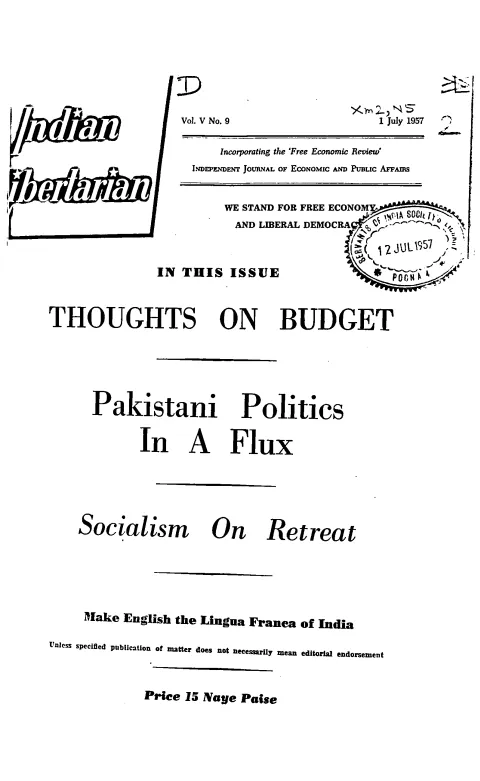
periodical issue
The Indian Libertarian
Independent Journal of Economic and Public Affairs
By J. K. Dhairyawan, Ludwig von Mises, A Ranganathan, BS Sanyal
The Indian Libertarian, Arya Bhuvan, Sandhurst Road, Bombay 4 · Bombay · 1957
24 pages
The Indian Libertarian
Summary
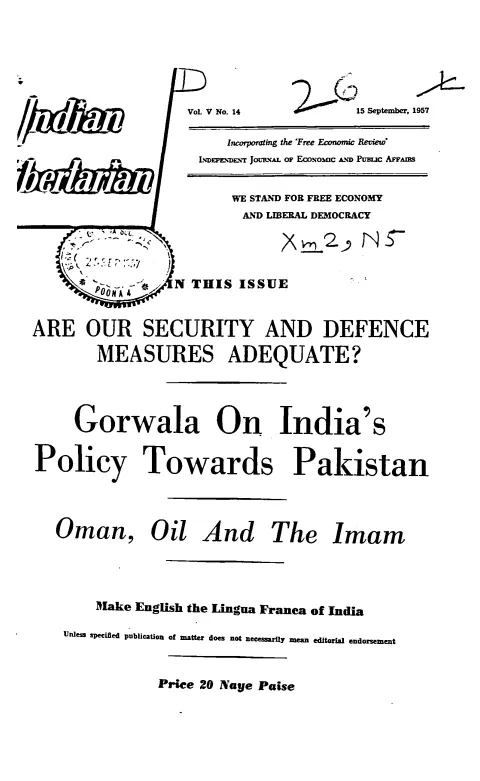
This 15 September 1957 issue (Vol. V No. 14) of The Indian Libertarian, the Bombay free-economy and liberal-democracy fortnightly then edited by Kusum Lotwala, ranges across foreign policy, defence, and political philosophy. Its lead pieces engage A. D. Gorwala’s views on India-Pakistan policy, ask whether India’s security and defence are adequate, and dissect the Oman oil crisis and the Imam. An embedded four-page (A-D) Research Department supplement of the R. L. Foundation reprints Ludwig von Mises on full employment and monetary policy; A. Ranganathan reflects on the politics of removing statues; and S. A. Das offers an essay on humanism. The issue’s argumentative center is a classical-liberal, anti-socialist reading of Indian foreign and economic policy in the early Cold War.
Key points
-
This 15 September 1957 issue of The Indian Libertarian (Vol. V No. 14), edited by Kusum Lotwala, ranges across foreign policy, defence, and political philosophy.
-
Signed ‘Fairplay’, ‘Gorwala on India’s Policy Towards Pakistan’ reports A. D. Gorwala’s address to the Indian Council of World Affairs, calling for a realist reappraisal of India’s Pakistan policy.
-
S. A. Das’s ‘Humanism’ sketches the philosophy from Nehru down to modern variants, distinguishing genuine humanism centred on human dignity and reason from sentimental imitations.
-
J. K. Dhairyawan’s ‘Are our Security and Defence Measures Adequate?’ questions whether India’s military preparedness matches the threat from Pakistan and the wider region.
-
The Research Department supplement of the R. L. Foundation, edited by B. S. Sanyal, reprints Ludwig von Mises’s ‘Full Employment and Monetary Policy’ across four pages.
-
Mises’s reprinted essay blames above-market trade-union wage rates for involuntary unemployment and argues that inflationary ‘full employment’ policy only debases the currency.
-
A. Ranganathan’s ‘Removal of Statues’ critiques the drive to tear down colonial-era monuments as immature nationalism, invoking Tagore, Gandhi and Churchill in the argument.
-
B. S. Sanyal’s ‘Oman, Oil And The Imam’ analyses the 1957 Omani crisis and the Imam’s revolt, reading it as a failure of British policy in the Gulf.
Essays
Gorwala on India’s Policy Towards Pakistan
By “Fairplay”
‘Gorwala on India’s Policy Towards Pakistan’, signed ‘Fairplay’, reports A. D. Gorwala’s address to the Indian Council of World Affairs and argues for a critical, realist reappraisal of Indian policy toward Pakistan. It contends that sentimentality and drift have weakened India’s position and that a firmer, principled stance is needed, weighing the dangers of both appeasement and provocation on the subcontinent.
- Reports A. D. Gorwala’s address to the Indian Council of World Affairs.
- Calls for a realist reappraisal of India’s Pakistan policy.
- Criticises sentimentality and drift in foreign affairs.
- Weighs appeasement against firmness on the subcontinent.
Humanism
By S. A. Das
S. A. Das’s ‘Humanism’, by an Officer d’Academie of Paris, sketches the philosophy of humanism from Nehru down to its modern variants, distinguishing a humanism centred on man’s dignity and reason from narrower or sentimental versions. The essay treats humanism as a basis for ethics independent of dogma.
- Surveys humanism as a philosophy centred on human dignity and reason.
- Distinguishes genuine humanism from sentimental imitations.
- Presents humanism as a ground for ethics apart from dogma.
Are our Security and Defence Measures Adequate?
By J. K. Dhairyawan
J. K. Dhairyawan’s ‘Are our Security and Defence Measures Adequate?’ reviews recent developments in Indian defence and asks whether the country’s preparedness matches the threat from Pakistan and the wider region. It argues for a sober, hard-headed assessment of military readiness rather than complacency.
- Questions the adequacy of India’s defence preparedness.
- Frames the threat in terms of Pakistan and regional pressures.
- Calls for realism over complacency in defence policy.
Supplement of Research Department of R. L. Foundation: Full Employment and Monetary Policy
By Ludwig von Mises
The R. L. Foundation Research Department supplement (pages A-D), edited by B. S. Sanyal, reprints Ludwig von Mises’s ‘Full Employment and Monetary Policy’. Mises argues that trade-union-driven wage rates above the market level are the true cause of involuntary unemployment, and that attempts to cure it through inflationary monetary policy only postpone the adjustment while debasing the currency. The piece is a compact statement of the Austrian case against demand-management orthodoxy.
- Reprints Ludwig von Mises on full employment and monetary policy.
- Blames above-market union wage rates for involuntary unemployment.
- Argues inflationary ‘full employment’ policy only debases the currency.
- States the Austrian critique of demand-management economics.
- Edited by B. S. Sanyal for the R. L. Foundation Research Department.
Removal of Statues
By A Ranganathan
A. Ranganathan’s ‘Removal of Statues’ reflects on the impulse to tear down monuments of the colonial past, treating it as a sign of an immature nationalism. Drawing on figures from Tagore to Gandhi to Churchill, he argues that a confident nation absorbs rather than erases its history, and that statue-removal substitutes symbolic vengeance for genuine self-respect.
- Critiques the drive to remove colonial-era statues as immature nationalism.
- Argues a confident nation absorbs its history rather than erasing it.
- Invokes Tagore, Gandhi, and Churchill in the argument.
- Casts statue-removal as symbolic vengeance, not self-respect.
Oman, Oil and Imam
By B. S. Sanyal
B. S. Sanyal’s ‘Oman, Oil And The Imam’ analyses the 1957 crisis in Oman, where the Imam’s revolt against the Sultan and the strategic stakes of oil drew in Britain and exposed the fault lines of Western policy in the Gulf. Sanyal weighs the failure of British policy and the dangers of a power vacuum in an oil-rich, strategically vital region.
- Analyses the 1957 Oman crisis and the Imam’s revolt against the Sultan.
- Foregrounds oil and strategic stakes drawing in Britain.
- Reads the episode as a failure of Western Gulf policy.
- Warns of a power vacuum in a strategically vital region.
Generated by the v1.5 extraction pipeline. Awaiting editorial review.
Metadata and summary are AI-extracted from the source PDF and reviewed for editorial accuracy. The original work is available via the Read PDF tab above (where present); paragraph-level citation inside the PDF is deferred to a future engagement.