essay
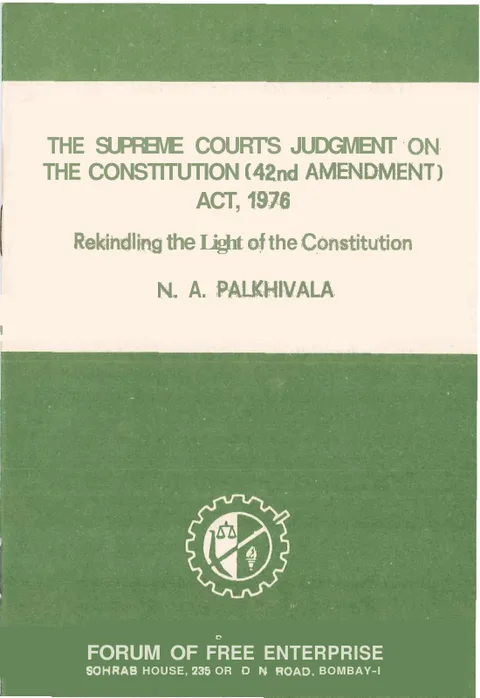
The Light of the Constitution
Published by M. R. PAI for the Forum of Free Enterprise, 235, Dr. Dadabhai Naoroji Road, Bombay-400 001, and printed at TATA PRESS Ltd., 414, Veer Savarkar Marg, Prabhadevi, Bombay 400 025. · Bombay · 1976
13 pages
The Light of the Constitution
By N. A. Palkhivala
Summary
‘The Light of the Constitution’ is N. A. Palkhivala’s eve-of-debate critique of the Constitution (Forty-fourth Amendment) Bill 1976 — the sweeping measure enacted during the Emergency as the Forty-second Amendment — reprinted by the Forum of Free Enterprise from his Indian Express article of 22 October 1976. Palkhivala notes that the Prime Minister’s professed wish for a ‘free and open public debate’ and a ‘study in depth’ has gone unfulfilled, and sets the limited aim of exposing the contradiction between the ‘fundamental duties’ the Bill seeks to impose and the Bill’s own provisions. He argues that the duty to develop ‘the scientific temper’ and ‘the spirit of inquiry’ would itself rule out hasty changes to the basic structure of the Constitution under emergency conditions, while the duty ‘to cherish and follow the noble ideals which inspired our national struggle for freedom’ is irreconcilable with stripping away the human freedoms in Articles 14, 19 and 31.
To establish those ‘noble ideals’, Palkhivala traces the long Indian demand for inalienable fundamental rights: the Constitution of India Bill 1895 (associated with Lokamanya Tilak), the Commonwealth of India Bill 1925 (in which Annie Besant played a part), the Nehru Report’s nineteen rights, and the 1945 Sapru Committee’s insistence on rights as a standard of conduct for legislatures, government and courts. He invokes the Constituent Assembly debates to show the founders treated fundamental human freedoms as permanent and inalienable, and as a guard not only against executive but against legislative aggression.
Palkhivala then itemises what he sees as the Bill’s gravest effects: it would make Parliament supreme over the Constitution (the instrument becoming the master), render fundamental rights non-justiciable, shatter the balance between executive, legislature and judiciary in favour of the central executive, and even allow enforcement of laws already held unconstitutional by the courts. Warning that ‘every major constitutional change represents a mood’ and that the present mood is unfit to weigh such mind-boggling consequences, he closes on Diwali, the festival of lights: as the lamps glimmer, ‘inexorable Time will be ticking away the remaining few days before the light goes out of the Constitution.‘
Key points
-
Palkhivala writes on the eve of Parliament taking up the Constitution (Forty-fourth Amendment) Bill 1976 — the measure enacted as the 42nd Amendment during the Emergency.
-
He notes the Prime Minister’s promised ‘free and open public debate’ and ‘study in depth’ never materialised.
-
The Bill’s own imposed ‘fundamental duties’ — the scientific temper, the spirit of inquiry, and cherishing the ideals of the freedom struggle — contradict its substantive provisions.
-
He traces the historic Indian demand for inalienable rights: the 1895 Constitution of India Bill (Tilak), the 1925 Commonwealth of India Bill (Annie Besant), the Nehru Report, and the 1945 Sapru Committee.
-
He argues fundamental rights guard against legislative as well as executive aggression, citing the Constituent Assembly debates.
-
The Bill’s four gravest effects: Parliament made supreme over the Constitution; rights made non-justiciable; the executive-legislature-judiciary balance shaken toward the central executive; and enforcement of laws even after they are held unconstitutional.
-
He closes with the Diwali image of the ‘light going out of the Constitution’.
-
Originally published as an article in The Indian Express, 22 October 1976.
Generated by the v1.5 extraction pipeline. Awaiting editorial review.
Metadata and summary are AI-extracted from the source PDF and reviewed for editorial accuracy. The original work is available via the Read PDF tab above (where present); paragraph-level citation inside the PDF is deferred to a future engagement.