speech · memorial lecture
The Public Sector — A Manager's Report
By Air Chief Marshal P. C. Lal
Forum of Free Enterprise, Piramal Mansion, 235, Dr. Dadabhai Naoroji Road, Bombay 400 001 · Bombay · 1976
32 pages
No. 11 in A. D. Shroff Memorial Lecture
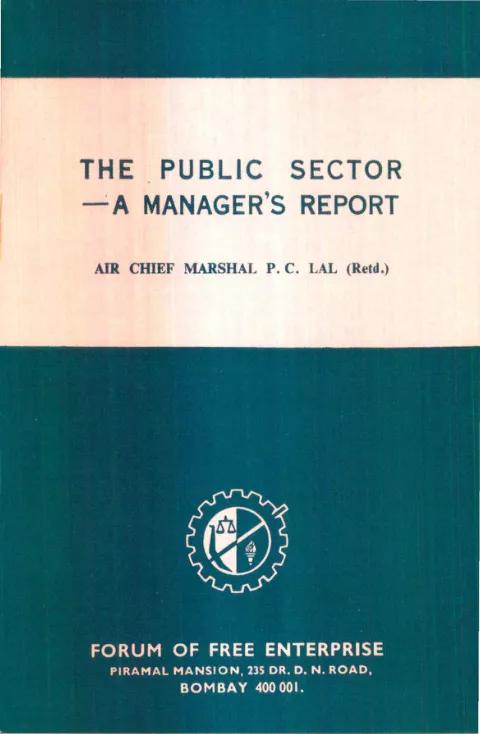
The Public Sector — A Manager’s Report
By AIR CHIEF MARSHAL P. C. LAL (Retd.)
Summary
This booklet is the text of the Eleventh A. D. Shroff Memorial Lecture, delivered by Air Chief Marshal P. C. Lal (Retd.) under the auspices of the Forum of Free Enterprise in Bombay on 4 November 1976. Lal, who had served as Chief of Air Staff and then run Indian Airlines and Hindustan Aeronautics, frames his talk explicitly as a manager’s report rather than a policymaker’s or economist’s verdict. He opens in memory of A. D. Shroff and credits the Forum’s president, Nani Palkhivala, for the invitation, then sets out to describe the major problems of the public sector as he has experienced them from the inside, disclaiming any intent to convert listeners for or against state ownership.
In the rendered pages Lal traces the historical roots of India’s public sector to the freedom movement’s goal of improving the common man’s economic condition, recalling the National Planning Committee under Nehru (of which Shroff was a member) and the rival Bombay, People’s, Gandhian and government plans. He presents aggregate statistics for 1970/71-1974/75 showing investment up about 55 per cent and net profit up fifteen-fold, arguing the public sector is now firmly established and ‘a force to reckon with’, even as it has been persistently criticised for inefficiency. He identifies characteristics peculiar to state-owned enterprises — the precedence of public need and national interest, nationalisation to control vital sectors like banking and insurance — that make them harder to manage than private firms.
The core of the rendered argument is managerial and human: Lal contends that the manager’s central duty is to build a sound working relationship with the labour force through personal integrity and fair, firm dealing rather than through labour legislation, and that excess manpower and productivity-sapping wage agreements inherited from the enterprises’ early years must be addressed. He sees encouraging signs in a younger generation of public-sector managers, better trained in modern techniques and more willing to work alongside workers on the shop floor. The lecture continues beyond the rendered pages.
Key points
-
Text of the Eleventh A. D. Shroff Memorial Lecture, Bombay, 4 November 1976.
-
Speaker P. C. Lal writes as a manager (ex-Indian Airlines, Hindustan Aeronautics), not as economist or policymaker.
-
Roots the public sector in the freedom movement and the Nehru-chaired National Planning Committee (with Shroff a member).
-
Cites 1970/71-1974/75 data: investment up ~55%, net profit up fifteen-fold, employment from 6.60 to 14.08 lakhs.
-
Argues the public sector is now well established and ‘a force to reckon with’ despite inefficiency criticism.
-
Notes characteristics peculiar to SOEs (public need first; nationalisation of banks, LIC) that complicate management.
-
Holds the manager’s chief duty is a sound labour relationship built on integrity, not labour legislation.
-
Flags inherited excess manpower and low-productivity wage agreements as a major problem.
-
Sees promise in a younger, better-trained generation of public-sector managers.
Generated by the v1.5 extraction pipeline. Awaiting editorial review.
Metadata and summary are AI-extracted from the source PDF and reviewed for editorial accuracy. The original work is available via the Read PDF tab above (where present); paragraph-level citation inside the PDF is deferred to a future engagement.