speech
The Union Budget, 1972-73
FORUM OF FREE ENTERPRISE, SOHRAB HOUSE, 235 DR. D. N. ROAD, BOMBAY-1 · Bombay · 1972
20 pages
Part of The Union Budget
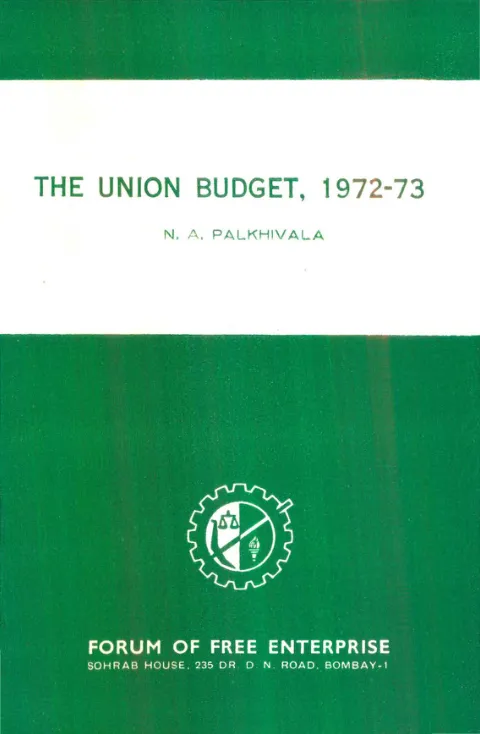
The Union Budget, 1972-73
By N. A. PALKHIVALA
Summary
Delivered in Madras on 1 April 1972 and published as a Forum of Free Enterprise booklet, N. A. Palkhivala’s address on the Union Budget for 1972-73 argues that the Government has squandered a rare ‘moment of absolute political stability’ — a post-victory euphoria and a huge parliamentary majority — by treading ‘the same old unimaginative path’. He frames the Budget against three tests: does it seize India’s moment of opportunity, will it meet the Planning Commission’s Fourth Plan objectives, and will it achieve economic growth with social justice? On each, he answers no. The combined burden of income-tax (up to 97.75%) and wealth-tax (up to 8%, plus 7% on urban property) is continued without abatement, amounting in his view to ‘annual confiscation’.
A central thread is the distinction between social justice and mere equality: social justice, he insists, demands adequate differentials for ability, effort and risk, and ‘it is impossible to have social justice without economic growth’. He marshals comparative and official evidence — the U.K.’s tax-cutting budget, the Wanchoo Committee’s recommendation to cut the top marginal rate to 75%, the Planning Commission’s own Mid-Term Appraisal on the corporate sector and falling savings, and economists W. H. Hutt, Michael Lipton and P. T. Bauer — to argue that punitive taxation depresses savings (national savings down from 11.1% in 1965-66 to 8.3% in 1970-71), starves investment and condemns India to the lowest growth among developing countries.
The second half turns constructive, offering concrete suggestions: mandatory public disclosure of political donations and repeal of the Companies Act ban on corporate political giving; lowering corporate tax with offsetting cuts to inflated Plan provisions; ending the ‘patently unfair’ near-exemption of agricultural income (agriculture yields Rs. 16,000 crores but pays only Rs. 13 crores in tax) by having States legislate under Article 252; and abandoning the public/private dichotomy in favour of a single ‘national sector’ judged only by efficiency and honesty. He closes with Galbraith’s observation that the principal enemy of public enterprise is now the socialists themselves, and the aphorism that while ‘there is richness in our poverty, there is poverty in our socialism’. The booklet is complete in the rendered pages and ends with an A. D. Shroff epigraph and the FFE colophon.
Key points
-
The 1972-73 Budget squandered a rare moment of political stability and post-1971-victory euphoria by following ‘the same old unimaginative path’.
-
Palkhivala judges the Budget against three tests — seizing India’s opportunity, meeting Fourth Plan objectives, and growth with social justice — and finds it failing all three.
-
Income-tax up to 97.75% and wealth-tax up to 8% (15% on urban property) are continued, amounting to annual confiscation of income and wealth.
-
Social justice is distinguished from mere equality: it requires differentials for ability and effort, and is impossible without economic growth.
-
Evidence is marshalled from the Wanchoo Committee (recommending a 75% top rate), the Planning Commission’s Mid-Term Appraisal, the U.K.’s tax-cutting budget, and economists Hutt, Lipton and Bauer.
-
National savings fell from 11.1% (1965-66) to 8.3% (1970-71); high taxation is named the prime cause of stagnating investment and growth.
-
Constructive proposals: disclosure of political donations, lower corporate tax offset by trimmed Plan outlays, taxing agricultural income via Article 252, and a single efficiency-judged ‘national sector’.
-
Closes with Galbraith on socialists as the enemy of public enterprise and the line ‘there is richness in our poverty, there is poverty in our socialism’.
Generated by the v1.5 extraction pipeline. Awaiting editorial review.
Metadata and summary are AI-extracted from the source PDF and reviewed for editorial accuracy. The original work is available via the Read PDF tab above (where present); paragraph-level citation inside the PDF is deferred to a future engagement.