edited volume · anthology
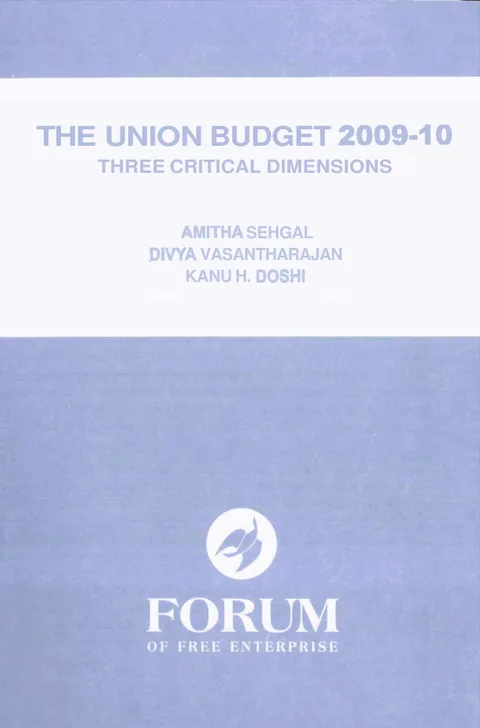
The Union Budget 2009-10
Three Critical Dimensions
Edited by Sunil S. Bhandare
Published by S. S. Bhandare for the Forum of Free Enterprise, Peninsula House, 2nd Floor, 235, Dr. D. N. Road, Mumbai 400001, and Printed by S. V. Limaye at India Printing Works, India Printing House, 42 G. D. Ambekar Marg, Wadala, Mumbai 400 031. · Mumbai · 2009
19 pages
Part of The Union Budget
The Union Budget 2009-10
Summary
This Forum of Free Enterprise booklet, edited by Sunil S. Bhandare, gathers three presentations on the Union Budget for 2009-10 — the first budget of the newly re-elected Congress-led coalition — under the heading ‘Three Critical Dimensions’. Bhandare’s Editor’s Note frames the volume around the high expectations that the ‘Left being left out’ would let the government push aggressive long-pending reforms, and concedes the budget conveyed ‘different perspectives for different experts’. The three contributors approach the budget from complementary angles: Amitha Sehgal offers a macro-fiscal critique measuring the budget against the Planning Commission’s Vision 2020; Divya Vasantharajan reads the micro, sector-by-sector impact on the capital market; and the chartered accountant Kanu H. Doshi works through the direct-tax proposals clause by clause. Across the three, the booklet balances alarm over India’s mounting fiscal deficit and debt against cautious optimism about growth, employment and market revival.
Key points
-
Sunil S. Bhandare’s Editor’s Note frames the booklet around high expectations that the Congress-led coalition, with the Left ‘left out’, would push long-pending economic reforms in the 2009-10 budget.
-
Amitha Sehgal measures the budget against the Planning Commission’s Vision 2020 report and finds it flawed on fiscal deficit control and employment generation.
-
Sehgal flags a fiscal deficit heading toward 6.8 per cent of GDP, a combined Centre-state deficit near 13 per cent, and interest payments consuming 56 per cent of the fiscal deficit.
-
She credits sustained capital expenditure during the global meltdown but criticises NREGA wages for crowding out private farm labour and neglecting agricultural investment.
-
Divya Vasantharajan reads the equity markets as bullish on post-election political stability despite an initial fall on Budget day, 3 August, before recovery.
-
Vasantharajan maps sectoral winners including oil and gas under Section 80-IB, roads through a 23 per cent NHDP rise, and relief for white goods, housing, pharmaceuticals and textiles.
-
She predicts a bullish year for the capital market, forecasting the Sensex could return to 21,000 on rising FII inflows and disinvestment signals.
-
Kanu H. Doshi’s clause-by-clause review of the Finance (No.2) Bill, 2009 covers the raised basic exemption to Rs 1,60,000, abolition of the Fringe Benefit Tax, and the Minimum Alternate Tax rise to 15 per cent.
-
Doshi registers mixed feelings, welcoming the scrapped personal surcharge and FBT while regretting the retained 10 per cent company surcharge and 3 per cent education cess.
Essays
The Union Budget 2009-2010: Does It Dovetail With Vision 2020?
By Amitha Sehgal*
Amitha Sehgal asks whether the 2009-10 budget dovetails with the Planning Commission’s Vision 2020 report, opening with the claim that ‘a country needs to dream’ and invoking Lord Macaulay’s and the report’s framing of India’s latent greatness. Her macro-fiscal audit is sobering: a fiscal deficit headed toward 6.8 per cent of GDP (with combined Centre-state borrowing pushing the deficit toward 13 per cent), revenue deficit rising, interest payments consuming 56 per cent of the fiscal deficit, and tax-to-GDP ratios falling. She credits the government with sustaining capital expenditure during the global meltdown but argues the budget fails on employment generation — citing declining organised-sector jobs since the reforms, the centrality of SMEs (which generate the bulk of jobs internationally), and the limits of NREGA, whose wages she warns crowd out private farm labour. Her conclusion: the budget is ‘flawed on two major counts: huge debt and a lack of focus on generating meaningful employment’.
- Measures the budget against the Planning Commission’s Vision 2020 report and finds it short on employment and debt control.
- Flags a fiscal deficit toward 6.8% of GDP, combined Centre-state deficit near 13%, and interest payments at 56% of the fiscal deficit.
- Credits sustained capital expenditure during the global meltdown as a positive.
- Argues organised-sector employment has declined post-reform and SMEs are the real job engine.
- Criticises NREGA wages for crowding out private farm labour and neglecting livestock/agricultural investment.
Impact on Capital Market
By Divya Vasantharajan*
Divya Vasantharajan assesses the budget’s micro impact on the capital market, opening with an India past-performance table and budget-estimate breakdown. She reads the equity markets as bullish on post-election political stability even though, on Budget day (3 August), markets initially fell as a ‘major let down’ before recovering. Sector by sector she maps winners and losers: power and IIFCL refinancing draw a neutral verdict, oil and gas gains from extended Section 80-IB holidays, roads benefit from a 23 per cent NHDP rise, white goods and housing from customs and duty cuts, while pharmaceuticals, telecom, textiles and auto components each get targeted relief. Her optimistic close holds that good-monsoon hopes, disinvestment signals and rising FII inflows position the Indian capital market for a major revival in IPOs, mutual-fund NFOs and retail participation — predicting the next year ‘promises to be bullish for the capital market which may see the Sensex again at 21,000’.
- Reads equity markets as bullish on political stability despite an initial Budget-day fall on 3 August.
- Maps sectoral winners: oil & gas (Section 80-IB), roads (23% NHDP rise), white goods, housing, pharma, telecom, textiles, auto components.
- Treats power and IIFCL infrastructure refinancing as broadly neutral.
- Sees disinvestment signals, monsoon hopes and rising FII inflows driving a market revival.
- Predicts a bullish year ahead with the Sensex potentially returning to 21,000.
Direct Tax Proposals
By Kanu H. Doshi*
The chartered accountant Kanu H. Doshi provides a clause-by-clause summary of the budget’s direct-tax proposals under the Finance (No.2) Bill, 2009, framing them as an effort to lower the burden on individual taxpayers by raising the basic exemption, introduce a presumptive scheme for small businesses, encourage foreign investment, and simplify dispute resolution and TDS. He details the revised slabs (basic exemption raised to Rs.1,60,000, with higher thresholds for women and senior citizens), the unchanged 30 per cent company rate, the abolition of the Fringe Benefit Tax and its replacement under new section 115WM, the raised Minimum Alternate Tax rate to 15 per cent under section 115JB, the enlarged section 80-E education-loan deduction, wealth-tax threshold changes, the new statutory definition of ‘manufacture’ (section 2(29BA)), and LLP-conversion provisions. His conclusion registers ‘a mixed feeling of some joy, some disappointment and some hope’ — joy at the abolition of the 10 per cent personal surcharge and FBT, disappointment at the continued 10 per cent company surcharge and 3 per cent education cess, and hope for a Direct Tax Code and the reintroduction of the SARAL return form.
- Walks through the Finance (No.2) Bill, 2009 direct-tax proposals: aimed at lowering individual burden, aiding small business and foreign investment.
- Basic exemption raised to Rs.1,60,000 (higher for women and senior citizens); 30% company rate retained.
- Fringe Benefit Tax abolished (new section 115WM); Minimum Alternate Tax raised to 15% under section 115JB.
- New statutory definition of ‘manufacture’ (section 2(29BA)), enlarged section 80-E and weighted R&D deduction provisions.
- Mixed verdict: joy at surcharge/FBT abolition, disappointment at continued company surcharge and education cess, hope for a Direct Tax Code and SARAL’s return.
Generated by the v1.5 extraction pipeline. Awaiting editorial review.
Metadata and summary are AI-extracted from the source PDF and reviewed for editorial accuracy. The original work is available via the Read PDF tab above (where present); paragraph-level citation inside the PDF is deferred to a future engagement.