pamphlet
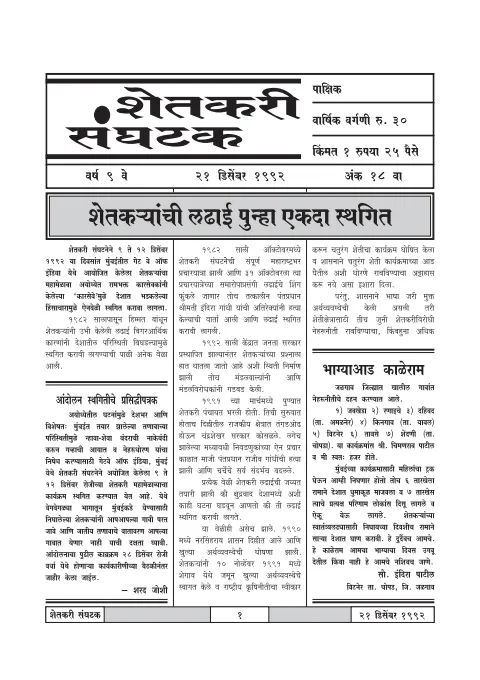
Shetkari Sanghatana
Visionaries of a new Bharat
Shetkari Sangathna, Angarmala Vill. & Po: Ambethan, Tal. Khed, Distt: Pune-410501, Maharashtra, India · Ambethan, Tal. Khed, Pune, Maharashtra
13 pages
Shetkari Sanghatana
Summary
This English-language promotional booklet profiles the Shetkari Sanghatana (SS), the Maharashtra-based farmers’ organisation founded in the late 1970s by Sharad Joshi, presenting its history, ideology and policy positions to a general readership. It opens with a capsule history of farmers’ movements in India, tracing rural poverty from the British-era Zamindari and Ryotwari systems through post-independence ‘low-cost economy’ policies that, in the SS reading, deliberately depressed agricultural prices to subsidise urban industrialisation. Against this backdrop it describes the ‘new agrarian mobilization’ of the early 1980s, in which SS and allied bodies under the Kisan Co-ordination Committee led mass agitations around a single demand: remunerative prices and freedom of access to markets and technology.
The booklet’s argumentative centre is Sharad Joshi’s theory of the ‘Bharat-India’ divide, which recasts the country’s primary contradiction not as a geographic town-versus-country split but as one between ‘Bharat’ (the exploited rural and unorganised sector) and ‘India’ (a ‘westernized industrial bureaucratic elite’ inheriting colonial patterns of exploitation). From this premise the SS derives a thoroughly market-liberal programme: it rejects the pastoral romanticisation of village life, attacks the Agricultural Produce Marketing Committees, the Commission for Agricultural Costs and Prices, the Food Corporation of India and the Public Distribution System as instruments of exploitation, and champions free domestic and international trade, foreign direct and institutional investment, WTO multilateral-trade rules, disinvestment of public-sector units, and farmers’ rights over property and technology.
Later sections set out the SS view on farmers and intellectual property rights — welcoming the dismantling of the ‘license-permit Raj’, subsidies and trade restrictions, and arguing farmers should be free to access frontier agricultural technology — and survey ‘challenges in the future’, including biotechnology and bio-fuels (bio-Diesel from sugar cane, sugar beet and molasses), Special Economic Zones, the right to sell or retain farmland, and the threat that global-warming-driven ‘precautionary’ regulation could restrict agricultural innovation. Throughout, the text invokes degrees of freedom — the number, range and novelty of choices available to individuals — as the measure of a community’s quality of life. The full thirteen-page booklet was rendered; it carries no author byline, editor, or printed year, and lists only a Shetkari Sangathna postal address (Ambethan, Pune) for further enquiries.
Key points
-
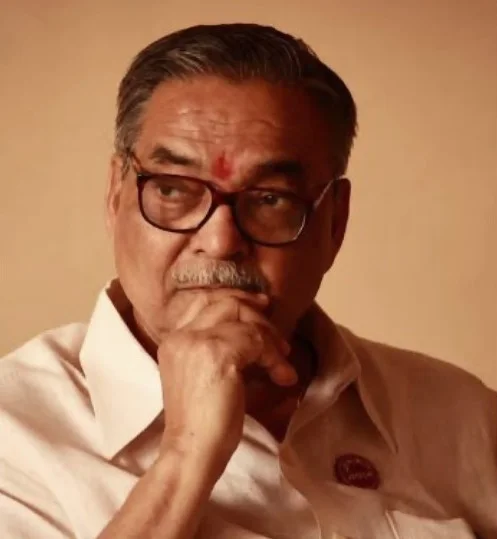
Organisational profile of the Shetkari Sanghatana (SS), the Maharashtra farmers’ organisation founded c.1978 by Sharad Joshi.
-
Frames Indian rural poverty as the product of deliberate ‘low-cost economy’ policies that depressed farm prices to fund urban industrialisation.
-
Centres on Sharad Joshi’s ‘Bharat vs India’ theory: the real contradiction is exploited rural ‘Bharat’ against a westernised elite ‘India’, not town vs country.
-
Single-point programme: remunerative prices for agricultural produce and freedom of access to markets and technology.
-
Attacks state market institutions — APMCs, CACP, FCI and the PDS — as instruments that exploit farmers.
-
Endorses a market-liberal agenda: free trade, FDI/FII, WTO rules, disinvestment of PSUs, and farmers’ property and technology rights.
-
Supports farmers’ access to frontier technology and IPR-protected innovation, opposing the ‘license-permit Raj’ and subsidies.
-
Future-facing sections cover bio-fuels, biotechnology, SEZs, land rights, and resistance to precautionary ‘Luddite’ regulation.
Generated by the v1.5 extraction pipeline. Awaiting editorial review.
Metadata and summary are AI-extracted from the source PDF and reviewed for editorial accuracy. The original work is available via the Read PDF tab above (where present); paragraph-level citation inside the PDF is deferred to a future engagement.