book · collected works
Warnings of History
Trends in Modern India
By K. M. Munshi
FORUM OF FREE ENTERPRISE, SOHRAB HOUSE, 235, D. NAOROJI ROAD, BOMBAY-1 · Bombay
35 pages

Warnings of History
By K. M. Munshi
Summary
K. M. Munshi’s Warnings of History is a six-essay pamphlet (Bombay: Forum of Free Enterprise, 1957) gathering Munshi’s mid-1950s warnings against the drift of independent India towards collectivism, state capitalism, and what he calls ‘modern despotism’. A. D. Shroff’s foreword frames the collection as a Forum-of-Free-Enterprise intervention against the ‘onslaught of collectivism and statism’ and the ‘emotion-mongering of politicians wedded to totalitarian ideologies’. The rendered chunk carries the full text of the first three essays and the opening of the fourth.
In the title essay ‘Warnings of History’ (pp. 7–17), Munshi argues that virile nations depend on three things — a common memory of heroic achievement, a will to unity, and a habitual urge to collective action — and that India’s eleven post-Independence years have squandered each: ‘a generation has now grown up which takes freedom for granted but draws no inspiration from the way it was won.’ He warns that planners impatient for economic self-sufficiency forget the historic dangers of materialism, regional and caste loyalties, and the seductive ‘Communist technique of coercing the masses to their way of living’. Spirituality, he insists, is not the antithesis of material advance but the inner discipline without which a struggling nation cannot rise.
‘Are We Failing Gandhiji?’ (pp. 18–23) accuses Congress India of substituting Bhakra Dams, steel mills and external ‘planned paradise’ for the Gandhian programme of self-purification, austerity and faith. Munshi reads Gandhiji as a teacher of multi-central life and self-restraint who would have rejected linguism, communalism and bureaucratic regimentation. ‘Despotism — Old and New’ (pp. 24–33, with an appendix) draws a sharp contrast between old despotism — physically coercive but limited by Dharma, Shastras, autonomous guilds and religious authority — and the modern totalitarian state, which controls ‘production, distribution and consumption of wealth’, regiments education and family, and ‘stifles religious activities by propagating the supremacy of materialistic aims’. Parliamentary democracy, he writes, is the ‘safe compromise’ but is increasingly exposed to swinging emergency powers and gradual elimination of private property.
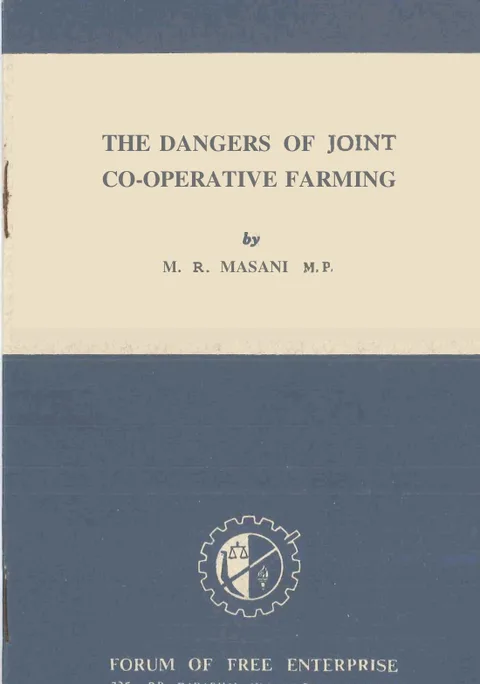
The opening pages of ‘Congress Objective and Co-operatives’ (pp. 35–37, rendered through p. 37) attack the Nagpur Resolution’s drive toward compulsory co-operative farming. Munshi argues that wherever co-operative farming has been tried — Yugoslavia, Russia, China — voluntary co-operation has failed and coercion has followed, while family farming with profit incentive and supporting services has actually delivered the production gains seen in Japan and Israel. The remaining two essays (‘Role of Legal Order in a Democracy’, ‘Crisis in Democracy’) were not in this chunk.
Key points
-
Frames the work as a Forum of Free Enterprise warning against state capitalism, with A. D. Shroff’s foreword positioning Munshi’s essays as a ‘realistic appraisal’ of collectivist proposals like co-operative farming and the erosion of the Rule of Law.
-
Argues nations rise on three factors — common memory of achievement, will to unity, and habitual urge to collective action — and that post-1947 India has weakened on all three under a ‘sterile educational policy’.
-
Treats spirituality (Aryavarta, Karma-Bhoomi) as a load-bearing source of national unity; warns that scoffing at it leaves only Communist coercion as a method of mass mobilisation.
-
Reads Gandhiji as a prophet of inner discipline and multi-central life and accuses Congress of replacing Gandhian self-purification with external symbols (Bhakra Dam, steel mills) and emotion-mongering against private enterprise.
-
Contrasts ‘old despotism’ — physically coercive but bounded by Dharma, autonomous guilds, religious authority, Vaishya Mahajans — with ‘modern despotism’ that exercises psychological coercion over education, media, marriage and family.
-
Names compulsory co-operative farming as the central danger of the Nagpur Resolution: it has failed in Yugoslavia and Russia, succeeded nowhere voluntarily, and would replace incentive with coercion.
-
Holds up Japan, Israel and U.S. family farming as evidence that profit incentive plus fertiliser, credit and storage support — not collectivisation — drives agricultural productivity.
-
Defends parliamentary democracy as a ‘safe compromise’ between laissez-faire and totalitarian statism, but warns that its survival depends on independent universities, press, judiciary and ‘multi-centric’ civil institutions.
Generated by the v1.5 extraction pipeline. Awaiting editorial review.
Metadata and summary are AI-extracted from the source PDF and reviewed for editorial accuracy. The original work is available via the Read PDF tab above (where present); paragraph-level citation inside the PDF is deferred to a future engagement.