speech
WE ARE HEADING TOWARDS A MAN-MADE ECONOMIC CRISIS
By A. D. Shroff
FORUM OF FREE ENTERPRISE "Sohrab House", 235, Dr. Dadabhai Naoroji Road, BOMBAY 1. · Bombay · 1957
4 pages
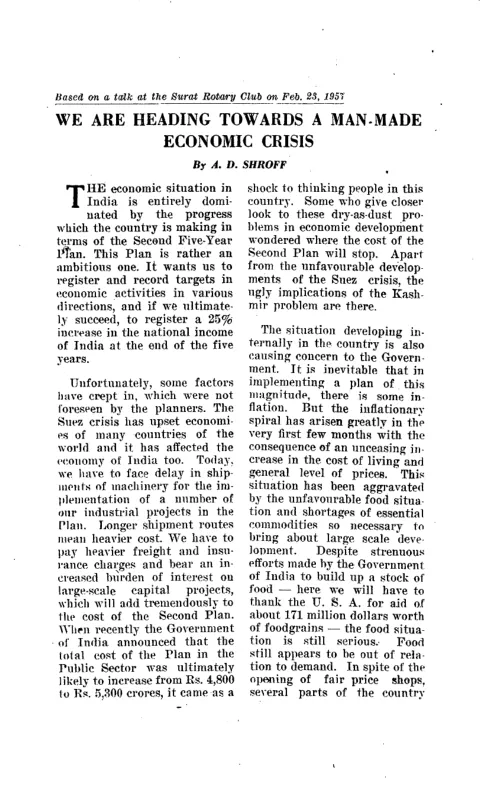
WE ARE HEADING TOWARDS A MAN-MADE ECONOMIC CRISIS
By A. D. Shroff
Summary
Based on a talk at the Surat Rotary Club on 23 February 1957, A. D. Shroff argues that India is sliding into a self-inflicted economic crisis whose ultimate cause is not the Suez disturbance or the loss of Kashmiri food supplies but the ambition and arithmetic of the Second Five-Year Plan itself. The Plan, originally pegged at Rs 4,800 crores and now likely to climb to Rs 5,300 crores, was framed without regard to either domestic resources or the foreign credit India could realistically raise, and its targets — a 25 per cent rise in national income within five years — have generated cost overruns, shipment delays, and shortages of steel and cement that are choking ordinary industrial activity.
Shroff catalogues the symptoms of a planning bureaucracy that has lost touch with economic reality: imported steel at Rs 615 per ton against Indian steel produced for Rs 293, currency notes pouring out of the Nasik Printing Press to sustain government spending, and a foreign exchange reserve drawn down from Rs 117 crores to Rs 8 crores, forcing him personally to negotiate a 127.5 million-dollar loan from the IMF at the Bretton Woods Conference. He warns that with only Rs 8 crores left, India will face a ‘very disturbing situation’ on foreign currency by 30 June, and that food prices are propped up only by 171 million dollars of US PL-480 grain.
The corrective Shroff prescribes is unglamorous: revise the Plan, cut the coat according to the cloth, and stop pretending that statutory enactments can suspend the laws of economics. The framers of the Plan and the ‘sponsors of the ideology of socialistic pattern of society’, he says, have ignored how economies actually behave; laws of supply, demand and scarcity are now asserting themselves and no Parliament resolution or ministerial speech in Delhi can override them. The pamphlet closes — in a deliberate piece of editorial framing by the Forum of Free Enterprise — with a Nehru quotation about not sacrificing ‘the spirit of man’ to the production of material goods, turning the Prime Minister’s own words into a brief against his Plan.
Key points
-
Shroff names the Second Five-Year Plan, not the Suez crisis or Kashmir, as the root cause of India’s gathering economic distress.
-
Plan costs have already escalated from Rs 4,800 to Rs 5,300 crores because of delayed machinery shipments, higher freight, insurance and interest charges on large capital projects.
-
Indian-produced steel costs Rs 293 per ton against Rs 615 for imported steel — yet the Plan and its strain on the economy force India to keep importing at Rs 120 per ton even on cement and similar commodities.
-
The government is funding its outlays by running the Nasik Printing Press, even as banks face an acute shortage of credit — ‘water-water everywhere; but not a drop to drink.’
-
India’s foreign exchange reserve has fallen from Rs 117 crores to Rs 8 crores; Shroff himself, as Indian delegate at the Bretton Woods Conference, secured an IMF loan of 127.5 million dollars to bridge the gap.
-
Food situation is held up by 171 million dollars of US foodgrain support; without it prices would have risen further still.
-
Shroff frames the crisis as a clash between economic laws and political ideology — Parliament cannot legislate away scarcity, and ‘the laws of economics’ are beginning to reassert themselves on the socialistic pattern.
-
His prescribed remedy is to revise the Plan to match available domestic resources and realistic foreign credit, and to act with ‘honesty of conviction and moral courage’ once the elections are over.
Generated by the v1.5 extraction pipeline. Awaiting editorial review.
Metadata and summary are AI-extracted from the source PDF and reviewed for editorial accuracy. The original work is available via the Read PDF tab above (where present); paragraph-level citation inside the PDF is deferred to a future engagement.