speech
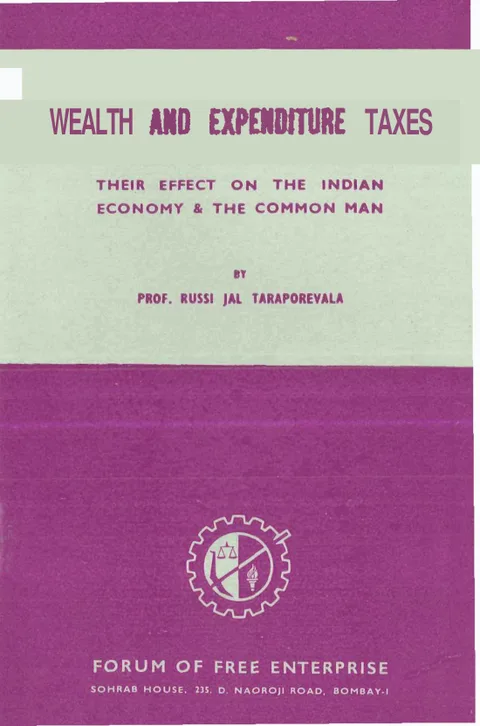
Wealth and Expenditure Taxes
Their Effect on the Indian Economy & the Common Man
FORUM OF FREE ENTERPRISE, SOHRAB HOUSE, 235, D. NAOROJI ROAD, BOMBAY-1 · Bombay · 1957
15 pages
Wealth and Expenditure Taxes
By Prof. RUSSI JAL TARAPOREVALA
Summary
Prof. Russi Jal Taraporevala’s pamphlet, drawn from public lectures delivered under the auspices of the Forum of Free Enterprise at the Indian Merchants’ Chamber in Bombay (19 August 1957) and at Wadia College Hall in Poona (27 August 1957), is a systematic attack on the wealth tax and expenditure tax introduced in the Government of India’s then-recent budget. Taraporevala argues that the two novel taxes, layered on top of already steep income tax and super tax, take the total direct and indirect tax burden beyond that of any previous Indian budget and amount, at higher slabs, to the outright confiscation of private capital and wealth. He builds the case in three movements — wealth tax, expenditure tax, effects on the common man — and repeatedly contrasts what the Finance Minister has done with what Nicholas Kaldor actually recommended in the Kaldor Report.
The wealth-tax chapters reconstruct, slab by slab, what the marginal rates do in combination with income and super tax: at gross incomes around Rs 32,000 with wealth around Rs 5 lakhs the regime begins to claw back capital, and beyond about Rs 22 lakhs of wealth the net effect is to confiscate the entire gross income plus roughly 0.54 per cent of capital each year. Taraporevala stresses that Kaldor had proposed the wealth tax as a substitute for the highest reaches of income and super tax, with the combined marginal burden capped at 45 per cent of gross income — a ceiling the Finance Minister has ‘flouted’ by piling the new taxes on top of the existing ones. Extending the wealth tax to companies, he argues, imposes double taxation on the same assets, hits small shareholders and middle-class savers who hold company securities, and threatens the corporate sector on whose retained earnings the Second Five-Year Plan depends.
The expenditure-tax chapters open by noting that the proposed personal allowance (Rs 30,000 for an assessee plus Rs 3,000 per coparcener for Hindu Joint Families, with capital exempt) is ‘far from liberal’ and that the levy is steeply progressive once crossed. Taraporevala records that members of the Select Committee — Dr. A. Krishnaswami, Mr. Minoo Masani and Maharaja Karni Singh of Bikaner — predicted that the tax would yield negligible revenue while inflicting major psychological dislocation, and that no other free-world country has been able to make such a tax administratively workable. The most ‘inhuman’ provision, he writes, is the absence of any exemption for expenditure on aged, disabled, unemployed or dependent relatives — turning the tax into a levy on the living expenses of the poorest sections supported by middle-class assessees.
The closing chapters argue that the combined taxes will choke saving and investment, drive away foreign investors and foreign technicians, encourage extravagant rather than thrifty spending, and threaten labour itself by making the State the sole employer — Taraporevala cites the Government’s handling of the Post and Telegraph strike as a warning. He concludes by urging that the wealth tax on individuals be retained only if income and super tax rates are sharply reduced (with a 45 per cent ceiling as Kaldor proposed, or an 80 per cent Swedish-style cap), that the wealth tax on companies be dropped outright, and that the expenditure-tax proposal be withdrawn; otherwise, he warns, the Finance Minister will force the country into ‘a gamble on its economic progress in which the odds appear heavily against success.‘
Key points
-
The 1957-58 Indian budget introduced two novel direct taxes — a wealth tax and an expenditure tax — on top of already heavy income and super tax, producing a total direct-tax burden heavier than any previous Indian budget and, the author argues, heavier than that of any country in the free world.
-
The Finance Minister has invoked Nicholas Kaldor’s Kaldor Report but has ‘flouted’ Kaldor’s central condition: Kaldor proposed the wealth tax as a substitute for the highest slabs of income and super tax, with a combined marginal cap of 45 per cent of gross income, rather than as an addition to them.
-
At gross incomes around Rs 32,000 and wealth around Rs 5 lakhs the combined regime begins to eat into capital; once net wealth exceeds about Rs 22 lakhs the regime confiscates the entire gross income plus roughly 0.54 per cent of capital annually.
-
Extending the wealth tax to companies (at a flat 0.5 per cent on assets above Rs 5 lakhs) imposes double taxation on the same assets — once via the company and again via shareholders — and was not recommended by Kaldor; the burden falls especially on small investors in public companies, whose holdings make up most of the corporate equity surveyed by the Reserve Bank of India in 1955.
-
The expenditure tax exemption — Rs 30,000 per assessee plus Rs 3,000 per coparcener for Hindu Joint Families — is ‘far from liberal’; the levy rises sharply to 100 per cent of net expenditure and provides no relief for sums spent on aged, disabled, unemployed or dependent relatives, an ‘inhuman’ feature absent from the Bill.
-
Members of the Select Committee on the Expenditure Tax Bill — Dr. A. Krishnaswami, Mr. Minoo Masani and Maharaja Karni Singh of Bikaner — in their Minutes of Dissent predicted the tax would yield negligible revenue while triggering psychological dislocation and harassment; no other free-world country, including Britain, the United States, Sweden and other European nations, has found such a tax administratively workable.
-
Statistical evidence from the Federation of Indian Chambers of Commerce and Industry and from the Office of the Controller of Capital Issues already shows a sharp post-November 1956 collapse in paid-up capital growth and in new capital issues, which the author reads as proof that earlier tax burdens have begun to choke private investment; the new taxes will deepen the slowdown.
-
If the proposals stand, the country risks driving away foreign capital and foreign technicians, encouraging extravagant rather than thrifty spending, and making the State the sole employer — a danger the author dramatises with the Government’s coercive handling of the Post and Telegraph workers’ strike.
Generated by the v1.5 extraction pipeline. Awaiting editorial review.
Metadata and summary are AI-extracted from the source PDF and reviewed for editorial accuracy. The original work is available via the Read PDF tab above (where present); paragraph-level citation inside the PDF is deferred to a future engagement.