edited volume · anthology
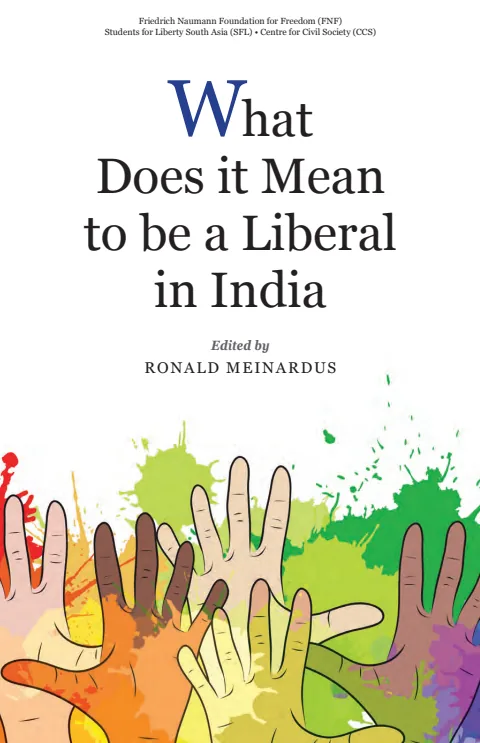
What Does it Mean to be a Liberal in India
Edited by Ronald Meinardus
Academic Foundation · New Delhi · 2016
142 pages
Part of CCS Publications
Summary
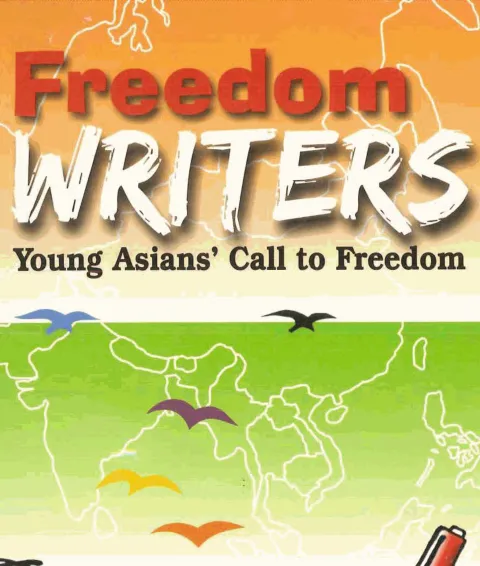
The book that came out of an essay competition. Ronald Meinardus, then regional director for South Asia at the Friedrich Naumann Foundation for Freedom, set young Indians the question in his own title and published the best answers, working with Students for Liberty South Asia to reach entrants and with the Centre for Civil Society as the institutional partner. The result is nineteen essays by writers mostly in their late teens and twenties, published by Academic Foundation in 2016.
Meinardus explains the motive in his introduction, and it is partly a puzzle. India is the largest democracy on earth and has no liberal party or major liberal political force. He has served the Foundation in Germany, Egypt, the Philippines, South Korea and Greece, and has found that liberal priorities take a different shape in each place while the belief in the primacy of individual freedom holds across all of them. What he wanted to know was what that belief looks like from inside contemporary India, described by people young enough to have grown up after liberalisation.
The essays answer in very different registers. Kalyani Subbiah writes on sexual illiberalism in Indian society, Karthik Shankar as a disgruntled liberal, Cherryy Chauhan on liberal hypocrisy, Harish Alagappa on the decline and fall of Indian liberalism, and Prakhar Misra on what he calls the Lucifer effect. Vageesha Sushan defends freedom of expression by distinguishing liberty from liberalism; Vaishnavi Ray writes a letter to the first person singular. Several are confessional rather than argumentative, and the collection is the more valuable for it: a record of what the word meant to a particular Indian generation at a particular moment.
Key points
- The volume collects nineteen essays written for a competition run by the Friedrich Naumann Foundation for Freedom, in partnership with Students for Liberty South Asia and the Centre for Civil Society.
- Ronald Meinardus conceived and edited it, and says so plainly: the idea for the competition and the book was his own.
- His framing question is why India, the largest democracy in the world, has no liberal party or major liberal political force.
- The contributors are young, most in their late teens and twenties, and several were students at the time of writing.
- The essays range from sexual illiberalism and liberal hypocrisy to the defence of free expression and the decline of organised Indian liberalism.
- Meinardus argues from his own postings in Germany, Egypt, the Philippines, South Korea and Greece that liberal agendas differ by society while the primacy of individual freedom does not.
- The collection is best read as evidence of what liberalism meant to a generation that grew up after 1991 rather than as a statement of doctrine.
Metadata and summary are AI-extracted from the source PDF and reviewed for editorial accuracy. The original work is available via the Read PDF tab above (where present); paragraph-level citation inside the PDF is deferred to a future engagement.