
pamphlet
Your Prosperity Through Freedom
By M. R. Pai
Printed and Published By L. A. Miranda At The Jagdishwar Printing Press, Gaiwadi, Bombay - 4. Produced in collaboration with the Forum of Free Enterprise, 235, Dr. D.N. Rd., Post Box 48-A, Bombay-1. A Beacon Publication. · Bombay
16 pages
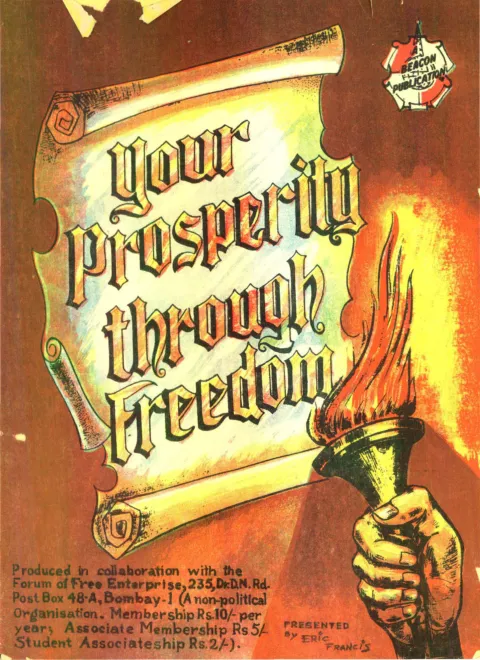
Your Prosperity Through Freedom
By M. R. Pai
Summary
An illustrated free-enterprise primer scripted by M. R. Pai for the Forum of Free Enterprise (issued as a Beacon Publication, with cartoon art by Eric Francis), the booklet uses coloured comic panels to make a popular case for what it calls “People’s Private Enterprise” or “Free Enterprise.” It opens by asking why people work, answering that work is a social necessity rooted in specialisation and the division of labour, a source of personal satisfaction, and a means to earn leisure and a life of human dignity. A. D. Shroff, President of the Forum, supplies a short foreword arguing that an informed public is the basis of a healthy democracy and that the illustrated medium is well suited to public education in economics.
The central argument contrasts three ways of organising production, distribution and exchange: entirely in private hands, entirely in government hands (which it labels “State Capitalism”), or a combination (“Mixed Economy”). It depicts state ownership as placing the state above the individual and stripping people of choice over their work, spending, purchases and leisure, illustrating the point with a quotation attributed to Leon Trotsky and an octopus figure of socialist controls. It contends that socialism, though it professes faith in individual freedom, achieves state capitalism through nationalisation, and marshals quotations from British Labour thinkers (Hugh Gaitskell, Anthony Crosland), Burma’s U Nu, the Italian communist Palmiro Togliatti, and Indian figures (Hanumanthaiya, Jayaprakash Narayan, S. G. Barve) to argue that socialists themselves were reconsidering nationalisation.
The booklet’s prescription is “people’s private enterprise regulated by the state” — free enterprise operating within reasonable rules laid down by democratically elected representatives, covering not just big industry but all trade, services, agriculture and the professions. It insists free enterprise is not opposed to planning, nor synonymous with big business or monopoly, but stands for competition among enterprises large and small. The government’s proper role, it argues, is to provide infrastructure (roads, ports, power, transport, hospitals, schools), a simple and fair administration, sound institutions and a stable currency, and to keep taxes low. The closing pages tie equality of opportunity, prosperity and freedom to free enterprise, and a final page reproduces a Mahatma Gandhi passage warning against increases in the power of the state.
Key points
-
An illustrated FFE pamphlet (Beacon Publication) scripted by M. R. Pai, art by Eric Francis, making a popular case for free enterprise.
-
Foreword by A. D. Shroff, President of the Forum of Free Enterprise, frames the work as public economic education.
-
Argues people work out of social necessity (specialisation/division of labour), for satisfaction, and to earn leisure and human dignity.
-
Distinguishes private ownership, government ownership (‘State Capitalism’), and ‘Mixed Economy’ as the three modes of economic organisation.
-
Equates socialism’s nationalisation with state capitalism and the loss of individual choice and liberties.
-
Cites Western and Indian figures (Gaitskell, Crosland, U Nu, Togliatti, Hanumanthaiya, Jayaprakash Narayan, S. G. Barve) reconsidering nationalisation.
-
Prescribes ‘people’s private enterprise regulated by the state’ within democratic rules, not laissez-faire and not monopoly.
-
Assigns government a role in infrastructure, fair administration, sound institutions, stable currency and low taxes; closes with a Gandhi passage on the danger of state power.
Generated by the v1.5 extraction pipeline. Awaiting editorial review.
Metadata and summary are AI-extracted from the source PDF and reviewed for editorial accuracy. The original work is available via the Read PDF tab above (where present); paragraph-level citation inside the PDF is deferred to a future engagement.
People in this work
Related across the archive
 ExcerptYour Prosperity Through Freedom
- Primary workSocialism or State Capitalism
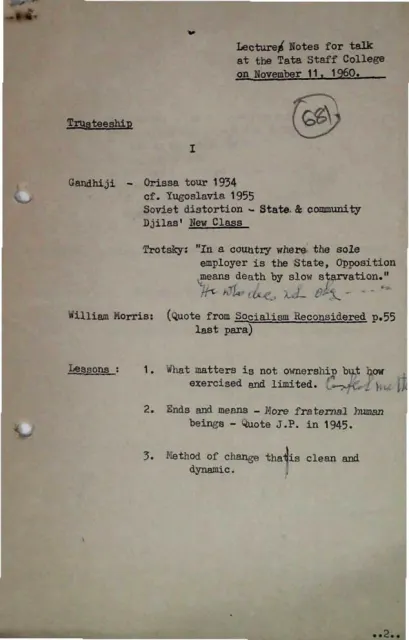 Primary workLectures Notes for talk at the Tata Staff College on November 11, 1960.
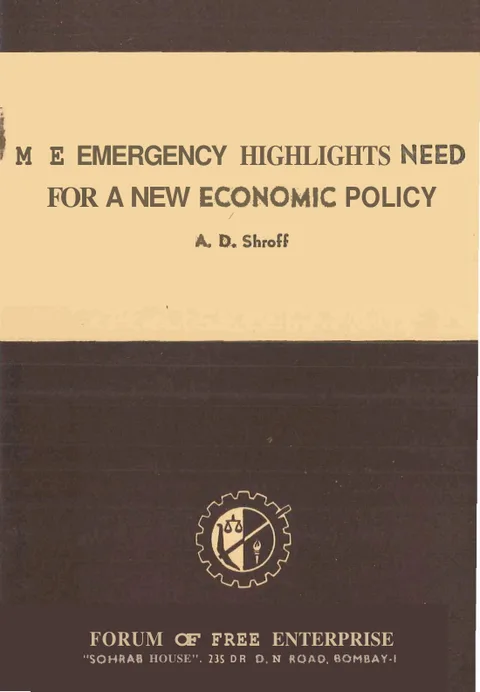 Primary workTHE EMERGENCY HIGHLIGHTS NEED FOR A NEW ECONOMIC POLICY
 ThePrintFree-enterprise features are reshaping Russia’s socialist institutions: AD Shroff