Summary
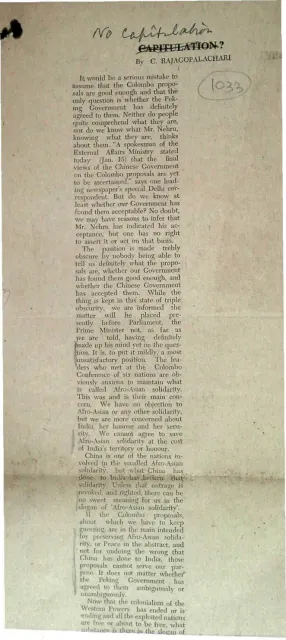
In this short newspaper column, C. Rajagopalachari attacks the drift he detects in New Delhi’s handling of the Colombo proposals that followed China’s 1962 aggression on the Indian frontier. He complains that neither the public nor Parliament has been told plainly what the proposals are, whether the Indian Government finds them acceptable, or whether Peking has actually agreed to them, and he refuses to read Nehru’s silence as a settled position. Behind the diplomatic fog, he argues, lies a serious question of national self-respect: the proposals, as far as anything is known of them, are aimed at preserving ‘Afro-Asian solidarity’ and abstract peace rather than at undoing the wrong China has done to India.
Rajaji then turns on the slogan of Afro-Asian solidarity itself. With Western colonialism gone and the once-exploited nations free or about to be free, he sees the slogan as nothing more than a cold war of ancient grudge against former masters — a racial grouse dressed up as principle and now serving as a handy instrument for the communist camp. India’s interest at this juncture, he insists, is its own independence, honour and status, not a solidarity that China has itself broken by invading Indian territory. To negotiate on Chinese terms in the name of that solidarity would reduce India to a permanent satellite of Peking, in the position of Poland or Hungary under Russia, with no hope of matching China in military or industrial power. His remedy is bluntly stated: resist China with the support of the anti-communist Powers of the West and let genuine neighbourliness follow from mutual and balanced respect, rather than surrender India’s honour and future by accepting terms offered under the advice of the Colombo nations while China is flushed with victory.
Key points
- Rajaji objects that the Government has not disclosed the substance of the Colombo proposals, whether India accepts them, or whether China has actually agreed to them, leaving Parliament and the public in triple obscurity.
- He refuses to treat Nehru’s cautious posture as settled acceptance, noting the Prime Minister has, so far as reported, not definitely made up his mind on the question.
- He recasts ‘Afro-Asian solidarity’ as a cold war of ancient grudge against former colonial masters — a racial grouse that has become a handy instrument for the communist camp.
- He asserts that India’s paramount concern is its own independence, honour and security, and that these cannot be traded for a solidarity that China itself has broken by aggression on Indian territory.
- He warns that negotiating on China’s terms would reduce India to permanent satellite status, comparable to Poland or Hungary under Russia, with no military or industrial hope of matching China alone.
- He argues that the only way out is to resist Chinese pressure with the support of the anti-communist Powers of the West, letting peace and neighbourliness follow from balanced mutual respect.
- He treats accepting terms brokered by the Colombo nations while China is ‘flushed with victory’ as a surrender of India’s honour and future and an acceptance of Chinese hegemony in Asia.
Metadata and summary are AI-extracted from the source PDF and reviewed for editorial accuracy. The original work is available via the Read PDF tab above (where present); paragraph-level citation inside the PDF is deferred to a future engagement.