Summary
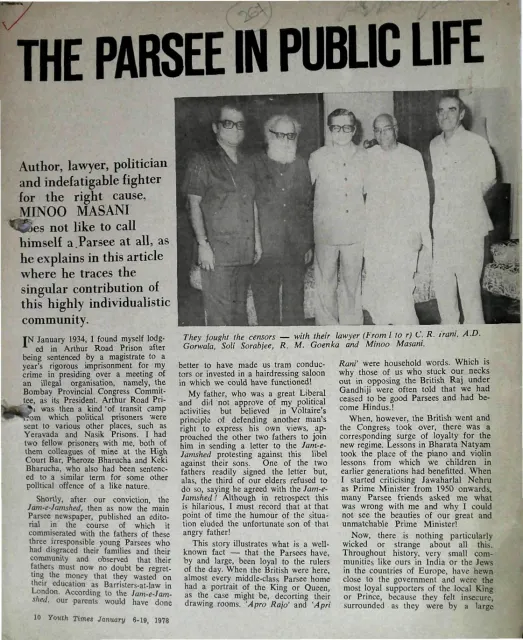
In the rendered pages, Minoo Masani presents the Parsee community as unusually individualistic, politically active, and committed to public life, while resisting the idea that he should be defined primarily by religious identity. He recalls his imprisonment in 1934 for presiding over a Bombay Provincial Congress Committee meeting, his family’s defence of free expression, and the community’s shifting relationship with British rule, Congress, and post-Independence governments. His account stresses loyalty to India over ethnic chauvinism and rejects using Parsee identity as an electoral argument.
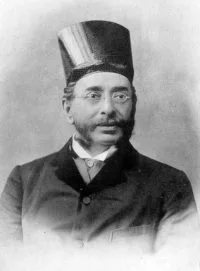
In the rendered pages, Masani links Parsee public service to liberal institutions: economic enterprise, journalism, law, parliamentary representation, and civil-liberties advocacy. He surveys figures including Dadabhai Naoroji, Pherozeshah Mehta, Dinshaw Wacha, Jamshedji Tata, A. D. Gorwala, Soli Sorabjee, and others, arguing that the community’s contribution has extended from industry and municipal politics to the defence of a free press. The visible article ends with a broader claim that bourgeois social groups can serve as a bulwark of civil liberties, provided they continue to produce dissenters and “occasional maverick[s].”
Key points
- Masani recounts his 1934 imprisonment for presiding over a Bombay Provincial Congress Committee meeting.
- He describes his family’s defence of the right to express unpopular views, including a dispute over the Parsee newspaper Jam-e-Jamshed.
- The article distinguishes loyalty to India from ethnic or religious chauvinism.
- Masani traces Parsee participation in public life through Dadabhai Naoroji, Pherozeshah Mehta, Dinshaw Wacha, and other figures.
- Industrial, legal, journalistic, musical, and civic achievements are presented as part of the community’s national contribution.
- The article highlights Parsee journalists and lawyers who resisted censorship during the Emergency.
- Masani argues that bourgeois communities can support civil liberties and freedom of expression.
- The visible pages do not establish the article’s final extent beyond printed page 13.
Metadata and summary are AI-extracted from the source PDF and reviewed for editorial accuracy. The original work is available via the Read PDF tab above (where present); paragraph-level citation inside the PDF is deferred to a future engagement.