periodical issue
Freedom First
A Quarterly of Liberal Ideas
By S. V. Raju, V. S. Srinivasa Sastri
Democratic Research Service, 4th floor, Maneckji Wadia Bldg., 127, Mahatma Gandhi Road, Bombay 400 023. Published by J.R. Patel for the Democratic Research Service and printed by him at Parsiana Publications Pvt. Ltd., 300 Perin Nariman Street, Bombay 400 001. · Bombay · 1992
52 pages
Freedom First
Summary
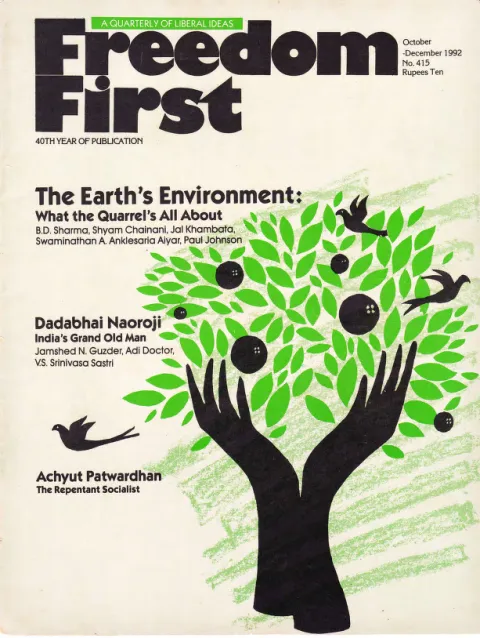
This is issue No. 415 (October–December 1992) of Freedom First, the Bombay-based quarterly of liberal ideas, in its 40th year of publication. In the rendered pages, the issue opens with editorial and topical commentary — an editors’ note on the Rio Earth Summit, a ‘With Many Voices’ page of press quotations, and a ‘Cabbages and Kings’ column on media hathos surrounding the Harshad Mehta scandal and on fiscal collapse in West Bengal and Kerala — followed by S.V. Raju’s piece challenging the Home Minister’s dismissal of human-rights abuses as ‘stray incidents,’ a three-part tribute to Dadabhai Naoroji marking the centenary of his election to the House of Commons (essays by Jamshed N. Guzder, Adi Doctor, and an excerpt from V.S. Srinivasa Sastri’s ‘Thumb-nail Sketches’), Minoo Masani’s regular opinion column, and the opening of the cover feature on the environment and the Rio summit, beginning with Chief Seattle’s 1854 letter and a report on the World Bank’s independent (‘Morse Committee’) review of the Sardar Sarovar/Narmada River project.
Key points
-
S.V. Raju’s editorial “‘Stray Incidents’ Did You Say, Mr. Home Minister?” rebuts Home Minister S.B. Chavan’s dismissal of human-rights abuses, citing playwright Vijay Tendulkar’s public-interest petition and specific police-brutality cases to argue Amnesty International’s criticism has substance.
-
Jamshed N. Guzder’s biographical tribute traces Dadabhai Naoroji’s life from founding girls’ schools in 1849 Bombay through his 1892 election as the first Indian MP in the British House of Commons to his mentorship of a young Gandhi in South Africa.
-
Adi Doctor’s “Dadabhai — The Secular Nationalist” contrasts Naoroji’s secular, rights-based nationalism against the religio-spiritual nationalism of Tilak and Aurobindo, and explains his “drain of wealth” theory of British extraction from India.
-
V.S. Srinivasa Sastri’s reprinted “Dadabhai in the House of Commons” recounts Naoroji’s narrow three-vote 1892 election victory and his parliamentary work on simultaneous ICS examinations and the Welby Commission on Indo-British finances.
-
Minoo Masani’s column praises Captain Lakshmi of the INA for refusing a Quit India commemorative award, supports a separate Jharkhand state for Adivasis, and condemns Iran’s persecution of the Baha’i community.
-
The cover feature on the environment opens with Chief Seattle’s 1854 letter and reports on the World Bank’s independent “Morse Committee” review finding the Sardar Sarovar Narmada project’s resettlement programme inadequate, accompanied by Medha Patkar’s “Narmada Action Alert.”
Essays
’Stray Incidents’ Did You Say, Mr. Home Minister?
By S.V. Raju
S.V. Raju’s editorial rebuts Union Home Minister S.B. Chavan’s September 1992 claim that India has rule of law and that reported abuses are merely ‘stray incidents.’ Raju argues that four decades of Congress rule produced a bureaucracy, including the police, that serves ruling-party interests rather than citizens’ rights, and catalogues specific cases (a public interest petition by playwright Vijay Tendulkar, and police brutality incidents involving Rajiv Agrawal, B.L. Miranda, Baburao Jadhav, and Dilip D’Souza) as well as further ‘stray incidents’ — CBI mistreatment of a bank official, torture of a Lucknow jailer’s family, and an armed police raid on a Bombay family — to argue that Amnesty International’s criticism of India’s human rights record has substance.
- Home Minister S.B. Chavan told The Times of India (Sept 27, 1992) that India would not tolerate Amnesty International’s claim there is no rule of law, conceding only ‘stray incidents.’
- Raju argues 40 of India’s 45 post-independence years have been ruled by Congress, whose bureaucracy (including police) grew a ‘cozy relationship’ with political masters.
- Playwright Vijay Tendulkar filed a Bombay High Court petition asking for an independent body to investigate police complaints, citing four specific Bombay cases of police violence.
- Additional ‘stray incidents’ recounted: brutal beating of a truck driver by a sub-inspector; assault of a bank executive by CBI officers seeking kickback information; torture of a Lucknow deputy jailer and threats against his family; an armed police raid on a middle-class Bombay family’s home.
- Raju concludes that barring Amnesty International from India is ‘silly if not idiotic’ given this record.
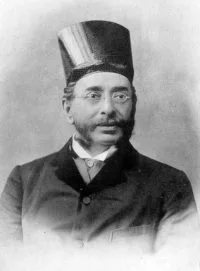
Dadabhai Naoroji: Grand Old Man of India
By Jamshed N. Guzder
Jamshed N. Guzder’s biographical tribute traces Dadabhai Naoroji’s life from his childhood as the son of a poor Parsi priest through his education at Elphinstone Institute, his pioneering work founding girls’ schools in Bombay in 1849, his career in London as manager of the Cama brothers’ firm and professor of Gujarati at University College London, his role in Bombay Municipal Corporation and the founding of the Indian National Congress, his election to the British House of Commons in 1892 as the first Indian MP, his mentorship of a young Gandhi in South Africa, and his death in 1917.
- Naoroji’s father died when he was four; his mother sent him to the Native Education Society School, and he later attended Elphinstone Institute.
- In 1849, at age 24, Naoroji helped found Bombay’s first school for girls, recruiting 44 Parsi and 24 Hindu students despite parental resistance.
- He managed the Cama brothers’ London firm from 1855, coined the phrase ‘India for Indians,’ and founded the London Zoroastrian Association in 1861.
- He was a founder of the Indian National Congress (1885) and was elected the first Indian Member of the British House of Commons for Central Finsbury in 1892.
- He guided a young Mahatma Gandhi during Gandhi’s early years in South Africa, corresponding regularly and advising him.
- He died on 30 June 1917; Sir Narayan Chandavarkar’s tribute is quoted at length.
Dadabhai — The Secular Nationalist
By Adi Doctor
Adi Doctor contrasts Dadabhai Naoroji’s secular nationalism, which viewed the state as a collectivity of individuals with rights, against the religio-spiritual nationalism of Tilak, Aurobindo, and Dayanand Saraswati, which imagined the nation as a divine, maternal shakti. The essay traces Naoroji’s constitutionalism (his insistence on Britain’s own pledged rights to Indian subjects), his ‘drain of wealth’ theory arguing that British rule, unlike Mughal or Maratha rule, permanently extracted India’s wealth abroad, and his efforts to build a purely secular, unifying political-economic platform for the Congress that avoided divisive social and religious reform.
- Naoroji’s secular nationalism saw the state as a collectivity of persons with rights and institutions, contrasted with Tilak/Aurobindo’s mystical, shakti-based nationalism.
- Naoroji is called ‘the father of constitutionalism in India’ for consistently invoking Britain’s own royal proclamations and pledges to Indian subjects.
- His ‘drain of wealth’ theory held that British loot of India was continuous and irrecoverable, unlike Mughal/Maratha plunder which stayed within India.
- He proposed ending the drain via Indian-managed development, restructured financial relations with Britain, and a swadeshi movement.
- Naoroji sought a purely secular, political-economic unifying platform for Congress, opposing efforts to fold social/religious reform into Congress business to avoid communal splits.
- Gandhi’s 1938 foreword to Masani’s Naoroji biography is reproduced, describing Naoroji as a hero and fatherly advisor during Gandhi’s South Africa years.
Dadabhai in the House of Commons
By V.S. Srinivasa Sastri
This excerpt from V.S. Srinivasa Sastri’s 1946 ‘Thumb-nail Sketches’ narrates Dadabhai Naoroji’s campaign for the British House of Commons, including Lord Salisbury’s 1888 ‘black man’ gaffe that inadvertently won Naoroji sympathy, his narrow three-vote victory for Central Finsbury in 1892 as the first Indian MP, and his subsequent parliamentary work pressing for simultaneous ICS examinations in India and England and for the Welby Commission on Indo-British financial relations, before which Gokhale gave evidence.
- Lord Salisbury’s 1888 Edinburgh speech dismissively calling Naoroji ‘a black man’ backfired, drawing British sympathy for Naoroji’s cause.
- Naoroji was elected MP for Central Finsbury in 1892 by a majority of just three votes, earning the nickname ‘Narrow Majority.’
- A contemporary newspaper description portrays Naoroji as resembling ‘a cultivated English gentleman’ with ‘a large leaven of benevolence’ and formidable rhetorical skill.
- In 1893 Naoroji had Herbert Paul move a resolution for simultaneous ICS examinations in India and England, which passed in a sparsely attended ‘snatch vote’ (84 to 76).
- The Welby Commission was appointed to examine Indo-British financial relations; Gokhale, G. Subrahmanya Ayyar, Surendranath Banerjea, and Sir Dinshaw Wacha gave evidence, and Naoroji himself submitted to cross-examination as a Commission member.
- A closing letter from Naoroji to an ‘American disputant’ condemns Britain’s ‘destructive and dishonourable system of government’ in India.
The Masani Viewpoint
By Minoo Masani
In his regular column, Minoo Masani (the magazine’s founder) comments on several current topics: the hypocrisy of official ‘Quit India’ commemorations, praising Captain Lakshmi of the INA for rejecting a state award and criticising the concentration of wealth and resurgence of communalism; support for tougher action against Saddam Hussein following the Gulf War; concern over the persecution of Baha’is in Iran, referencing a Liberal International resolution; support for a separate Jharkhand state for Adivasis in Bihar, drawing on his own 1957 election experience; and a personal remembrance of his late friend Dr. John Marsh.
- Masani praises Captain Lakshmi of the INA for refusing a Quit India commemorative award, quoting her criticism of wealth concentration, communal disharmony, and casteism.
- Masani argues Saddam Hussein should have been removed during the Gulf War and criticises the ‘half-hearted’ post-war handling of Iraq.
- He cites a Liberal International Executive Committee resolution condemning Iran’s persecution of the Baha’i community and the execution of Bahman Samandari.
- Masani supports a separate Jharkhand state for Adivasis, recalling that he was elected to Parliament in 1957 largely with Adivasi support in a constituency with its own informal ‘ground rules.’
- He recalls his friendship with the late Dr. John Marsh, former Director of the Industrial Welfare Society and British Management Association, who visited India nearly twenty times.
The Earth’s Environment: What the Quarrel’s All About — I am a Savage and I Do Not Understand
By Chief Seattle
The cover feature on the environment opens (unattributed introductory framing) with a reprint of Chief Seattle’s celebrated 1854 letter to the US President on the interconnectedness of humans and nature and the folly of treating land as property, followed by a report (originally from Geotimes) on the World Bank-commissioned independent ‘Morse’ review of the Sardar Sarovar Projects on the Narmada River, which found the resettlement and rehabilitation program inadequate, environmental impacts unassessed, and recommended the Bank ‘step back’ from the project — accompanied by a boxed ‘Narmada Action Alert’ by Medha Patkar summarising the Morse Report’s findings and calling for international pressure to halt funding.
- Chief Seattle’s 1854 letter is reprinted in full, arguing land, air, animals, and humans are interconnected and cannot simply be bought and sold.
- The World Bank’s independent review of the Sardar Sarovar Projects, chaired by Bradford Morse with Thomas Berger as deputy, was released 18 June 1992.
- The review found resettlement and rehabilitation ‘not possible under prevailing circumstances’ and environmental impacts of the dam/canal project inadequately assessed.
- The Sardar Sarovar complex includes a 535-foot dam, 3,970-foot length, 47,000 miles of canals, would affect at least 240,000 people including submergence of 245 villages.
- Medha Patkar’s ‘Narmada Action Alert’ box summarises the Morse Report’s findings and calls readers to write to the World Bank, Indian government ministers, and MPs/MLAs to halt the project.
- A letter from Louisiana-based engineer Raphael Kazmann, reprinted as a preface, warns that sedimentation effects on a project of this scale, based on Missouri/Arkansas river experience, have likely not been properly accounted for.
Generated by the v1.5 extraction pipeline. Awaiting editorial review.
Metadata and summary are AI-extracted from the source PDF and reviewed for editorial accuracy. The original work is available via the Read PDF tab above (where present); paragraph-level citation inside the PDF is deferred to a future engagement.