speech
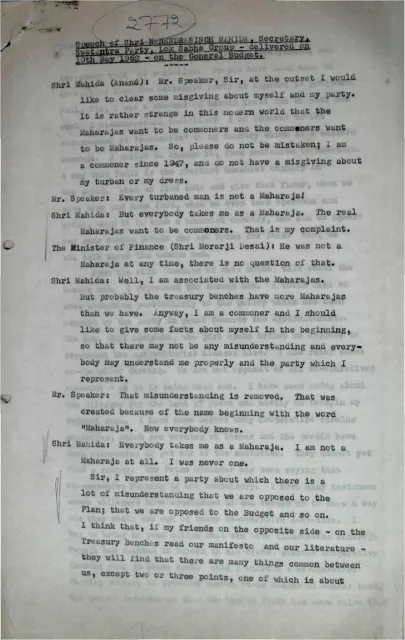
Speech of Shri NARENDRA SINGH MAHIDA, Secretary, Swatantra Party, Lok Sabha Group - delivered on 10th May 1962 - on the General Budget.
1962
8 pages
Summary
This eight-page transcript records Narendra Singh Mahida’s Lok Sabha speech of 10 May 1962 on the General Budget. Mahida begins by rejecting the perception that the Swatantra Party represents princes or wealthy interests, insisting that he is a “commoner” and that the party’s opposition to the government concerns policy rather than hostility to progress or to the common people. He distinguishes the party’s preferred “humanism” from the enforcement of socialism as a Western concept, and argues that poverty should be addressed through practical improvements in agriculture, education, and living standards.
Mahida criticises compulsory or financially burdensome cooperative farming, arguing that experiments should not be conducted at the people’s expense. He attacks the Congress government’s statist and socialist pattern, questions the losses and subsidies associated with public-sector enterprises, and calls for a mixed economy in which private enterprise can operate alongside the public sector. He also argues that education and agriculture deserve priority over heavy industry, citing budgetary comparisons, and objects to conspicuous official luxury while ordinary people lack food, clothing, and water. The speech closes by presenting the Swatantra Party as nationalist rather than reactionary, advocating political competition, national unity, and greater attention to the needs of farmers and the common man.
Key points
- Mahida rejects the characterization of the Swatantra Party as a party of princes or the rich and presents it as a representative of common people and agriculturists.
- He distinguishes his party’s opposition to imposed socialism from opposition to progress, describing his preferred alternative as a humanist approach.
- He argues that cooperative farming should not be imposed and that the treasury, rather than villagers, should bear the cost of experimentation.
- He criticises Congress policy as increasingly statist and warns that excessive state control could lead the country to economic disaster.
- He supports a mixed economy with healthy competition between public and private enterprise.
- He urges the government to prioritise education and agriculture over heavy industry, citing spending on steel plants compared with primary education.
- He links budgetary policy to regional and rural concerns, including water shortages, tobacco and tea taxation in Gujarat, agricultural needs, and third-class railway passengers.
- He presents the Swatantra Party as nationalist, opposed to excessive state control, and committed to political competition and national unity.
Metadata and summary are AI-extracted from the source PDF and reviewed for editorial accuracy. The original work is available via the Read PDF tab above (where present); paragraph-level citation inside the PDF is deferred to a future engagement.