Summary
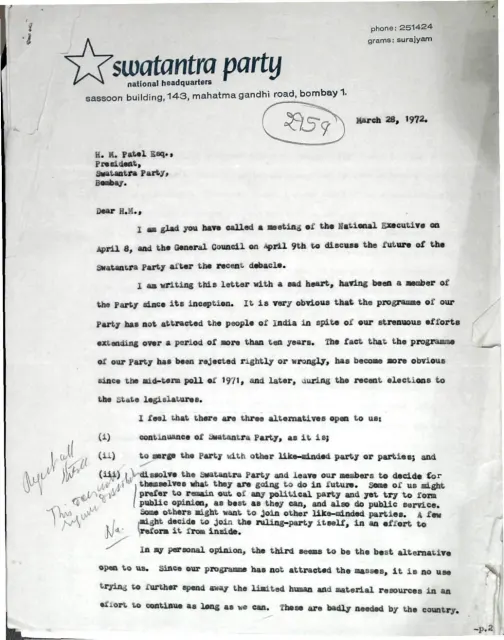
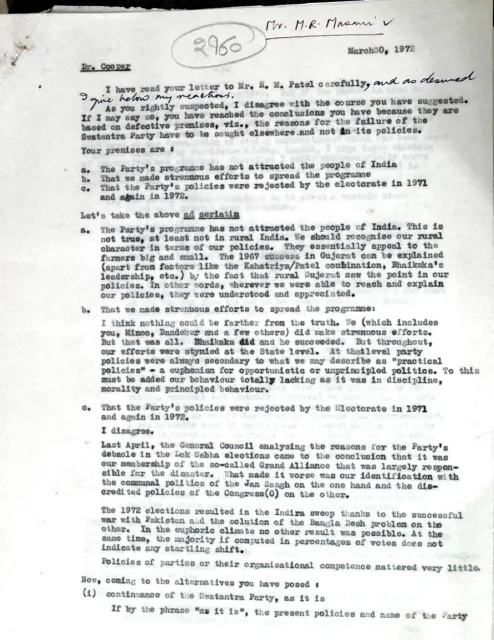
In this letter dated March 30, 1972, S. V. Raju responds to Dr. R. C. Cooper’s proposal concerning the future of the Swatantra Party after its poor electoral performance. Raju rejects the claim that the party’s programme failed to attract Indians, arguing that its policies appealed to rural voters wherever they were properly explained. He also disputes the claim that the party made strenuous efforts to spread its programme, attributing its weakness to state-level conduct, inadequate discipline, and the subordination of policy to short-term political considerations.
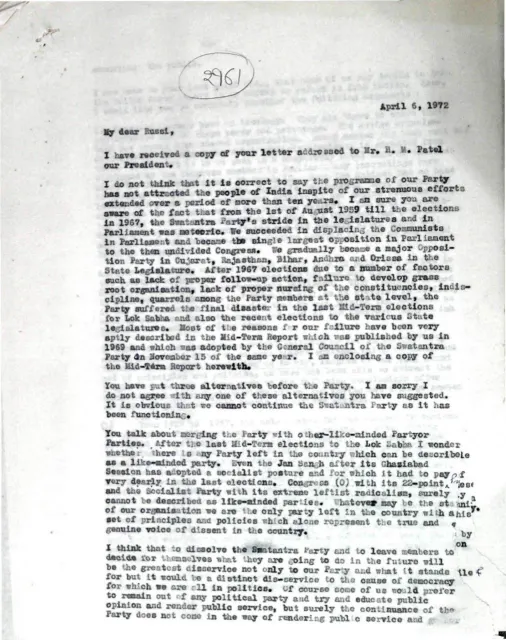
Raju argues that the 1972 election result reflected the emotional impact of India’s victory in the war with Pakistan and the Bangladesh crisis more than a rejection of Swatantra policies. He supports radical policy and organisational rethinking, including greater self-sufficiency, younger leadership, a stronger grassroots presence at polling-station level, and the use of peaceful agitation and public platforms. He rejects merging the party with other organisations and strongly opposes joining the Congress, presenting Swatantra as a necessary vehicle for individual liberty, initiative, enterprise, and reward, and warning that abandoning it would assist a drift toward dictatorship.
Key points
- Raju rejects the diagnosis that Swatantra Party policies were broadly unattractive, especially in rural India.
- He attributes the party’s organisational weakness to limited outreach, state-level opportunism, poor discipline, and insufficiently principled behaviour.
- He argues that the 1972 electoral outcome was chiefly shaped by the successful war with Pakistan and the Bangladesh crisis, not by a decisive rejection of Swatantra’s policies.
- He supports radical rethinking within the party framework, including policy changes that attract mass attention and greater financial self-sufficiency.
- He calls for younger leadership, stronger polling-station organisations, vigilance against corrupt electoral practices, and peaceful public agitation.
- He rejects merger with like-minded parties if it means abandoning Swatantra’s identity and opposes any merger with the Congress.
- He presents Swatantra as a political instrument for individual liberty, individual initiative, individual enterprise, and reward.
Metadata and summary are AI-extracted from the source PDF and reviewed for editorial accuracy. The original work is available via the Read PDF tab above (where present); paragraph-level citation inside the PDF is deferred to a future engagement.