Summary
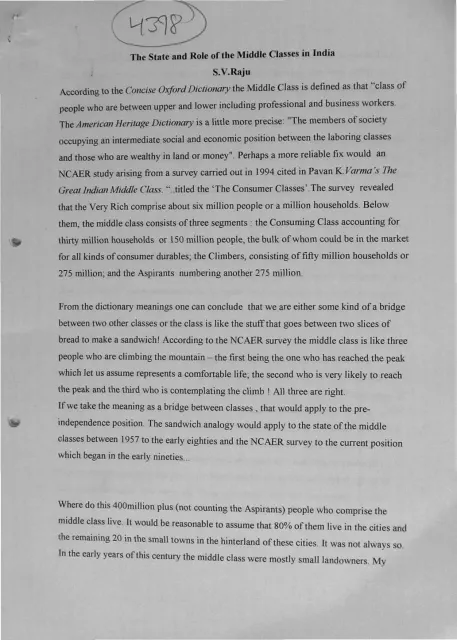
S. V. Raju traces the changing position of India’s middle classes from the early twentieth century to the 1990s. He begins by distinguishing the middle class from both the wealthy and the laboring classes, using an NCAER survey cited in Pavan K. Varma’s The Great Indian Middle Class to identify the “Very Rich,” “Consuming Class,” “Climbers,” and “Aspirants.” Raju presents the middle class as successively a bridge between social groups, a “sandwich” caught between them, and a set of upwardly mobile groups at different stages of prosperity. He describes its urban growth through migration, government and commercial employment, ties to ancestral villages, upper-caste composition, religious observance, and predominantly arranged marriage.
The essay then recounts the middle class’s cautious relationship with the freedom movement, its administrative role during British rule, and its post-independence experience of partition, land ceilings, affirmative-action policies, restricted government employment, and high taxation. Raju contrasts Sardar Patel’s middle-class background and organizational competence with Jawaharlal Nehru’s Fabian socialism and lack of sympathy for landed farmers and the middle class. In the later period, middle-class families move from government service toward manufacturing, computing, overseas careers, and consumption as economic reforms open the market. Raju concludes that the expansion of voluntary organizations and civil-society activism may enable the middle classes to exert greater influence over public affairs and government accountability.
Key points
- The essay defines the middle class as an intermediate social and economic group and distinguishes several internal segments, including consumers, climbers, and aspirants.
- Raju uses bridge, sandwich, and mountain-climbing analogies to describe the middle class’s changing social position before and after independence.
- Urban middle-class growth is linked to migration, government and commercial employment, family formation, and continuing connections with ancestral villages.
- The middle class is portrayed as socially conservative in the early twentieth century, with upper-caste predominance, religious obligations, and arranged marriage as the norm.
- Raju argues that the urban middle class was only lukewarm in its support for Gandhi’s non-violent non-cooperation movement and remained important to the functioning of British administration.
- Post-independence policies, including land ceilings, affirmative action, restrictions on government employment, and high taxation, are presented as sources of middle-class insecurity.
- Economic opening redirected middle-class aspirations toward manufacturing, technology, overseas careers, consumer goods, and participation in voluntary organizations and civil society.
Metadata and summary are AI-extracted from the source PDF and reviewed for editorial accuracy. The original work is available via the Read PDF tab above (where present); paragraph-level citation inside the PDF is deferred to a future engagement.