pamphlet
From Speeches in the Lok Sabha
1960
3 pages
Summary
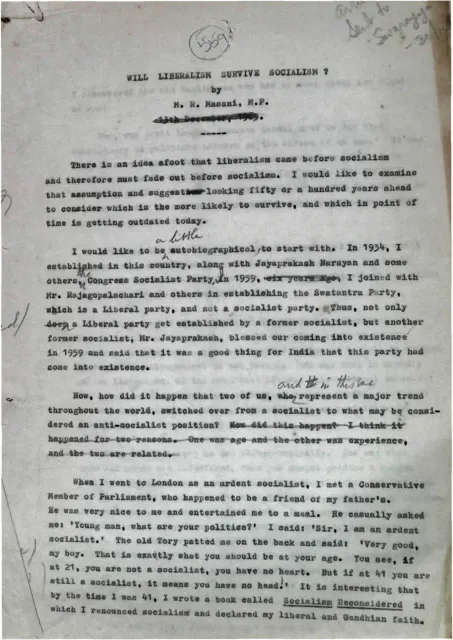
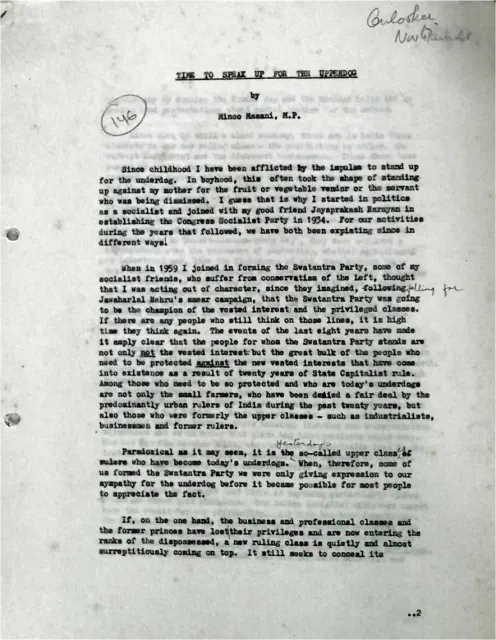
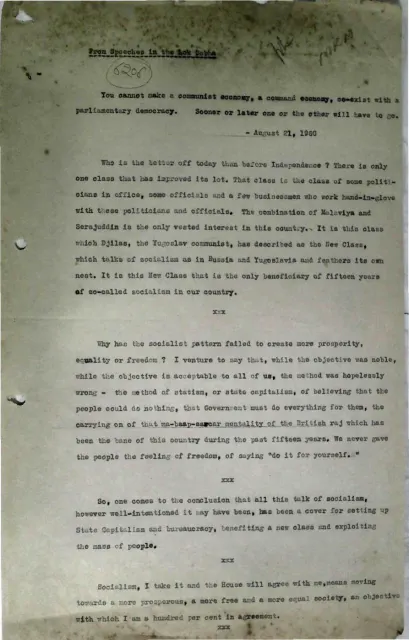
This three-page English compilation, headed “From Speeches in the Lok Sabha,” presents dated extracts from parliamentary interventions between 1960 and 1967. The excerpts argue that post-Independence socialism has benefited a politically connected “New Class” of politicians, officials, and allied businessmen rather than the mass of the population. They distinguish the stated aim of a free and equal society from the methods used to pursue it, criticizing statism, state capitalism, bureaucratic control, and the belief that government must do everything for citizens.
The selections advocate a mixed economy in which private and state enterprises operate freely and competitively, while the state concentrates on infrastructure, education, and limited regulation against anti-social practices. They attack nationalization, central planning, and policies that suppress consumption and agricultural prosperity in the name of building heavy industry. Later excerpts use rural income figures to illustrate the alleged failures of successive Five-Year Plans, criticize planners as economically inexperienced intellectuals, and insist that socialism cannot be reduced to slogans or state control.
Key points
- The excerpts claim that the principal beneficiaries of fifteen years of post-Independence socialism were politically connected officials, politicians, and businessmen.
- They invoke Milovan Djilas’s concept of a “New Class” to characterize the beneficiaries of state socialism.
- They distinguish support for a free and equal society from support for statist or state-capitalist methods.
- They defend a mixed economy based on free and equal competition between private and state enterprises.
- They assign the state responsibility for infrastructure, education, water, power, transport, communications, and limited regulation.
- They criticize nationalization and central planning as detached from economic realities and hostile to consumer and agricultural needs.
- They cite very low rural and poor-household incomes as evidence of the results of Five-Year Plans and prevailing socialism.
- They argue that socialism should be judged by outcomes and freedom rather than by slogans, promises, or bureaucratic control.
Metadata and summary are AI-extracted from the source PDF and reviewed for editorial accuracy. The original work is available via the Read PDF tab above (where present); paragraph-level citation inside the PDF is deferred to a future engagement.