
speech · parliamentary
Speech on the III Plan in Lok Sabha
1961
12 pages
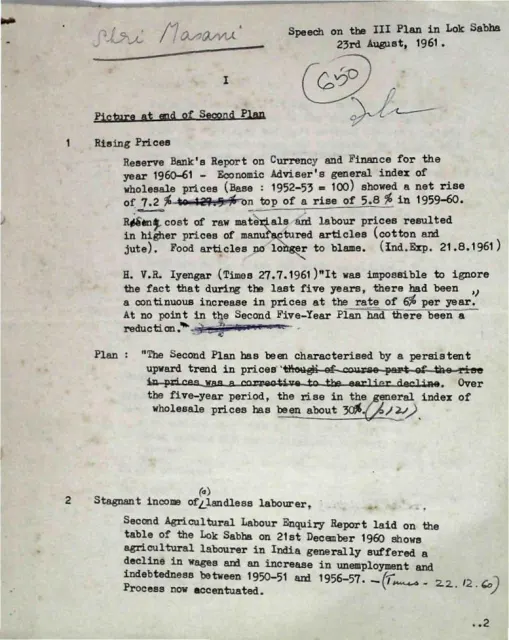
Summary
This typed and heavily annotated manuscript sets out a sustained critique of India’s Third Five-Year Plan, delivered in the Lok Sabha on 23 August 1961. It begins by arguing that the Second Plan left India with rising prices, stagnant or declining real incomes among agricultural and industrial workers, worsening unemployment, depleted foreign-exchange reserves, and growing external obligations. The notes attribute the gains from planning chiefly to a new ruling class, the state, and private monopolists, while presenting ordinary workers, landless labourers, and the lower middle class as having lost ground.
The manuscript then asks whether the Third Plan addresses India’s principal needs—investment, productivity, and exports—and argues that it defeats each through heavy taxation, deficit finance, restrictions on agriculture and private enterprise, costly public-sector industrialisation, and state domination of the economy. Drawing on P. T. Bauer, John Kenneth Galbraith, Andrew Shonfield, and other contemporary commentators, it links these policies to inflation, unemployment, high domestic costs, weak exports, and dependence on state monopolies. The final sections frame the Plan as a politically driven attempt to impose a state-capitalist or socialist structure, warning that excessive centralisation and concentration of political and economic power threaten property, individual liberty, state rights, and parliamentary democracy. The last rendered page is a handwritten note page rather than a continuation of the typed argument.
Key points
- The manuscript attributes the Second Plan’s legacy to inflation, stagnant wages, unemployment, foreign-exchange depletion, and rising debt.
- It argues that planning benefited the state, a new ruling class, and private monopolists more than workers, agricultural labourers, and the lower middle class.
- It identifies investment, productivity, and exports as India’s principal economic needs, then argues that the Third Plan undermines all three.
- Heavy industry and atomic energy are presented as costly priorities that divert resources from agriculture, education, roads, and consumer goods.
- Taxation, deficit finance, licensing, import restrictions, and state-sector expansion are linked to inflation and a high-cost economy.
- The manuscript argues that India’s uncompetitive production makes export growth difficult and encourages dumping or dependence on monopolies.
- Its central political warning is that excessive centralisation and socialist planning endanger individual liberties, state rights, property, and parliamentary democracy.
Metadata and summary are AI-extracted from the source PDF and reviewed for editorial accuracy. The original work is available via the Read PDF tab above (where present); paragraph-level citation inside the PDF is deferred to a future engagement.
Related across the archive
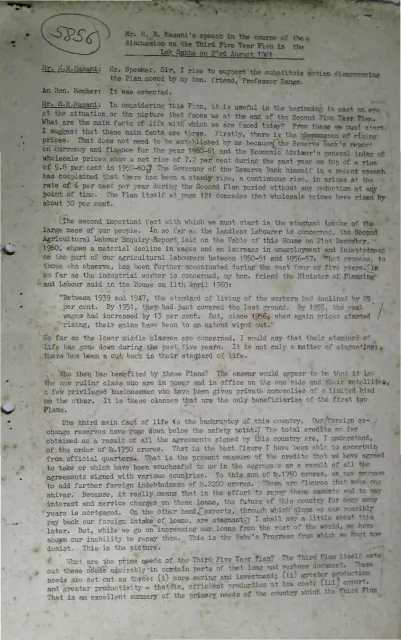 Primary workMr. M. R. Masani's speech in the course of the discussion on the Third Five Year Plan in the Lok Sabha on 2nd August 1961
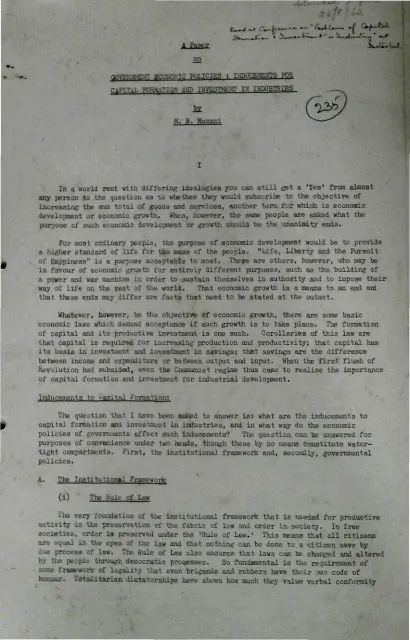 Primary workGOVERNMENT ECONOMIC POLICIES : INDUCEMENTS FOR CAPITAL FORMATION AND INVESTMENT IN INDUSTRIES
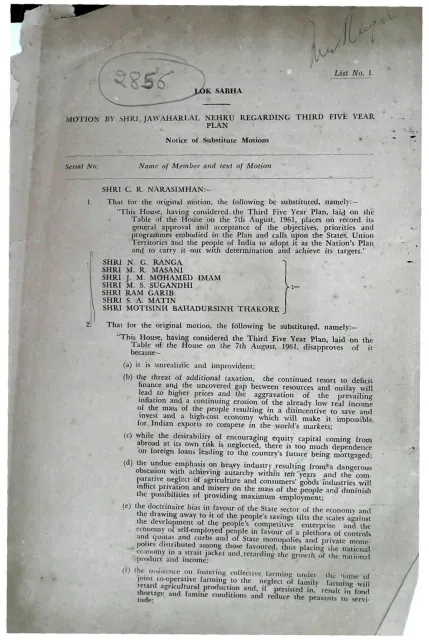 Primary workMOTION BY SHRI JAWAHARLAL NEHRU REGARDING THIRD FIVE YEAR PLAN
 ExcerptB.R. Shenoy on Economic Growth with Social Justice
 ExcerptSocialism or State Capitalism