minutes
Meeting of the British Group of Liberal International on 15th February, 1961 at 7.30 p.m.
1961
8 pages

Summary
These typewritten notes record a 15 February 1961 meeting of the British Group of Liberal International. The discussion assesses India’s democratic achievements—free elections, the rule of law, a free press, and physical construction—while expressing disillusionment with the absence of a compelling public philosophy and the gap between political professions and practice. The notes contrast claims of unity, austerity, and non-alignment with factionalism, conspicuous economic grabbing, and what is described as a double standard in foreign policy. They also argue that the lack of an effective alternative government creates a “double imbalance.”
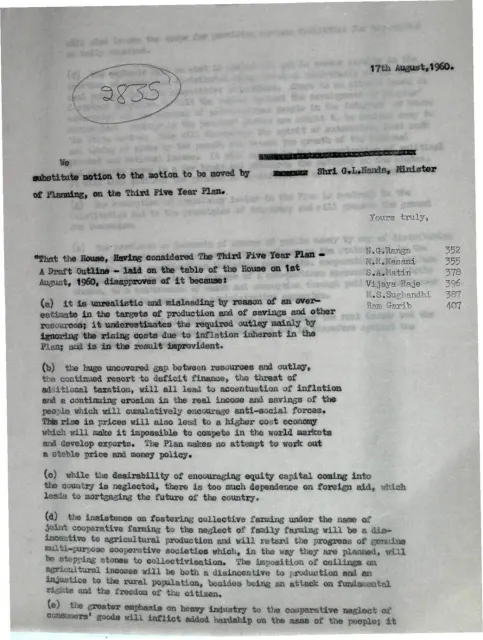
The later sections present the Swatantra Party’s response to the Nagpur Resolution, especially its opposition to land ceilings, state monopolies in wholesale trade and food grains, and compulsory cooperative farming. The notes defend competitive markets, checks and balances, dispersed economic and political power, and planning compatible with parliamentary democracy rather than a Soviet-type model. They also call for a review of non-alignment after Chinese occupation of Indian territory, a more practical defence policy, stable currency, restraint in heavy-industry priorities, and measures against corruption. The concluding outlook is cautiously optimistic about India’s productive vitality and public awareness, but warns that population growth, dependence on foreign aid, unrealistic ambitions, and excessive government-to-government lending remain serious problems.
Key points
- The notes balance recognition of India’s free elections, rule of law, press, and development achievements against political disillusionment.
- They identify a gulf between professed unity, austerity, and non-alignment and actual factionalism, economic grabbing, and inconsistent foreign-policy practice.
- The Nagpur Resolution is presented as creating the basis for a viable opposition through its challenge to land ceilings, state monopolies, and compulsory cooperative farming.
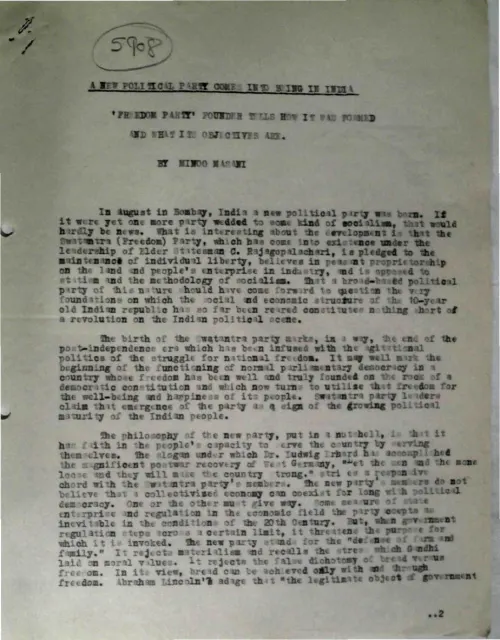
- The preferred liberal philosophy combines faith in popular capacity, competitive markets, dispersed power, parliamentary democracy, and limited government.
- The notes criticize Soviet-style planning and the institutional power of the Planning Commission, advocating clearer responsibility through the Cabinet and budgetary process.
- Defence policy should respond to Chinese occupation, settle outstanding issues with Pakistan, and develop regional security cooperation in South and South-East Asia.
- The outlook acknowledges India’s economic potential while warning about population growth, foreign-aid dependence, unrealistic planning ambitions, and corruption.
Metadata and summary are AI-extracted from the source PDF and reviewed for editorial accuracy. The original work is available via the Read PDF tab above (where present); paragraph-level citation inside the PDF is deferred to a future engagement.