
lecture
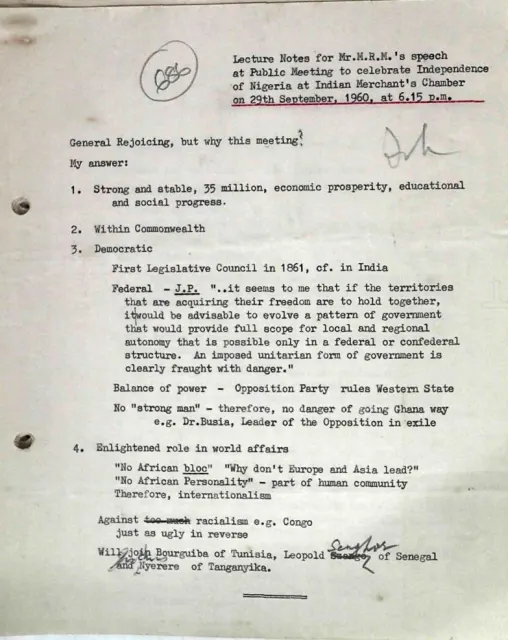
Lecture Notes for Mr.M.R.M.'s speech at Public Meeting to celebrate Independence of Nigeria at Indian Merchant's Chamber on 29th September, 1960, at 6.15 p.m.
1960
4 pages
Summary
This four-page English-language scan contains notes for two apparently separate talks. The first page outlines a speech celebrating Nigeria’s independence, emphasizing the country’s prospects as a strong, stable, democratic state within the Commonwealth. The notes stress economic prosperity, educational and social progress, federalism as a safeguard for local and regional autonomy, and an opposition party as a protection against personal rule. They also advocate an internationalist posture: Nigeria should avoid an exclusive “African bloc,” reject racialism in either direction, and participate fully in the human community.
Pages 2–4 contain notes for a separate talk, “Should Corporate Enterprises Finance Political Parties?”, dated 16 September 1960. These pages argue that business enterprises must act as citizens and participate responsibly in public life, while raising concerns about corporate political influence and the use of shareholders’ money. The notes compare British and American practice, cite corporate political-education programmes in the United States, and discuss Indian law permitting corporate contributions to charitable and other purposes. The central issues are limits on money power, the danger of parties becoming dependent on big business, whether voluntary control can work in a planned economy, and the risk that vested interests will produce further corruption.
Transcript
Summary
This four-page English-language scan contains notes for two apparently separate talks. The first page outlines a speech celebrating Nigeria’s independence, emphasizing the country’s prospects as a strong, stable, democratic state within the Commonwealth. The notes stress economic prosperity, educational and social progress, federalism as a safeguard for local and regional autonomy, and an opposition party as a protection against personal rule. They also advocate an internationalist posture: Nigeria should avoid an exclusive “African bloc,” reject racialism in either direction, and participate fully in the human community.
Pages 2–4 contain notes for a separate talk, “Should Corporate Enterprises Finance Political Parties?”, dated 16 September 1960. These pages argue that business enterprises must act as citizens and participate responsibly in public life, while raising concerns about corporate political influence and the use of shareholders’ money. The notes compare British and American practice, cite corporate political-education programmes in the United States, and discuss Indian law permitting corporate contributions to charitable and other purposes. The central issues are limits on money power, the danger of parties becoming dependent on big business, whether voluntary control can work in a planned economy, and the risk that vested interests will produce further corruption.
Key points
- The scan combines notes for a Nigeria-independence speech with notes for a separate talk on corporate finance of political parties.
- Nigeria is presented as a strong, stable, democratic country with economic, educational, and social prospects.
- Federal or confederal government is proposed as better suited than imposed unitary government to newly independent territories.
- The Nigeria notes favor internationalism over an exclusive African bloc and reject racialism as harmful both in colonial and reversed forms.
- The corporate-politics notes treat business enterprises as citizens with responsibilities toward government, Parliament, and public reputation.
- Examples from the United States describe corporate political-affairs departments, employee political training, lobbying, and non-partisan civic participation.
- The Indian notes question corporate donations to political causes and identify money power, party dependence, and corruption as central risks.
Metadata and summary are AI-extracted from the source PDF and reviewed for editorial accuracy. The original work is available via the Read PDF tab above (where present); paragraph-level citation inside the PDF is deferred to a future engagement.
Related across the archive
 Primary workLecture Notes.
 Primary workMr. M. R. Masani's speech in the course of the discussion on the Companies (Amendment) Bill, 1959, in the Lok Sabha on 16.11.1960
 Primary workMr. M. R. Masani's intervention in the Lok Sabha on 30-11-60
 ExcerptManifesto for Indian Liberals
 ExcerptThe Liberal Budget: Building an Equitable Society