
essay
Inflation and Society
1960
1 pages
Summary
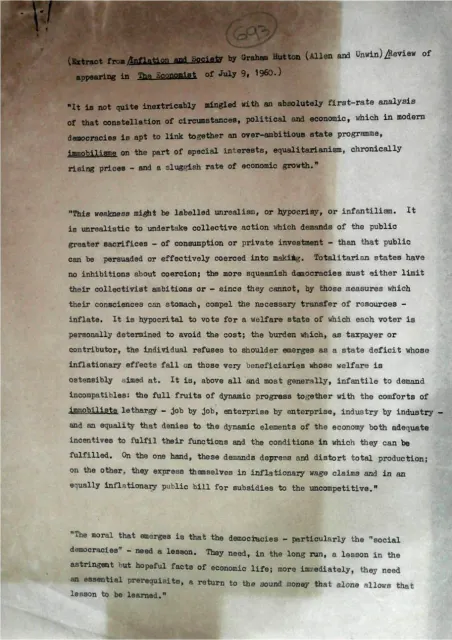
This single-page English extract, identified as drawn from Graham Hutton’s Inflation and Society and reviewed in The Economist on July 9, 1960, argues that modern democracies can combine an overambitious state programme, pressure from special interests, egalitarian demands, rising prices, and weak economic growth. It presents inflation as a consequence of democratic governments promising more collective action and welfare than voters will acceptably finance through reduced consumption, private investment, or taxation.
The extract characterises this political weakness as “unrealism, or hypocrisy, or infantilism.” It argues that demands for both dynamic economic progress and extensive economic equalisation can depress and distort production, generate inflationary wage claims, and require subsidies for uncompetitive activity. Its concluding prescription is that social democracies must learn from the “stringent but hopeful facts of economic life” and return to sound money. The page is an extract/review rather than a complete standalone work; no independent byline or title for the archival item is printed.
Key points
- The extract links an overambitious state programme and special-interest mobilisation to rising prices and sluggish economic growth.
- It argues that democratic governments cannot sustainably impose sacrifices larger than the public can be persuaded or compelled to bear.
- Welfare-state promises are portrayed as hypocritical when voters seek benefits while avoiding their costs.
- The text contrasts coercive totalitarian states with democracies that must restrain collectivist ambitions or accept inflation.
- It argues that demands for both rapid progress and equalisation can weaken incentives, reduce production, and distort the economy.
- Inflationary wage claims and subsidies to uncompetitive activities are presented as consequences of these incompatible demands.
- The concluding remedy is a return to sound money, which would allow democracies to learn from economic constraints.
Metadata and summary are AI-extracted from the source PDF and reviewed for editorial accuracy. The original work is available via the Read PDF tab above (where present); paragraph-level citation inside the PDF is deferred to a future engagement.
Related across the archive
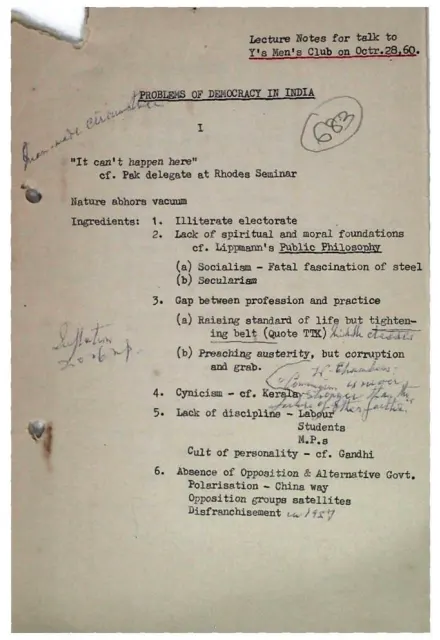 Primary workPROBLEMS OF DEMOCRACY IN INDIA
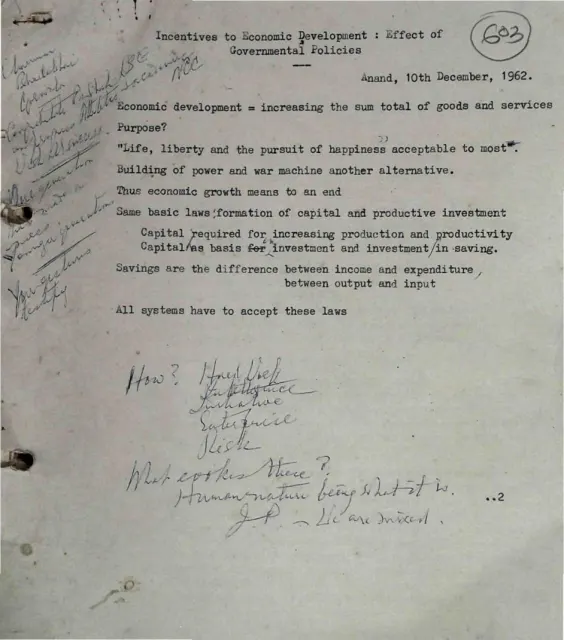 Primary workIncentives to Economic Development : Effect of Governmental Policies
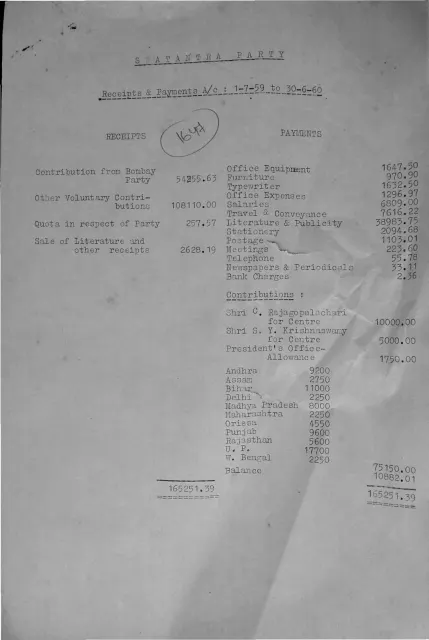 Primary workReceipts & Payments A/c.: 1-7-59 to 30-6-60
 ThePrintCapitalism isn’t responsible for mass unemployment. Look at Japan, Singapore: BS Iyer
 ExcerptOBSTACLES TO LIBERALISATION AND MARKET ECONOMY