letter
EXTRACTS FROM J.P.'s LETTER TO J.N. FROM URLI KANCHAN (POONA) DATED MARCH 7, 1957.
Urli Kanchan (Poona) · 1957
2 pages

Summary
In these two pages, Jayaprakash Narayan explains his position on the 1957 elections in a letter to J.N. He argues that the Congress party’s large legislative majorities over the previous decade have harmed good government and that continued Congress dominance poses a serious danger to the country’s interests. He therefore advocated coordination among opposition parties so that they would not divide the anti-Congress vote, while stressing that this advice arose from political principles rather than personal hostility to Congress.
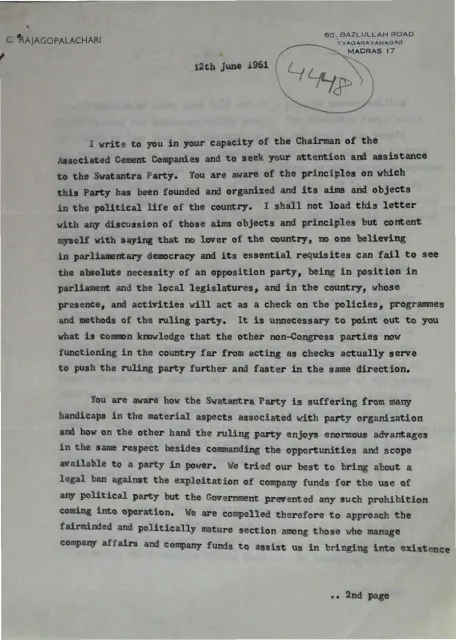
Narayan presents opposition parties as an essential democratic check, even when they are not individually superior to the ruling party. He says he was not concerned by warnings of political instability because he did not expect Congress to be removed from office; his immediate objective was instead the “deflation” of Congress power. The extract closes by noting that C. Rajagopalachari (“Rajaji”) had been thinking along similar lines, which Narayan takes as confirmation that his position was not irrational despite the ridicule directed at him.
Key points
- Narayan regards Congress’s decade of large legislative majorities as harmful to good government.
- He argues that unchecked Congress power is dangerous to the country’s interests.
- He recommends electoral coordination among opposition parties to reduce Congress dominance.
- He grounds this recommendation in parliamentary democratic theory rather than hostility to Congress.
- He treats opposition parties as checks on one another and as necessary to keep democracy functioning.
- His immediate electoral aim was to reduce or “deflate” Congress power, not necessarily to remove Congress from office.
- He cites Rajaji’s similar thinking as encouragement and validation.
Metadata and summary are AI-extracted from the source PDF and reviewed for editorial accuracy. The original work is available via the Read PDF tab above (where present); paragraph-level citation inside the PDF is deferred to a future engagement.