periodical issue
Freedom First
No. 11 — April 1953
By Minoo Masani
Edited by Aziz Madni; printed & published by Narie Oliaji at Kanada Press, 109 Parsi Bazaar Street, Bombay 1. · Bombay · 1953
12 pages
Freedom First
Summary
This is issue No. 11 of Freedom First (April 1953), the monthly bulletin of the Indian Committee for Cultural Freedom, edited by Aziz Madni and affiliated to the World Movement for Cultural Freedom. The issue opens with Asoka Mehta’s essay ‘Stalin,’ written in the immediate aftermath of Stalin’s death, diagnosing Stalinism as an attempt to erase individuality and culture in service of the state. A ‘Notes’ section comments on Indian and international affairs: the ethics of anti-communist coalition politics amid Praja Parishad agitation in Kashmir, a critical retrospective on U.S. Ambassador Chester Bowles’s tenure in New Delhi, a report on a Tibetan earthquake suppressed by Chinese authorities, and support for banning communists from government service. The centerpiece is a condensed transcript of a Tokyo roundtable, ‘The Intelligentsia in Modern Society’ (November 1952), featuring Minoo Masani, François Bondy, Herbert Passin, Kenzo Takayanagi, Matsuhei Matsuo, Jinji Kobori, and Takeo Naoi, comparing the political role of intellectuals across the U.S., Europe, Japan, and India, with sustained attention to why intellectuals have proven vulnerable to totalitarian co-option. A report on a Bombay public meeting, ‘After Stalin,’ records reactions from M. R. Masani, Purshottam Tricumdas, Prabhakar Padhye, G. D. Parikh, Umadevi, and Asoka Mehta. Adam Adil contributes ‘The Tasks of Our Leadership,’ a rejoinder in a running exchange with J. B. H. Wadia over Sampurnanand’s argument for religion-based moral education, defending religion’s historical role in India against charges of fostering tyranny. The issue closes with a reader’s letter on communist infiltration of trade unions, a satirical poem on Hungary banning Sherlock Holmes, a review of Carsun Chang’s The Third Force in China, and the recurring ‘With Many Voices’ column of quotations on Cold War themes.
Key points
-
Asoka Mehta’s “Stalin,” written just after Stalin’s death, argues Stalin sought to erase individuality into a “mass-man,” using Brecht’s Die Massnahme against Toller’s humanist tragedy to illustrate the pattern, and calls for cultural freedom as the antidote.
-
The “Notes” section backs Congress-Praja Socialist Party cooperation while insisting international communism remains the primary democratic threat, and supports banning communist party members from government and teaching posts.
-
A condensed transcript of a Tokyo roundtable, “The Intelligentsia In Modern Society,” features Minoo Masani, Francois Bondy, Herbert Passin and Japanese panelists debating why 20th-century intellectuals have proven vulnerable to totalitarian co-option; Masani argues British colonial rule created an unrepresentative “new Brahmin” intelligentsia that Communists now target.
-
A report on the Bombay meeting “After Stalin” records M. R. Masani calling Stalin “the most efficient and ruthless embodiment of an evil system,” while Asoka Mehta warns that a “hot war” is already underway in Korea.
-
Adam Adil’s rejoinder to J. B. H. Wadia defends Indian religious tradition’s historical tolerance, arguing India’s social degradation stemmed from economic self-interest rather than religion itself.
-
A reader’s letter from M. Kerkera describes Communist lawyers displacing non-Communist counsel in Industrial Courts as part of a strategy to infiltrate white-collar trade unions.
-
A condensed review of Carsun Chang’s “The Third Force in China” is credited as the most impressive condemnation yet written of India’s international policy toward China.
Essays
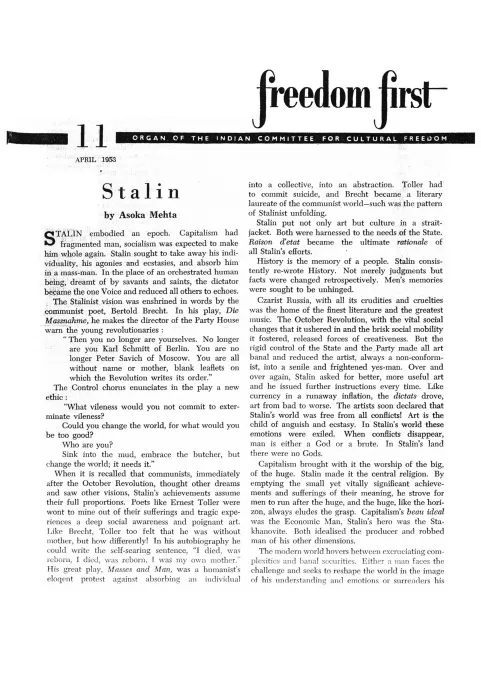
Stalin
By Asoka Mehta
Asoka Mehta’s ‘Stalin’ argues that Stalin embodied an epoch in which capitalism’s fragmentation of man was to be answered by socialism making him whole, but that Stalin instead sought to erase individuality altogether, reducing people to echoes of a single Voice. Mehta uses Bertolt Brecht’s play Die Massnahme, contrasted with Ernst Toller’s humanist tragedy Masses and Man, to show the pattern of Stalinist absorption of the individual into the collective. He argues Stalin subordinated art and culture to raison d’etat, rewrote history to unmoor collective memory, and set impossible productivist ideals (the Stakhanovite) against the older capitalist ideal of Economic Man. Mehta closes by locating hope not in socio-economic change alone but in a resurgence of humanity and self-culture achieved ‘in the climate of freedom,’ urging that cultural freedom, not counter-vileness, is the antidote to Stalinism.
- Stalin is framed as attempting to dissolve individuality into a ‘mass-man,’ with Brecht’s Die Massnahme cited as the literary enshrinement of this ethic
- Ernst Toller is contrasted with Brecht as a humanist playwright destroyed by the same totalitarian pattern he depicted
- Stalin is accused of retrospectively rewriting history and suppressing artistic non-conformity via strict Party control
- Capitalism’s ‘Economic Man’ and Stalin’s ‘Stakhanovite’ are compared as parallel productivist ideals that rob man of other dimensions
- The essay closes with a call for cultural freedom and self-culture as the only real antidote to Stalinism
Notes (First Things First; Failure of a Mission; Suppressed Tremors; Communists in State Service; Shabash!)
The ‘Notes’ section is an unsigned editorial column commenting on current affairs. ‘First Things First’ cautiously welcomes Congress-Praja Socialist Party cooperation talks but insists the primary democratic danger is international communism and its domestic fifth column, not communal politics, naming G. M. Sadiq and V. K. Krishna Menon as troubling figures. ‘Failure of a Mission’ offers a critical retrospective on outgoing U.S. Ambassador Chester Bowles, arguing his popularity in New Delhi came at the cost of a widened India-U.S. policy gulf, and that he failed to see India’s foreign policy required more than personal appeals to Nehru. ‘Suppressed Tremors’ reports that a September 1952 Tibetan earthquake was concealed from the outside world for six months. ‘Communists in State Service’ endorses the Bombay government’s move to ban communist employment in government service, framing Communist Party membership as incompatible with the objectivity required of teachers and civil servants. A closing ‘Shabash!’ item sarcastically congratulates Osmania University on hosting V. K. Krishna Menon as a visiting professor, mocking his record on Cold War issues.
- Backs Congress-Praja Socialist Party cooperation but insists international communism, not communalism, is the primary democratic threat
- Critiques Chester Bowles’s ambassadorship as personally popular in Delhi but strategically ineffective for U.S.-India relations
- Reports a six-month news blackout on a Tibetan earthquake as evidence of communist-state secrecy
- Supports banning communist party members from government and teaching posts on academic-freedom grounds
- Sarcastically criticizes V. K. Krishna Menon’s appointment as a visiting professor at Osmania University
The Intelligentsia In Modern Society
By MINOO MASANI, FRANCOIS BONDY, HERBERT PASSIN, KENZO TAKAYANAGI, MATSUHEI MATSUO, JINJI KOBORI, TAKEO NAOI
A condensed transcript of a November 1952 Tokyo roundtable on ‘The Role of the Intelligentsia in Modern Society,’ chaired by Kenzo Takayanagi and featuring Minoo Masani (India), François Bondy (Switzerland/Congress for Cultural Freedom), Herbert Passin (U.S.), Matsuhei Matsuo, Jinji Kobori, and Takeo Naoi (Japan). Bondy opens by describing intellectuals’ historically central role in shaping Europe’s political and moral climate, and the tension between intellectual responsibility and the temptation to defend theories that lead to oppression. Passin contrasts this with the U.S., where intellectuals are habitually denigrated and valued mainly for practical, applied contributions rather than theoretical authority. Masani argues India’s colonial history created an unusually powerful but unrepresentative intelligentsia — a ‘new Brahmin class’ fluent in English, ruling by monopoly of literacy while cut off from the illiterate mass, a gap Gandhi alone had bridged and which communists now exploit by targeting the intelligentsia rather than peasants or workers. Kobori and Naoi describe the Japanese intelligentsia’s isolation from both tradition and the masses since the Meiji restoration, which has bred political opportunism and vulnerability to both Nazi- and Soviet-style totalitarian appeals. Passin frames the discussion’s central puzzle as why 20th-century intellectuals, of all people, have proven least capable of defending the conditions of their own intellectual freedom, citing German scientists’ capitulation under Hitler and Soviet scientists’ capitulation during the Lysenko affair. Masani invokes James Burnham’s ‘Managerial Revolution’ to suggest technocrats and bureaucrats have a self-interested stake in communist dictatorship’s promise of caste privilege. The panel closes agreeing that cultural freedom organizations must help liberate intellectuals from treating knowledge as a ‘saleable commodity’ and orient them instead toward truth.
- Bondy: European intellectuals historically shaped political/moral climates but risk defending oppressive theories without confronting consequences
- Passin: American intellectuals are systematically denigrated and valued chiefly for practical/applied rather than theoretical contributions
- Masani: British colonial rule created a literate ‘new Brahmin’ intelligentsia ruling India while cut off from the illiterate masses, a gap Gandhi alone bridged
- Masani: Communists in India concentrate their ideological attack on the intelligentsia rather than peasants or workers because of this social gap
- Kobori/Naoi: Japan’s post-1868 rush to absorb Euro-American culture left its intelligentsia isolated from both tradition and the masses, breeding opportunism
- Passin frames the central puzzle as intellectuals’ historical failure to defend their own freedom, citing Nazi Germany and the Soviet Lysenko affair
- Masani invokes Burnham’s ‘Managerial Revolution’ to explain technocrats’ self-interested sympathy for communist dictatorship
- The panel agrees cultural freedom work means freeing intellectuals from treating knowledge as a commodity, orienting them to truth instead
After Stalin
A report on a Bombay public meeting titled ‘After Stalin,’ organised by the Democratic Research Service on March 13, described as perhaps the first Indian gathering to denounce Stalinism after Stalin’s death. M. R. Masani warned against complacency, calling Stalin ‘the most efficient and ruthless embodiment of an evil system of total regimentation’ and criticizing Indian press adulation of him. Purshottam Tricumdas, Prabhakar Padhye, and G. D. Parikh offered further critical assessments of Soviet succession politics, while Umadevi (Polish-born, now an Indian citizen) described communist-era massacres in Poland. Asoka Mehta, closing the meeting, called Stalin ‘the apogee and the apotheosis of an epoch’ but was doubtful a saner era would follow, pointing to Soviet expansionism and the ongoing war in Korea as evidence a ‘hot war’ was already underway.
- M. R. Masani warned that relaxing vigilance after Stalin’s death would be a tragic mistake and criticized Indian press adulation of Stalin
- Purshottam Tricumdas accused responsible leaders of abetting communists in propagating a ‘Stalin myth’
- Prabhakar Padhye and G. D. Parikh downplayed hopes for a major break in Soviet policy after Stalin
- Umadevi, Polish-born and now an Indian citizen, described communist massacres in Poland and satellite states
- Asoka Mehta closed by calling talk of a ‘cold war’ misleading, since a hot war was already underway in Korea
The Tasks Of Our Leadership
By Adam Adil
Adam Adil’s ‘The Tasks of Our Leadership’ is a rejoinder to J. B. H. Wadia’s reply (in an earlier issue) to Sampurnanand’s argument that moral education requires either religion or a philosophical substitute. Adil defends religion against Wadia’s charge that it is inherently tied to tyranny and human degradation, arguing that Indian religious tradition has historically upheld tolerance and the right to hold one’s own philosophy, citing the testimony of the Chinese pilgrim Hiuen Tsiang and the non-Brahmin authorship of major Hindu texts and epics. He argues social and political degradation in India stemmed from economic self-interest, not religion, and invokes Freud, Whitehead, and the Sufi concept of universal religious truth to defend the possibility of a Bergsonian ‘open religion’ compatible with democratic values. Adil closes by arguing that if religion can be socially useful, as Wadia himself concedes, leaders should not be barred from making use of it.
- Rejoinder to J. B. H. Wadia’s critique of Sampurnanand’s call for religion-based moral education
- Argues Indian religious tradition has historically been more tolerant of dissenting philosophy than Wadia suggests, citing Hiuen Tsiang’s testimony
- Notes major Hindu religious/literary figures (Vyasa, Valmiki, Buddha, Krishna, Kalidas, Bhartrahari) were non-Brahmins, countering charges of Brahminic monopoly
- Attributes India’s social and political degradation to economic self-interest rather than religion itself
- Invokes Freud, Whitehead, and Sufi teaching to frame religion as compatible with ‘world loyalty’ and democratic tolerance
s letter from M. Kerkera, an insurance-employees
By A reader
A reader’s letter from M. Kerkera, an insurance-employees’ trade unionist, describes communist lawyers making inroads into white-collar trade unions by offering exploitative free legal services in the Industrial Courts, undermining non-communist lawyers who charge reasonable fees. The letter calls on Freedom First to rally democratic lawyers to work in the Industrial Courts to counter communist influence in the labour movement.
- Describes communist lawyers displacing non-communist Industrial Court lawyers by offering free but exploitative legal services
- Argues this tactic is part of a broader communist strategy to infiltrate white-collar trade unions
- Calls on Freedom First and democratic lawyers to counter this by taking up Industrial Court work even at a financial loss
To The Editor
By M. Kerkera
A short satirical poem by Richard Armour, reprinted from The New Leader, responds to the news item that Hungary has banned Sherlock Holmes, joking that authoritarian regimes fear detectives because they ‘dig up’ truth in lands where truth itself has been murdered.
- Reprints a Richard Armour poem satirizing Hungary’s ban on Sherlock Holmes as fear of truth-seeking under totalitarianism
Review: The Third Force in China (by Carsun Chang)
By Condensation of Review by Edward Hunter, in the New Leader
A condensed review by Edward Hunter (reprinted from The New Leader) of Carsun Chang’s The Third Force in China (Bookman Associates). The review presents Chang, a Chinese liberal exile, as calling for the West to detach China militarily from Soviet Russia and support Formosa and mainland guerrillas. It highlights Chang’s warnings to Nehru against India’s ‘pro-communist stand,’ his portrayal of Indian ambassador Sardar Panikkar as either a communist sympathizer or a hypocrite, and his firsthand account of the failed U.S. Marshall mission mediating between Nationalists and Communists. The review credits Chang’s book with the most impressive condemnation yet written of India’s international policy, while noting the author does not fully resolve his own ambivalence about Chiang Kai-shek’s culpability for the Nationalist collapse.
- Reviews Carsun Chang’s The Third Force in China, which calls for Western support of Formosa and anti-communist guerrillas in China
- Highlights Chang’s criticism of Nehru’s India for adopting what he calls a pro-communist foreign policy stance
- Notes Chang’s portrayal of Indian ambassador Sardar Panikkar as either genuinely pro-communist or a hypocrite
- Describes Chang’s firsthand account of the failed U.S. Marshall mission and the Yalta concession of Manchuria to Soviet Russia
- The reviewer credits the book as the most impressive condemnation of India’s international policy he has read, while noting Chang does not fully resolve Chiang Kai-shek’s culpability
With Many Voices
The recurring ‘With Many Voices’ column collects short excerpts and quotations from Indian and international press (Thought, The Hindustan Times, The Free Press Bulletin, The New Leader, Cross-Roads) on Cold War themes: Stalin’s death and Soviet peace claims, communist rhetoric in Bombay, C. Rajagopalachari’s defense of retaining English, U.S. Cold War posture under Eisenhower, Aneurin Bevan’s remarks on Gandhi/Lenin/Stalin/Churchill, satire of Lysenkoism, criticism of ‘Third Force’ politics, and government censorship of the word ‘satellites.’ The page also carries an Indian Committee for Cultural Freedom membership enrollment form and the issue’s printer’s colophon (edited by Aziz Madni; printed and published by Narie Oliaji at Kanada Press, Bombay).
- A curated quotations column drawing on Indian and international press covering Stalin’s death, Cold War rhetoric, and Indian foreign policy debates
- Includes C. Rajagopalachari’s remark defending the retention of English in India
- Includes Aneurin Bevan’s quip about only discussing ‘respectable people’ (Gandhi, Lenin, Stalin) versus Churchill
- Satirizes ‘Lysenko-mania’ among Soviet-aligned progressives with a Rumanian peasant joke
- Notes the Government of India’s directive against using the term ‘satellites’ in official communications
- Carries the issue’s ICCF membership enrollment form and printer’s colophon
Generated by the v1.5 extraction pipeline. Awaiting editorial review.
Essay 9
No summary was extracted for this article. Listed for completeness.
Metadata and summary are AI-extracted from the source PDF and reviewed for editorial accuracy. The original work is available via the Read PDF tab above (where present); paragraph-level citation inside the PDF is deferred to a future engagement.