periodical issue
Freedom First
Organ of the Indian Committee for Cultural Freedom
By Philip Spratt, Prabhakar Padhye, M. V. Pradhan, R. H., Z. F.
Edited by Aziz Madni; printed & published by Narie Oliaji at Kanada Press, 109 Parsi Bazaar Street, Bombay 1. · Bombay · 1953
12 pages
Freedom First
Summary
This is the June 1953 issue (No. 13) of Freedom First, the monthly bulletin of the Indian Committee for Cultural Freedom (affiliated to the Congress for Cultural Freedom / World Movement for Cultural Freedom), edited by Aziz Madni. The issue is a Cold War-era anti-communist liberal periodical mixing signed essays, unsigned editorial notes, book reviews, letters, and a closing page of quoted excerpts from the press. Its argumentative center is anti-totalitarianism: warning against communist infiltration of Indian scientific, political, and cultural life, defending the U.N. position on non-forcible repatriation of Korean War prisoners, criticising Indian government (Nehru/Krishna Menon) equivocation towards communist aggression, and more broadly defending liberal, anti-Marxist positions on social reform and civil society. Contributors in this issue include Philip Spratt (on communist penetration of Indian scientific bodies), Prabhakar Padhye (on the history and future of Hindu social reform), and reviewers M. V. Pradhan, R. H., and Z. F., alongside a letter from Sidney Hook criticising Senator McCarthy’s methods.
Key points
-
Philip Spratt’s “The Scientist’s Responsibility” argues scientific men are unusually vulnerable to Communist recruitment, documenting the World Federation of Scientific Workers as effectively Communist-controlled and India’s Association of Scientific Workers as drifting toward sympathetic coverage of Communist positions.
-
The “Notes” section reports the Congress Working Committee’s ban on members joining Communist “Peace” front conferences and criticises V. K. Krishna Menon’s election to the Rajya Sabha as a possible “Trojan camel” toward a Cabinet post.
-
An unsigned editorial, “Godspeed,” argues India’s UN intervention on Korean POW repatriation weakened the moral clarity of the Western position, urging the UN Command to unilaterally release unwilling prisoners if negotiations stall.
-
Prabhakar Padhye’s essay on the role of social reform argues Indian freedom-fighters and social reformers made mirror-image errors of subordinating one cause to the other, and warns today’s champions of economic equality repeat the mistake by assuming redistribution alone will dissolve caste inequality.
-
M. V. Pradhan reviews Ernst and Loth’s “Report on the American Communist,” questioning whether its psychological framework of Party recruitment applies to India, where economic inadequacy rather than personal psychology draws the unemployed middle class to Communism.
-
Sidney Hook’s letter argues Senator McCarthy has become a liability to America’s international reputation for hounding reformed ex-Communists rather than investigating real threats.
-
A notice records the Indian Committee for Cultural Freedom’s tea party with Adlai Stevenson during his Bombay visit, attended by M. R. Masani, J. R. D. Tata and other prominent figures.
Essays
The Scientist’s Responsibility
By Philip Spratt
No summary was extracted for this article. Listed for completeness.
Notes (Congress Bans “Peace” Front; Trojan Camel; Symphonie Pathetique; Preservation of Wild Life; Theft of Names; History’s Revenge)
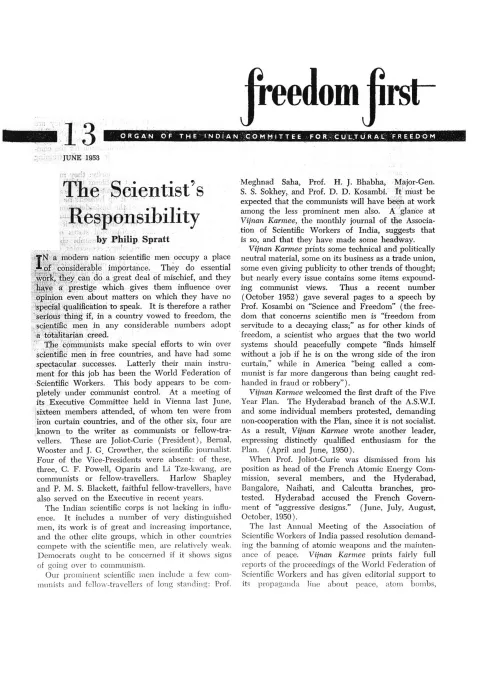
Philip Spratt argues that scientific men, because of their social prestige and their habitual, near-absolute trust in expert authority, are unusually vulnerable to communist recruitment and unusually poor at detecting communist falsehood outside their own specialism. He documents the World Federation of Scientific Workers as a communist-controlled body (citing its 1952 Vienna executive committee membership) and argues the Association of Scientific Workers of India and its journal Vijnan Karmee have drifted into sympathetic coverage of communist positions — welcoming the first Five Year Plan, protesting Joliot-Curie’s dismissal from the French Atomic Energy Commission, and passing resolutions on atomic weapons and peace that mirror Soviet propaganda lines while ignoring Soviet aggression (Korea) and refusing Western-proposed nuclear inspection regimes. He closes by challenging the special claim of Marxist theory to scientific status, arguing communist states subordinate science to politics and use a sophisticated ‘social relativity of truth’ argument to justify a wholesale falsification of facts, citing the population-crisis debate as a case of real practical danger from this politicized science.
- Scientific men carry prestige and influence beyond their specialist competence, which democrats should be concerned about if that influence tilts towards a totalitarian creed.
- The World Federation of Scientific Workers is assessed as effectively under communist control based on its 1952 Vienna executive committee composition.
- India’s Association of Scientific Workers and its journal Vijnan Karmee are shown giving increasing space to communist viewpoints, including qualified criticism of the Five Year Plan for not being socialist enough.
- Peace and anti-atomic-weapon resolutions from these bodies are argued to track Soviet propaganda lines exactly, ignoring the 1946 US offer of international atomic inspection that Russia refused.
- Scientific men are argued to be especially easy prey for communist recruitment because their professional habit of deferring to authority and trusting expert claims makes them poor judges of political falsehood outside their specialism.
- The essay challenges the Marxist claim that communist ‘science of history’ gives communist states superior authority to direct science, arguing this masks a wholesale license to invent facts for propaganda purposes.
- The population question is cited as a concrete case where dogmatic communist theory (‘overpopulation is reactionary, nay, cannibalism’) creates a practical danger by overriding empirical debate.
Godspeed
An unsigned Notes column covering several short items: the Congress Working Committee’s directive banning members from participating in communist-organised ‘Peace’ front conferences, naming Dr. Kitchlew as the front’s leader in India; criticism of the simultaneous election of V. K. Krishna Menon to the Rajya Sabha with Congress support, calling him a likely ‘evil genius of Indian political life’ and warning it may be a step toward his induction into the Union Cabinet; a commentary on continuing ‘meeting Russia half way’ rhetoric even after communist aggression in Laos, praising protests from Morocco’s Istiqlal Party and Tunisia’s Neo-Destour Party against ‘the new style imperialism’ of the USSR; a call for wildlife conservation legislation in India; an item on the Communist Party organ Cross Roads misusing the names of Mrs. Margaret Ahmadi, Mrs. Kamala Dongerkerry, Dr. Mrs. C. Kar, Mama Varerkar, and Mr. Shantilal Shah to imply support for communist-front bodies without authorisation; and a closing item on reports that Stalin’s son was in disgrace in Moscow after trying to release his father’s will.
- The Congress Working Committee directed members not to join or attend communist-organised ‘Peace’ front conferences, describing such fronts as designed to further political purposes under cover of promoting peace.
- The column criticises the election of V. K. Krishna Menon to the Rajya Sabha with Congress support as a ‘Trojan camel’, warning it may be a first step toward a Union Cabinet post.
- It highlights North African anti-colonial parties (Istiqlal of Morocco, Neo-Destour of Tunisia) condemning Soviet ‘communist imperialism’ at the U.N. over the invasion of Laos, contrasted with the muted response of the Asian-Arab bloc.
- It reports a Ministry of Food and Agriculture resolution (April 4, 1952) on a Central Board for wildlife, prompted by concern over vanishing species such as lion, rhinoceros, tragopan, and cheetah.
- It documents the Communist Party organ Cross Roads including named individuals (teachers, doctors) in lists of supposed supporters of a communist-sponsored ‘World Congress of Women’ without their authorisation, and similar name misuse involving Marathi writer Mama Varerkar and Labour Minister Shantilal Shah.
- A closing item recounts press reports that Stalin’s son, a Red Army general, fell into disgrace after trying to remove and release his father’s will, drawing an ironic parallel to Stalin’s earlier suppression of Lenin’s testament.
Release The Prisoners
This unsigned piece argues that India’s handling of the Korean POW repatriation issue at the U.N. has weakened the moral clarity of the Western position, and that Nehru’s and Krishna Menon’s statements reveal a ‘thoroughly cynical and amoral’ willingness to accept forcible repatriation if communist negotiators press hard enough. It reviews the history of the Indian resolution, communist counter-proposals for a neutral repatriation commission, and Krishna Menon’s own closing U.N. speech, which the piece reads as confirming that no real screening or right of asylum was intended for unwilling prisoners. It urges the U.N. Command to resist pressure and, if negotiations stall, to unilaterally release the unwilling Korean and Chinese prisoners in South Korea as both a practical and a symbolic act of the West’s declared policy of ‘Liberation.’
- The piece argues India’s U.N. intervention on POW repatriation has ‘confused, weakened and diluted the stand of the U.N. on a matter of moral principle’ without any concession from communist negotiators.
- It contrasts the U.N. Command’s insistence on a time limit for forcible detention against communist proposals for a repatriation commission staffed by two Soviet satellites and three neutrals.
- Nehru’s January 17, 1953 statement to the Congress Party session is quoted as denying voluntary repatriation, denying prisoners’ right to be asked their wishes, and denying any right of asylum for POWs.
- Krishna Menon’s closing U.N. speech is read as confirming there would be no interrogation or ‘screening’ process to separate willing from unwilling returnees.
- The piece proposes that, if talks stall, the U.N. Command should unilaterally set at large in South Korea those Korean and Chinese prisoners unwilling to be repatriated, framing this as consistent with the policy of Liberation and the principle that freedom is indivisible.
- It expresses sympathy for President Syngman Rhee and the Republic of Korea against what it calls the ‘continued vivisection of their country.‘
Adlai Stevenson Meets I.C.C.F.
A short unsigned notice describes a tea party and informal discussion the Indian Committee for Cultural Freedom held with Adlai Stevenson during his brief visit to Bombay on May 11, welcomed by M. R. Masani, with fifty members and friends present including D. K. Kunte, Shantilal Shah, N. J. Wadia, John Matthai, Asoka Mehta, J. R. D. Tata, and A. D. Gorwala. The substantive discussion is noted as off-the-record and not shared with readers.
- The Indian Committee for Cultural Freedom was the only Bombay group Adlai Stevenson found time to meet during his visit.
- M. R. Masani welcomed Stevenson on the Committee’s behalf; the discussion was frank and cordial but kept off-the-record.
- Notable attendees included D. K. Kunte (Speaker, Bombay Legislative Assembly), Shantilal Shah, N. J. Wadia, John Matthai, Asoka Mehta, J. R. D. Tata, and A. D. Gorwala.
The Role Of Social Reform
By Prabhakar Padhye
Prabhakar Padhye argues that India’s political-freedom and social-reform movements historically severed themselves from each other, to the detriment of both. He traces this to opposite errors: freedom-fighters like Tilak subordinated reform issues (e.g., opposing the Maratha Kshatriya community’s right to wear the sacred thread) to avoid alienating orthodox political allies, while social reformers of the era wrongly believed reform would automatically follow from political freedom under a providential British-Indian imperial relationship, making them politically loyalist and estranging them from independence campaigners who saw reform as a distraction. Padhye then turns to a new, parallel danger: today’s champions of economic equality similarly assume social reform will automatically follow economic redistribution, ignoring the deep, caste-rooted nature of Indian social inequality — a problem so entrenched that even a formally casteless religion like Islam has failed to escape it in India. He praises Justice P. B. Gajendragadkar’s presidential address to the recent Poona Social Reforms Conference for insisting that social equality cannot be reduced to economic uplift, while gently criticizing Gajendragadkar’s appeal to ‘progressive rationalism’ as an incoherent and insufficiently examined concept, contrasting it with the ‘humanist rationalism’ exemplified (imperfectly) by the Agarkarian school of Maharashtra reform, which understood reason as in service of, but not a substitute for, humane values.
- Padhye argues Indian freedom-fighters and social reformers made mirror-image errors: reformers subordinated to politics, or freedom subordinated to reform, rather than the two being seen as organically linked.
- Tilak is cited as an example of a freedom-fighter who avoided challenging orthodox social practice (the sacred-thread controversy) so as not to alienate his political base.
- Early social reformers (‘the Liberals’) are described as believing reform would automatically follow political freedom, framing British rule as providential and favouring continued Commonwealth ties rather than full independence — a position the nationalist ‘Extremists’ saw as strengthening political servitude.
- Padhye warns that today’s champions of economic equality repeat the earlier reformers’ mistake by assuming economic redistribution alone will dissolve caste-based social inequality.
- He cites the failure of a ‘casteless’ religion like Islam to eliminate caste traces among Indian converts as evidence of how entrenched the caste system is.
- He praises Justice P. B. Gajendragadkar’s Poona Social Reforms Conference address for insisting mere economic upliftment will not resolve caste-based social inequality, and for giving a ‘many-sided’ agenda covering family planning, prohibition, and bhoodan.
- Padhye criticises Gajendragadkar’s call for ‘progressive rationalism’ as internally incoherent, arguing reason alone cannot supply the values needed for reform and that ‘humanist rationalism’ — as embodied imperfectly by Maharashtra’s Agarkarian reform school — is the better frame.
C.C.F. News (Bon Voyage to Playwright; A New Trans-Atlantic Alliance; They Shall Have Music; Berlin Confreres Contact Refugees; Cuadernos Begins Publication)
An unsigned news roundup (‘C.C.F. News’) on Indian Committee for Cultural Freedom and Congress for Cultural Freedom activities: a send-off for Gujarati playwright Adi Marzban departing on a theatre-production scholarship to Europe and the U.S.; a new monthly English-language review of the Congress to be launched from September, edited jointly by Stephen Spender and Irving Kristol from the British Society for Cultural Freedom’s offices; sponsorship, with the Mozarteum in Salzburg, of the first international students’ orchestra under conductor Igor Markevitch; the Berlin Kongress fur die Freiheit der Kultur office’s refugee-counselling and literature-distribution work in the Soviet Zone (156 refugees contacted, tens of thousands of pamphlets and newspapers distributed); and the March 1953 launch of Cuadernos, the Congress’s new Spanish-language quarterly for Latin America and Spain.
- The Indian Committee for Cultural Freedom and the Theatre Centre gave a send-off to Gujarati playwright Adi Marzban, departing on a scholarship to study theatre production in Europe and the U.S.
- Stephen Spender and Irving Kristol will jointly edit a new monthly English-language review of the Congress for Cultural Freedom starting in September.
- The Congress is sponsoring, with Salzburg’s Mozarteum, the first international students’ orchestra, to be trained under conductor Igor Markevitch and to tour Austria.
- The Berlin affiliate Kongress fur die Freiheit der Kultur reports contacting 156 Soviet Zone refugees and distributing 285 books, ~49,000 pamphlets, ~12,000 illustrated reviews, and over 14,500 newspapers by mid-March 1953, plus a book drive across 84 refugee camps.
- March 1, 1953 saw the launch of Cuadernos, the Congress’s Spanish-language quarterly, with 6,000 copies distributed in Latin America and 2,000 mailed to Spain and Spanish residents in Europe and the U.S.
Review: Report on the American Communist
By M. V. Pradhan
The Review section contains three short pieces. M. V. Pradhan reviews Morris L. Ernst and David Loth’s ‘Report on the American Communist’ (Henry Holt, 1952), praising its case-study method (300 ex-communists) for showing that American communists are typically drawn from comfortable backgrounds, join between ages 18-23 out of a ‘poverty of the spirit,’ and leave the Party for psychological rather than specific political reasons; Pradhan questions the book’s applicability to India, arguing that in an underdeveloped country the lure of communism among the unemployed middle class stems more from inadequate economic opportunity than personal psychological inadequacy, and that balanced economic development matters more than psychological profiling for combating communism there. ‘R. H.’ reviews Martin Buber’s ‘Eclipse of God’ (Gollancz, 1953), summarizing Buber’s argument that a strand of modern thought (starting with an unpublished Kantian proposition) has reduced God to a ‘moral condition within us,’ and Buber’s critique of Sartre’s and Heidegger’s responses to Nietzsche’s ‘death of God,’ concluding the book aims high but only partly succeeds in communicating its ideas. ‘Z. F.’ reviews a collection of Gandhi-Jamnalal Bajaj letters, ‘To A Gandhian Capitalist’ (Hind Books), describing Bajaj as a close Gandhi associate since 1919 whose correspondence shows how the Trusteeship ideal was lived out, with a foreword by Jawaharlal Nehru and a note by Kaka Kalelkar.
- M. V. Pradhan reviews Ernst and Loth’s ‘Report on the American Communist,’ noting its finding that American Communist Party rank-and-file typically join young (18-23) from comfortable backgrounds out of psychological rather than economic ‘poverty,’ and leave for psychological rather than doctrinal reasons.
- Pradhan argues the Report’s psychological framework is less applicable to India, where the lure of communism among the unemployed urban/rural middle-class intelligentsia stems more from an inadequate economic system than personal psychological inadequacy.
- ‘R. H.’ reviews Martin Buber’s ‘Eclipse of God,’ tracing Buber’s argument from an unpublished Kantian proposition (‘God is not external substance, but only a moral condition within us’) through critiques of Sartre and Heidegger’s responses to the Nietzschean ‘death of God.’
- ‘Z. F.’ reviews a volume of letters between Gandhi and Jamnalal Bajaj (‘To A Gandhian Capitalist’), describing Bajaj as living out Gandhi’s Trusteeship theory, with the book carrying a foreword by Nehru and a note by Kaka Kalelkar.
Essay 8
Two letters to the editor. Sidney Hook, writing from New York, argues Senator McCarthy is doing incalculable harm to America’s international reputation and, more significantly, has shifted from investigating active communists to hounding former communists now loyally defending liberty, calling for a national movement to retire McCarthy from public life. A second letter, signed ‘B.H.,’ responds to an earlier Freedom First review of General Willoughby’s book on Soviet spy Richard Sorge, arguing the reviewer overlooked the role of Guenther Stein — then ‘Special European Correspondent’ of The Hindustan Times — as a member of the Sorge spy ring, quoting the book’s detailed claims about Stein’s espionage activity and code-name identification by Soviet Army Intelligence, and questioning whether the Hindustan Times’s editors were aware of whom they employed.
- Sidney Hook’s letter argues Senator McCarthy has become a liability to American democracy’s international reputation and has turned to hounding reformed ex-communists rather than investigating actual threats.
- Hook calls for organizing ‘a national movement of men and women of all political parties’ to retire McCarthy from public life.
- The second letter (B.H.) argues a prior Freedom First review of a book on Soviet spy Richard Sorge overlooked Guenther Stein’s role in the espionage ring.
- B.H. identifies Guenther Stein as the ‘Special European Correspondent’ of The Hindustan Times at the time of writing, and quotes the reviewed book’s claims that Stein was a top-level ring member known to Soviet Army Intelligence.
- The letter questions whether Hindustan Times editors were aware of Stein’s background when they engaged him as correspondent.
Review: Eclipse of God
By R. H.
The closing page, ‘With Many Voices’ (epigraph from Tennyson), is a compilation of short quoted excerpts from other newspapers and commentators on current affairs in May 1953: on Asian versus American attitudes to communism, on Middle East neutrality, on the proposed five-power peace pact as a Russian device, on journalism and public authority (Sir Christopher Chancellor), on Sri Prakasa’s warning to the middle class about the ‘tidal wave of communism,’ on Jayaprakash Narayan’s bhoodan movement remarks, on the alleged Soviet patronage behind Joliot-Curie, Mrs. Felton, Sgr. Nenni, and Dr. Kitchlew, on Nehru’s rejection of a joint India-Pakistan defence arrangement, on the consequences of a French defeat in Indo-China, and a closing reflection invoking Zamyatin’s novel ‘We’ on the predictability of modern authoritarian elections.
- The page compiles short excerpts from The National Standard, New Leader, The Eastern Economist, Thought, The Hindustan Times, and The Statesman (all dated May 1953) on communism, neutrality, and Cold War politics.
- One excerpt (Thought, May 2, 1953) groups Joliot-Curie, Mrs. Felton, Sgr. Nenni, and Dr. Kitchlew together as recipients of ‘Russian patronage in one form or another.’
- An excerpt from The Hindustan Times (May 18, 1953) reports Jayaprakash Narayan noting that all political parties except the communists had taken up the bhoodan yajna movement.
- An excerpt reports Nehru rejecting the idea of a joint India-Pakistan defence arrangement, asking against whom such an alliance would be directed.
- The page closes with a reference to the novel ‘We’ by ‘an ex-Russian supporter of the Bolshevik Revolution’ (i.e., Zamyatin), comparing Chinese political predictability unfavourably to the imagined primitiveness of ‘ancient’ democratic uncertainty.
Generated by the v1.5 extraction pipeline. Awaiting editorial review.
Metadata and summary are AI-extracted from the source PDF and reviewed for editorial accuracy. The original work is available via the Read PDF tab above (where present); paragraph-level citation inside the PDF is deferred to a future engagement.