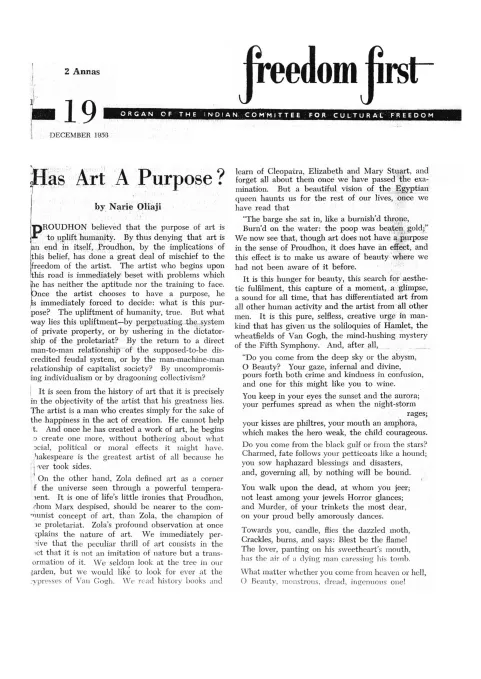
periodical issue
Freedom First
By R. Srinivasan, Philip Spratt, M. Bhaktavatsalam, Faiz Noorani, Rustam Hormuzdiyar, R.H., F. S. N.
Freedom First — Organ of the Indian Committee for Cultural Freedom; printed & published by Narie Oliaji at Kanada Press, 109 Parsi Bazaar Street, Bombay 1. · Bombay · 1953
12 pages
Freedom First
Summary
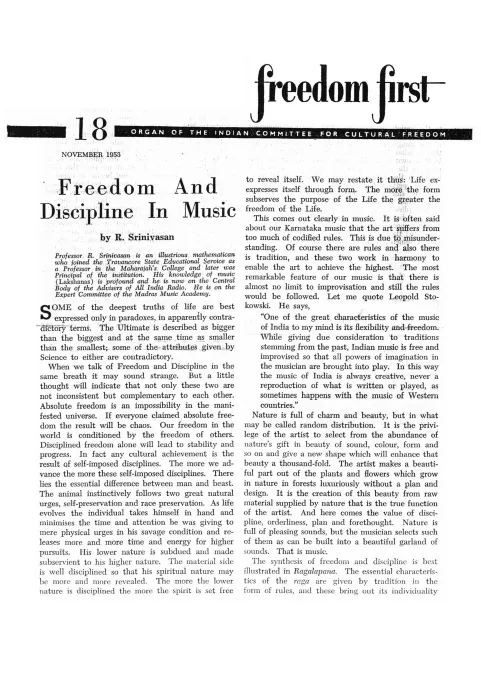
This is issue No. 18 of Freedom First (November 1953), the monthly bulletin of the Indian Committee for Cultural Freedom, affiliated to the Congress for Cultural Freedom. The issue opens with an essay by mathematician R. Srinivasan on freedom and discipline as complementary forces in Karnatic music, followed by a substantial Notes section commenting on Cold War affairs (the Kazakh refugees, British Guiana’s communist-infiltrated P.P.P. government, Chinese/North Korean POW repatriation, Stalin’s disputed will, a tribute to the late Ernst Reuter of Berlin) and domestic cultural-policy concerns (state patronage of theatre). M. Bhaktavatsalam’s welcome address to the Committee’s Annual Conference in Madras argues that Gandhian ethics — the unity of moral means and ends — are the strongest defence against ‘ideological germ-warfare’ and the totalitarian capture of the individual mind. A Review section covers Frank Moraes’s Report on Mao’s China (praised for puncturing illusions about the Chinese communist regime), Eugene O’Neill’s play A Moon for the Misbegotten, Roger Martin du Gard’s Notes on Andre Gide, and Geoffrey Ashe’s The Tale of the Tub, plus a long appreciative notice of the newly launched Encounter magazine. The issue closes with a reader’s letter from Santha Rama Rau contesting an earlier review, the I.C.C.F.’s formal membership and governance rules adopted at the Madras conference, and a closing page of pointed quotations (‘With Many Voices’) satirizing communist sympathizers and diplomatic doublespeak, alongside a membership subscription form.
Key points
-
R. Srinivasan’s “Freedom And Discipline In Music” argues codified rules in Karnatic music enable rather than restrict improvisation, citing Leopold Stokowski’s praise of Indian music’s flexibility relative to Western reproduction-bound performance.
-
The “Notes” section welcomes Kazakh refugee defectors into Kashmir, criticises state funding of theatres as inviting bureaucratic censorship of the arts, and reports that only 19 of 921 Chinese POWs, or 2 per cent, chose repatriation to Communist China.
-
Philip Spratt’s “The New Serfdom” reviews the 1953 ILO/UN report on forced labour, finding the Soviet Union’s use of forced labour for both political punishment and economic production the worst offender, though noting some forced labour existed even in Spain, South Africa and the US.
-
M. Bhaktavatsalam’s welcome address to the ICCF’s Madras conference argues Gandhi’s insistence that means be as pure as ends is the strongest defence against “ideological germ-warfare.”
-
Faiz Noorani reviews Frank Moraes’s “Report on Mao’s China,” praising its exposure of communist thought control while criticising Moraes’s lapse into providing intellectual cover for Indian neutralism.
-
A review of the inaugural issue of Encounter, edited by Stephen Spender and Irving Kristol, highlights Nicolas Nabokov’s essay on Soviet music and Denis de Rougemont’s somewhat patronising portrait of India.
-
Santha Rama Rau’s letter disputes a prior pseudonymous review of Perspectives, and the formal Rules of the Indian Committee for Cultural Freedom, adopted at the Madras conference, are reproduced in full.
Essays
Freedom And Discipline In Music
By R. Srinivasan
R. Srinivasan, a mathematician and authority on Karnatic music theory, argues that freedom and discipline are not opposites but complementary: absolute freedom without self-imposed discipline collapses into chaos, while true cultural freedom is always ‘disciplined freedom.’ He illustrates the point through Indian classical music, where codified rules (exemplified in ragalapana) coexist with, and in fact enable, an almost unlimited scope for improvisation — quoting conductor Leopold Stokowski’s praise of Indian music’s flexibility and creative freedom compared to the more reproductive tendency of Western music. He extends the argument with the metaphor of Shruti (note-intervals) as the indulgent ‘mother’ and Laya (rhythm) as the disciplining ‘father’ of music, and closes by describing artistic and cultural progress as an undulating series of ever-higher crests, achievable only through this synthesis of freedom and discipline.
- Freedom and discipline are presented as complementary, not contradictory, forces in both life generally and art specifically.
- Self-imposed discipline is framed as the distinguishing mark of human cultural advancement over animal instinct.
- Karnatic music’s codified rules and traditions are argued to enable, rather than restrict, improvisation and creative freedom.
- Leopold Stokowski is quoted praising Indian music’s flexibility and freedom relative to Western reproduction-bound performance.
- The Shruti/Laya (mother/father) metaphor is used to explain the interplay of expressive freedom and structural discipline.
- Cultural progress is described as occurring in an undulating, crest-by-crest pattern driven by ‘disciplined freedom.‘
Notes (Heads on Our Shoulders / The Show Must Go On / Who Speaks for Asia? / Ernst Reuter / Stalin’s “Will” / The Lesson of Guiana / Chinese & North Koreans Vote / Thanu Pillai and the Rope)
This unsigned Notes section comments on a run of Cold War and cultural-policy topics. It welcomes the defection of fifteen communist Kazakh refugees from China to Kashmir (noting their later departure for Turkey), criticizes the Bombay government’s plan to fund new theatres and drama prizes from entertainment tax revenue on the grounds that state patronage will substitute bureaucratic moral judgment for aesthetic judgment (citing Somerset Maugham), and questions various claimants to speak ‘for Asia,’ including a satirical aside on Asian table-tennis rankings. It memorializes West Berlin’s Lord Mayor Ernst Reuter as a symbol of resistance to Nazi and communist tyranny alike, reports that a widely circulated ‘Stalin’s Will’ document is judged a Paris-manufactured forgery, and analyzes A. D. Gorwala’s warnings (in the Statesman) about communist infiltration in Bengal in light of the collapse of Cheddi Jagan’s P.P.P. government in British Guiana — presented as a cautionary parallel for India. It further reports that of 921 Chinese POWs given the choice, only 19 (2%) opted to return to communist China, taken as decisive evidence against communist claims of popular support, and closes by criticizing P. Thanu Pillai, a Praja Socialist leader in Travancore-Cochin, for reportedly favoring a United Front with communists, quoting Lenin’s own cynical description of such alliances.
- Fifteen Kazakh communist-refugee defectors are welcomed into Kashmir and their eventual departure for Turkey is noted with approval.
- State funding of theatres via entertainment-tax revenue is criticized as inviting bureaucratic censorship of the arts over aesthetic judgment.
- Ernst Reuter’s death is marked with tribute to his resistance against Nazi and Soviet domination of Berlin.
- A circulating document purporting to be ‘Stalin’s Will’ is reported as a fabrication manufactured in Paris.
- The collapse of Cheddi Jagan’s P.P.P. government in British Guiana is presented as a lesson about communist infiltration relevant to India and Bengal specifically.
- Only 19 of 921 Chinese POWs (2%) chose repatriation to communist China, cited as proof communism lacks popular support among its own captured soldiers.
- P. Thanu Pillai of the Praja Socialist Party is criticized for reportedly favoring a communist-inclusive United Front in Travancore-Cochin elections.
The New Serfdom
By Philip Spratt
Philip Spratt reviews the 1953 Report of the ILO/ECOSOC Ad Hoc Committee on Forced Labour, chaired by Sir Ramaswamy Mudaliar, which investigated forced labour both for political coercion and for economic purposes worldwide. Spratt notes the Committee found forced labour for economic purposes existing on varying scales even in non-communist countries (Spain, South Africa, the U.S.A., and some colonies), with South Africa singled out as the worst offender outside the iron curtain, while communist countries — especially the Soviet Union — were found to use forced labour both to punish political dissent and as a structural element of the national economy. He quotes the Committee’s finding that such systems ‘violate the fundamental rights of the human person’ and warns that broader, more insidious forms of state coercion beyond outright forced labour threaten liberty even in welfare states, closing with the fear that the report will be politically shelved rather than acted upon.
- The essay reviews the 1953 ILO/UN Ad Hoc Committee on Forced Labour report chaired by Sir Ramaswamy Mudaliar.
- The Committee distinguished forced labour for political coercion from forced labour for economic purposes.
- Non-communist countries (Spain, South Africa, the U.S.A., some colonies) were found to have some forced labour, with South Africa cited as the worst case.
- The Soviet Union’s penal and labour legislation was found to function as both political punishment and an economic system element.
- Spratt frames state-driven forced labour as an extreme instance of a broader, more insidious coercive trend affecting welfare states generally, not only totalitarian ones.
- The piece ends pessimistically, predicting the report’s findings will be shelved for the sake of political convenience.
‘No Place For Ideological Germ-Warfare’ (Welcome Address of Chairman, Reception Committee, at the Annual Conference of the Indian Committee for Cultural Freedom in Madras)
By M. Bhaktavatsalam
M. Bhaktavatsalam’s welcome address to the Annual Conference of the Indian Committee for Cultural Freedom in Madras argues that true democracy is a ‘way of life’ rather than a mere form of government, and warns that modern man risks being reduced to a purposeless ‘man-machine’ by both material ambition and ideological totalitarianism. He argues that societies need men who feel a mission and purpose, not citizens ground down under ‘ideological steam-rollers,’ and invokes the ancient Tamil Sangam ideal that ‘the world is my home and all are my kin’ as a model of universal fraternity opposed to sectarian hatred. The address’s central argument is that Mahatma Gandhi’s greatest contribution to modern thought was insisting that means must be as pure as ends — that no noble end can be achieved by foul means — and that this Gandhian ethic of unity between personal and public morality is the strongest available defence against ‘ideological germ-warfare,’ i.e., the totalitarian capture and annihilation of individual conscience.
- Democracy is framed as a way of life and a partnership in progress, not merely a governmental form.
- Modern man is described as at risk of being reduced to a purposeless ‘man-machine’ by both greed-driven material struggle and ideological absolutism.
- The ancient Tamil Sangam saying ‘the world is my home and all are my kin’ is invoked as an ideal of universal brotherhood against sectarian division.
- Gandhi’s central ethical legacy is identified as insisting the means to any end must be as pure as the end itself.
- A ‘false moral code’ separating personal from public morality is condemned as the enemy of the Gandhian way of life.
- The essay concludes that education in culture and truth is the antidote to totalitarian ‘ideological germ-warfare’ that seeks to annihilate individuality.
Review: Report on Mao’s China (by Frank Moraes)
By Faiz Noorani
The Review section’s lead piece, by Faiz Noorani, covers Frank Moraes’s Report on Mao’s China (Macmillan, 1953). Moraes, unlike many Western fellow-travelling visitors, brings a sceptical, liberally-educated common sense to his conducted tour, and the review praises his exposure of the pervasive thought control, absence of rule of law, and Soviet-derived ideological ‘recipe’ behind China’s superficially Chinese ‘trimmings.’ The review does fault Moraes for a ‘lapse’ into providing a rationale for neutralism, arguing (against Moraes) that alliance among democratic countries against the communist threat is not itself ‘an incitement to war,’ and that there can be no genuine coexistence with a self-declared expansionist, imperialist communism. Shorter notices follow on Eugene O’Neill’s A Moon for the Misbegotten (by Rustam Hormuzdiyar), Roger Martin du Gard’s Notes on Andre Gide (by R.H.), and Geoffrey Ashe’s The Tale of the Tub (by F.S.N.), plus notice of a new Chilean Committee for Cultural Freedom established in Santiago under Prof. G. Nicolai.
- Faiz Noorani reviews Frank Moraes’s Report on Mao’s China, praising its clear-eyed exposure of communist thought control and absence of rule of law.
- The review criticizes Moraes’s defence of Indian neutrality as a lapse into providing intellectual cover for non-alignment.
- The review argues democratic alliance against communism is not itself an incitement to war, contra Moraes’s stated thesis.
- Shorter notices cover O’Neill’s A Moon for the Misbegotten, du Gard’s Notes on Andre Gide, and Ashe’s The Tale of the Tub.
- A C.C.F. News item reports the founding of a Chilean Committee for Cultural Freedom in Santiago under Prof. G. Nicolai.
Review: A Moon For The Misbegotten (by Eugene O’Neill)
By Rustam Hormuzdiyar
A review (signed R.H.) of the inaugural issue of Encounter, the new English-language literary-political monthly edited by Stephen Spender and Irving Kristol and sponsored by the Congress for Cultural Freedom, positioned as a companion to the Paris Bureau’s French-language Preuves. The review highlights Nicolas Nabokov’s essay on the state of music in the USSR (tracing Soviet composers’ retreat from experimentation to conventional idiom as rooted in the 1930s transformation of Soviet society, and celebrating small cracks appearing in Stalin-era cultural repression), Leslie Fiedler’s analysis of the Rosenberg case, and Denis de Rougemont’s ‘Looking For India,’ an outsider’s portrait of India that the reviewer finds ultimately patronizing. It closes praising the magazine as answering ‘many an unacknowledged prayer’ for untrammelled cultural exchange in the English-speaking world.
- Encounter, edited by Stephen Spender and Irving Kristol, launches as an English-language sister publication to the Congress for Cultural Freedom’s French Preuves.
- Nicolas Nabokov’s essay on Soviet music traces composers’ abandonment of experimentation to the social transformation of the Russian state since 1930.
- The review highlights the ‘complete disappearance’ of official portraits of Stalin and other Soviet figures as a hopeful sign.
- Leslie Fiedler’s piece on the Rosenberg case is quoted on the political uses of abstract declarations versus concrete suffering.
- Denis de Rougemont’s ‘Looking For India’ is treated as a somewhat patronizing outsider portrayal, ending on the line ‘India is problems.’
- The review closes by quoting Wordsworth’s ‘To Toussaint L’Ouverture’ in tribute to the new magazine.
Review: Notes On Andre Gide (by Roger Martin Du Gard)
By R.H.
A letter to the editor from Santha Rama Rau objects to a prior Freedom First review (in the May issue) of the quarterly Perspectives, written by a reviewer using the pseudonym ‘Agni,’ correcting factual errors about the Ford Foundation’s Intercultural Publications Inc. and criticizing the review’s tone as prejudiced and snobbish; she finds it odd that such an article appeared in a magazine dedicated to cultural freedom. The editor’s brief reply defends the decision to publish both the original review and this rebuttal as consistent with the principle that cultural freedom calls for publication rather than suppression of criticism. The facing page carries an advertisement for Encounter magazine listing its full roster of contributors and subscription details.
- Santha Rama Rau’s letter disputes factual and tonal criticisms made by pseudonymous reviewer ‘Agni’ against the quarterly Perspectives in an earlier Freedom First issue.
- She corrects ‘Agni’s’ claim that ‘Intercultural Publications Inc.’ is merely a synonym for the Ford Foundation, noting the Foundation’s broader activities.
- She characterizes the original review as prejudiced, ignorant, and inconsistent with a magazine dedicated to cultural freedom.
- The editor defends publishing both the original review and Rama Rau’s rebuttal as consistent with cultural-freedom principles.
- A facing advertisement for Encounter lists its contributor roster, including W. H. Auden, Albert Camus, Bertrand Russell, and Arthur Schlesinger Jr.
Review: The Tale of the Tub (by Geoffrey Ashe)
By F. S. N.
The formal Rules of the Indian Committee for Cultural Freedom (I.C.C.F.), adopted at the Annual Conference in Madras, are reproduced in full. They cover membership eligibility and application, the formation of autonomous Local Groups, procedures for Annual and Extraordinary General Meetings, voting arrangements by local group and cumulative vote for Executive Committee elections, the composition and powers of the twenty-member Executive Committee (which may co-opt up to five additional members), the Bombay office location, the Committee’s affiliation to the Paris-headquartered Congress for Cultural Freedom, and the two-thirds-majority procedure required to amend the Rules.
- Membership requires adherence to the 1951 Bombay Declaration on Cultural Freedom, a written application, paid subscription, and Executive Committee acceptance.
- Local Groups of more than ten members may be authorised to operate autonomously under Executive Committee bye-laws.
- General Meetings (Annual and Extraordinary) have defined notice periods, agendas, and voting-by-local-group procedures with cumulative voting for Executive Committee elections.
- The Executive Committee has up to twenty members (fifteen elected, up to five co-opted) and meets at least twice yearly.
- The Committee’s office is in Bombay and it is affiliated with the Paris-headquartered Congress for Cultural Freedom.
- Rule amendments require a two-thirds majority after fifteen days’ prior notice.
C.C.F. News
The closing page, ‘With Many Voices’ (epigraph from Tennyson), is a compilation of pointed newspaper and magazine quotations from October 1953, mostly aimed at satirizing complacency or sympathy toward communism among Indian and international public figures. It includes C. Rajagopalachari comparing communists to bugs, B. R. Ambedkar’s prediction that India would soon become communist, Vinoba Bhave on state-owned schools eliminating educational freedom, criticism of K. M. Panikkar’s pro-Chinese neutrality, and barbed remarks from Malcolm Muggeridge on diplomats’ careers built on appeasing dictators. The page closes with a membership enrolment form for the Indian Committee for Cultural Freedom and the publication’s imprint line.
- The page compiles satirical or pointed press quotations from October 1953 sources including Times of India, Christian Science Monitor, and Bombay Chronicle.
- C. Rajagopalachari is quoted comparing communists to nocturnal bugs.
- B. R. Ambedkar is quoted predicting India would soon become a communist country.
- Vinoba Bhave warns that state ownership of all schools would eliminate freedom in education, citing Russia as precedent.
- K. M. Panikkar is criticized (via Mark Alexander) as a fellow-travelling proponent of Egyptian/Arab and Indian neutrality aided by ‘crypto-communist’ journalists in Cairo.
- Malcolm Muggeridge’s satirical piece on diplomatic careers built on appeasing dictators (Gandhi, Goering, Stalin-era figures) closes the page.
- A membership enrolment form for the I.C.C.F. (annual fee Rs. 3/-) appears alongside the imprint, edited by Aziz Mauni.
Generated by the v1.5 extraction pipeline. Awaiting editorial review.
Metadata and summary are AI-extracted from the source PDF and reviewed for editorial accuracy. The original work is available via the Read PDF tab above (where present); paragraph-level citation inside the PDF is deferred to a future engagement.