periodical issue
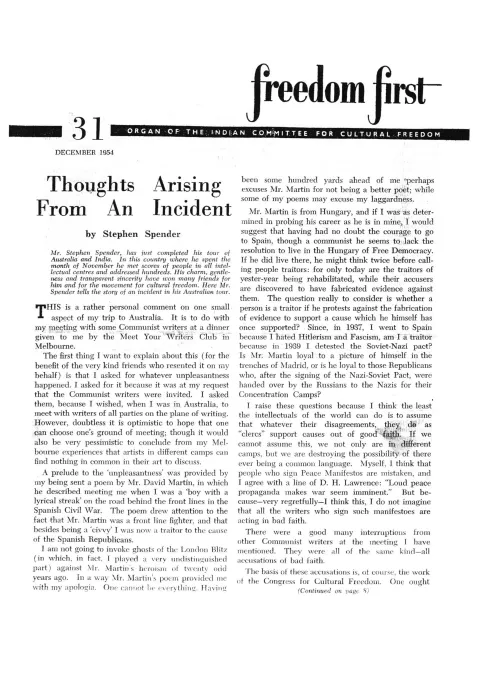
Freedom First
By Charles Morgan, V. B. Karnik, Stephen Spender, N.E.
Edited by V. B. Karnik; printed & published by Prabhakar Padhye at The Kaneda Press, 109 Parsi Bazzar Street, Bombay 1. · Bombay · 1955
12 pages
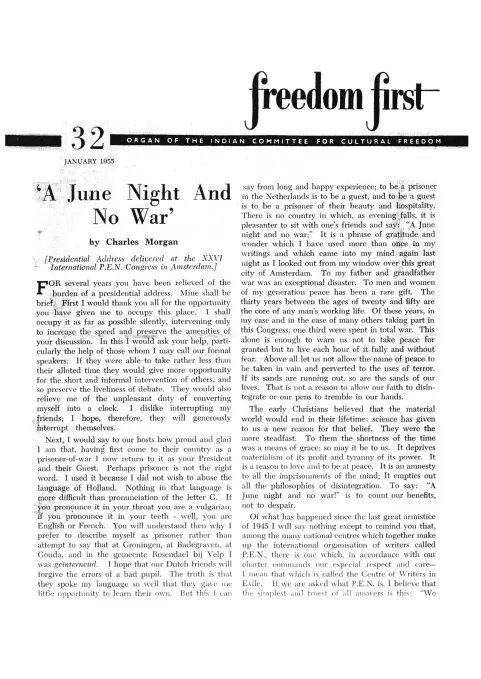
Freedom First
Summary
Freedom First No. 32 (January 1955), organ of the Indian Committee for Cultural Freedom, edited by V. B. Karnik, opens with Charles Morgan’s presidential address to the XXVI International PEN Congress in Amsterdam, reflecting on peace, the writer’s duty to bear witness, and the special obligation to the ‘Centre of Writers in Exile.’ The issue’s editorial ‘Notes’ section takes up domestic controversies: the false ‘bread or freedom’ dichotomy, a Gandhian non-violent method used to quell rebellion in Tunisia, Rajya Sabha debate over film censorship and ‘undesirable films,’ the Criminal Procedure Code Amendment Bill’s defamation-of-public-servants clause, a tribute to Dr. Sampurnanand on his election as U.P. Chief Minister, a satirical item on a Calcutta police hunger-strike, and obituary notes on the poet Jibanand Das and the Tamil writer-editor Kalki (R. Krishnamurthy). V. B. Karnik contributes a substantial analytical essay defending and extending Nehru’s public attack on Indian communists, arguing that Indian communism is an instrument of an internationally directed Soviet-controlled movement rather than an indigenous political current. An unsigned piece, ‘Real Wages In Soviet Russia,’ reports Kasturbhai Lalbhai’s assessment of Soviet living standards and summarises Janet G. Chapman’s statistical study of Soviet real wages, concluding that Soviet workers in 1952 stood roughly where they had been before the 1917 revolution. Stephen Spender’s essay ‘The Writer And Freedom’ is an extended meditation, cast partly as allegory, on the modern writer’s relationship to bourgeois society and to Marxist criticism (engaging George Lukacs at length), arguing for a definition of artistic freedom as the ‘vital margin’ between individual vision and social consciousness. A report, ‘Mr. Nabokov In India,’ covers Nicolas Nabokov’s (Secretary-General of the Congress for Cultural Freedom) visit to Bombay and Delhi. The issue closes with ‘Letters to the Editor’ (on Stephen Spender’s earlier visit and on a review of Minoo Masani’s book on the Communist Party of India) and ‘With Many Voices,’ a column of contemporary press quotations from Indian and international statesmen on communism, the Indian Constitution, and world affairs.
Key points
-
Charles Morgan’s presidential address to the XXVI International PEN Congress in Amsterdam reflects on the rarity of peace for his generation and the writer’s obligation to bear witness, invoking the Centre of Writers in Exile as PEN’s especial charge.
-
The “Notes” section rebuts the false “bread or freedom” choice via Ignazio Silone, praises a Gandhian-style unarmed peace mission used to quell rebellion in Tunisia, and criticises the enacted defamation-of-public-servants clause in the Criminal Procedure Code Amendment Bill.
-
V. B. Karnik’s “The Prime Minister And Communists” defends and extends Nehru’s condemnation of Indian Communists as anti-national, arguing Indian communism is an instrument of an internationally directed, Moscow-controlled apparatus.
-
An unsigned piece, “Real Wages In Soviet Russia,” summarises Janet G. Chapman’s statistical study concluding Soviet workers in 1952 stood roughly at pre-1917-revolution parity, blaming forced collectivisation and neglected consumer-goods production.
-
Stephen Spender’s “The Writer And Freedom” engages Marxist critic George Lukacs, defining artistic freedom as the “vital margin” separating a socially responsible artist from being reduced to a mechanical instrument of ideology.
-
A report, “Mr. Nabokov In India,” covers Nicolas Nabokov’s Bombay and Delhi visit, including his press conference on the “conformist tendency of modern intellectuals” and meeting with Prime Minister Nehru.
-
Letters to the editor debate whether the Congress for Cultural Freedom is more than “intellectual opportunism” and criticise Principal Dalvi’s dismissive review of Gandhism and the Bhoodan Movement as anti-communist forces.
Essays
’A June Night And No War’
By Charles Morgan
Charles Morgan’s presidential address to the XXVI International PEN Congress in Amsterdam reflects on the rarity of peace for his generation, the writer’s obligation to bear witness in his own idiom (pamphleteer or solitary artist), and a plea that the Congress not be wasted on partisan manoeuvring. He closes with tribute to the Netherlands and to ‘suffering humanity’ generally, invoking the PEN Centre of Writers in Exile as the movement’s especial charge.
- Delivered as the XXVI International PEN Congress presidential address in Amsterdam.
- Morgan reflects that peace has been a ‘rare gift’ for his generation, most of whose prime years were spent in war.
- He distinguishes writers who intervene as pamphleteers/satirists (citing Voltaire, Swift) from those who remain detached, arguing both are legitimate responses of conscience.
- He invokes Tolstoy and Turgenev as emblematic of the ‘militant’ versus ‘detached’ writer temperaments.
- He frames PEN’s core purpose as ending the very condition of ‘writers in exile.’
- He closes with homage to the Netherlands’ historical sacrifices for ‘the liberties of the mind’ and to suffering humanity broadly.
Notes (Why Freedom First? / A Gandhian Experiment / ‘Undesirable’ and ‘Objectionable’ / Defamation of Public Servants / A Scholar Honoured / Fast & Win / Jibanand Das / Kalki)
The unsigned ‘Notes’ section (editorial short items, likely by editor V. B. Karnik) covers: a rebuttal to the ‘bread or freedom’ false choice using Ignazio Silone’s Encounter essay; a Gandhian-style unarmed peace mission used to quell rebellion in Tunisia; Rajya Sabha debate on film censorship following Mrs. (Lilavati) Munshi’s resolution on ‘undesirable’ films and parallel Madras legislation against ‘objectionable’ drama; criticism of the enacted defamation-of-public-servants clause in the Criminal Procedure Code Amendment Bill; a tribute to Dr. Sampurnanand’s election as Congress leader and U.P. Chief Minister; a satirical item on a Calcutta police pay hunger-strike (‘Fast & Win’); and obituary notices for the Bengali poet Jibanand Das and the Tamil writer-editor Kalki (Sri R. Krishnamurthy).
- Argues against treating ‘Bread or Freedom’ as a false binary, quoting Ignazio Silone’s Encounter essay ‘The Choice of Comrades.’
- Praises a Tunisian experiment using unarmed Tunisian-French delegations to persuade Fellagha rebels to disarm, comparing it to Gandhi’s peace missions.
- Criticises calls in the Rajya Sabha (following Mrs. Munshi’s resolution) and Madras State Assembly for stricter censorship of ‘undesirable’/‘objectionable’ films and plays as vague and open to bureaucratic abuse.
- Criticises the enacted defamation-of-public-servants clause as creating a privileged class shielded from press criticism.
- Honours Dr. Sampurnanand’s election as U.P. Chief Minister, recalling his 1953 address on ‘The Neuroses of the Indian Intelligentsia.’
- Satirises the Calcutta police force’s hunger-strike for better pay and conditions.
- Notes the deaths of Bengali poet Jibanand Das and Tamil writer/editor Kalki (R. Krishnamurthy).
The Prime Minister And Communists
By V. B. Karnik
V. B. Karnik’s essay defends and elaborates Nehru’s public condemnation of Indian communists as anti-national. Karnik argues Indian communism is not an indigenous movement but an instrument of an internationally directed, Moscow/Bucharest-controlled communist apparatus whose ultimate aim in every country is dictatorship of the proletariat achieved by any means, fair or foul. He contends the Prime Minister, while alert to internal communist danger, has not sufficiently reckoned with the subversive influence exercised by communist states abroad, and closes by urging that anti-communist criticism be paired with a non-hostile, but clear-eyed, stance toward communist countries generally.
- Opens by summarising Nehru’s Delhi speech condemning Indian communists as anti-national, unpatriotic, and violent.
- Argues Indian communism is ‘a foreign organisation planted on the soil of India’ directed from Moscow (via the Cominform, now functioning from Bucharest).
- Compares the international communist movement’s structure to an army general staff directing national ‘contingents.’
- Asserts the ultimate aim of communist parties everywhere is dictatorship of the proletariat, pursued by any means including lying low or forming alliances.
- Criticises the Prime Minister for insufficiently recognising the subversive influence of communist states abroad despite his China visit.
- Concludes that condemnation of communism should not require hostility to communist nations, but must be paired with clear-eyed criticism of their methods.
Real Wages In Soviet Russia
This unsigned piece reports Kasturbhai Lalbhai’s press-conference claim, after leading an Indian industrialists’ delegation to the Soviet Union, that Russian workers’ living standards are almost as low as those of Indian workers, and it corroborates this with an extended summary of American economist Janet G. Chapman’s statistical study of Soviet real wages (1928-1952), published in The Review of Economics and Statistics. Detailed retail price and wage tables show prices rising far faster than money wages, with real wages after taxes and bond purchases in 1952 only marginally above (or, on 1937-weighted terms, close to) the 1928 level. The piece (continued on page 11) concludes that 35 years after the revolution the Soviet worker stood roughly where he had been four years before it, blaming forced collectivization and neglect of consumer goods under the Five Year Plans.
- Kasturbhai Lalbhai, leading an Indian industrialists’ delegation to the USSR, stated Soviet workers’ standard of living is almost as low as Indian workers’.
- Cites a 1953 Calcutta-published comparative study showing Soviet purchasing power considerably lower than American, British, or Indian counterparts for staples like bread and eggs.
- Summarises Janet G. Chapman’s study ‘Real Wages in the Soviet Union, 1928-52,’ based on indirect data since the USSR bans cost-of-living publication.
- Presents detailed 1928/1937/1948/1952 retail price index and real-wage tables showing prices rose far faster than money wages.
- Notes rising direct taxes and compulsory bond purchases further eroded Soviet workers’ real income over the period.
- Concludes (in the page-11 continuation) that 35 years after the revolution, Soviet workers’ real wages stood roughly at pre-revolution (1913-level) parity, blaming forced collectivization and neglected consumer-goods production.
The Writer And Freedom
By Stephen Spender
Stephen Spender’s essay uses an extended marriage/divorce allegory to explore the modern writer’s alienated relationship with bourgeois society, then turns to a direct engagement with Marxist critic George Lukacs, whose view that ‘bourgeois freedom’ is illusory Spender partly credits but ultimately rejects. Spender argues that true artistic freedom lies in the ‘super-imposition’ of individual vision onto socially shared concepts (illustrated via a painter’s apple, and art from Ajanta to Picasso), and that what must be defended is not unfettered individualism but the ‘absolutely vital margin’ separating a socially responsible artist from being reduced to a mechanical instrument of ideology.
- Opens with an allegory of the modern writer’s ‘marriage’ to and eventual ‘divorce’ from bourgeois society.
- Engages George Lukacs’ Marxist literary criticism, quoting his Austrian Quarterly (Meanyin) essay preferring Tolstoy’s example over Joyce’s and defending socialist realism against ‘dangerous decline of standards.’
- Argues that pure individualism (epitomised by James Joyce) is also an illusion, though historically fruitful as a form of resistance.
- Defines artistic freedom as the state in which the artist is simultaneously a social being and individually aware, illustrated by the ‘double image’ of a painted apple (shared concept plus unique vision).
- Extends the argument across art history — Ajanta caves, Lascaux, Greek vase painting, Picasso — as evidence of art’s dual contemporary/timeless character.
- Concludes that what must be fought for is not complete individual freedom but the ‘vital margin’ that separates a person from being one of ‘as many machines as there are members of the population.‘
Mr. Nabokov In India
By N.E.
This report (signed ‘N.E.’) covers the visit of Nicolas Nabokov, Secretary-General of the Congress for Cultural Freedom and noted composer/critic, to Bombay and Delhi under the Indian Committee for Cultural Freedom’s auspices. It recounts his provocative press conference on the ‘conformist tendency of modern intellectuals,’ his public lecture ‘Trends in Contemporary Music’ at Jai Hind College, a Rotary Club address on ‘Music — the universal language,’ his meeting with the Prime Minister in Delhi, and social gatherings including a dinner hosted by H. R. Pardiwala and a reception at Mme. Sophia Wadia’s home featuring a Bharat Natyam performance by Mrs. Shakuntala Masani.
- Nicolas Nabokov, Secretary-General of the Congress for Cultural Freedom, visited Bombay and Delhi under the Indian Committee’s invitation.
- His Bombay press conference addressed the ‘conformist tendency of modern intellectuals’ across both totalitarian and democratic/commercial societies.
- He delivered a public lecture, ‘Trends in Contemporary Music,’ at Jai Hind College Hall — the Committee’s first music programme.
- A misreport of his lecture in a Bombay daily required a published correction from Delhi regarding political terminology in musical aesthetics.
- At Bombay’s Rotary Club he spoke on the ‘triple danger’ facing the modern artist: economic peril, commercialism, and state dictation.
- In Delhi he met Prime Minister Nehru to discuss cultural questions, and attended social gatherings including a Bharat Natyam performance by Shakuntala Masani.
Letters to the Editor (Mr. Spender’s Visit / A Sectarian Outlook?)
By Sailesh K. Roy; S. N. Tripathi
Two letters to the editor: Sailesh K. Roy of Calcutta writes on Stephen Spender’s recent Indian visit, questioning whether the Congress for Cultural Freedom’s activities are seen as more than intellectual opportunism, and urges the Committee to stimulate creative vitality rather than mere anti-communist propaganda (with an editorial reply defending the Committee’s dual commitment to freedom and culture). S. N. Tripathi of Calcutta criticises Principal Dalvi’s review of Minoo Masani’s book Communist Party of India as unfairly dismissive of Gandhism and the Bhoodan Movement as anti-communist forces.
- Sailesh K. Roy questions whether the Congress for Cultural Freedom is seen in Calcutta as more than a group of ‘intellectual opportunists.’
- Roy urges the Committee to focus on stimulating creative vitality, citing Encounter and Preuves as models, and hopes for festivals of arts in India.
- The editor’s reply insists the Committee is ‘wedded to the ideal of freedom and culture,’ not merely an anti-communist front.
- S. N. Tripathi criticises Principal Dalvi’s review of Minoo Masani’s Communist Party of India for being contemptuous of Gandhism and the Bhoodan Movement without argument.
- Tripathi argues humanism should breed tolerance for multiple anti-communist remedies rather than sectarian dismissal of others.
With Many Voices
‘With Many Voices’ is the issue’s closing column of quotations from contemporary press and public statements, epigraphed with lines from Tennyson. It gathers remarks from Indian and international statesmen and commentators — including Vinoba Bhave, Jawaharlal Nehru, Sucheta Kripalani, Acharya Kripalani, Jayaprakash Narayan, M. Patanjali Sastri, and foreign ministers of South Korea and Japan — on themes of communism, diplomatic flexibility, India’s Constitution, and Cold War tensions.
- Column of quotations from December 1954/November 1954 press sources, framed by an epigraph from Tennyson.
- Includes Hallam Tennyson quoting Vinoba (Bhave) on the difference between communism-minus-violence and being alive.
- Quotes Nehru’s exception in favour of not expecting responsibility from the Communist Party, since it does not itself believe in democracy.
- Quotes Acharya Kripalani equating the need for a Preventive Detention Act internally with the need for the atom bomb internationally.
- Cites M. Patanjali Sastri contrasting the U.S. Constitution’s 22 amendments in 150+ years with India’s Constitution already amended three times in five years.
- Includes a call (via ‘Rover’ in Commerce) for Jayaprakash Narayan to add ‘Sattadan’ (gift of power) to his Bhoodan/Sampatidan/Shramdan/Samayadan quartet.
Generated by the v1.5 extraction pipeline. Awaiting editorial review.
Metadata and summary are AI-extracted from the source PDF and reviewed for editorial accuracy. The original work is available via the Read PDF tab above (where present); paragraph-level citation inside the PDF is deferred to a future engagement.