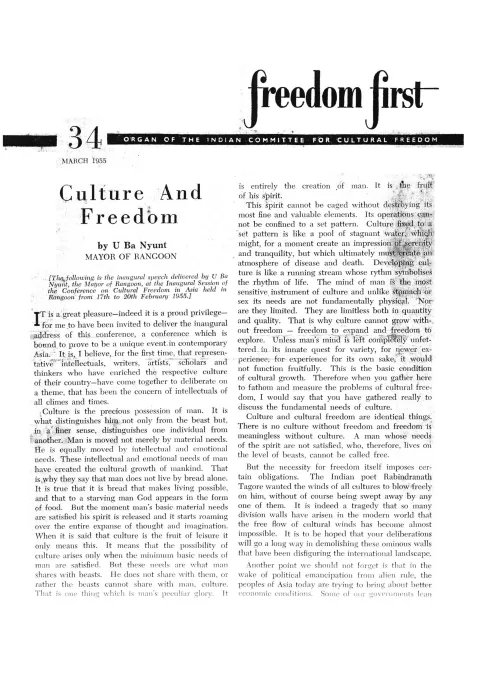
periodical issue
Freedom First
By Prabhakar Padhye, Karl A. Wittfogel
printed & published by Prabhakar Padhye at The Kanada Press, 109 Parsi Bazzar Street, Bombay 1 · Bombay · 1955
16 pages
Freedom First
Summary
This is issue No. 33 (February 1955) of Freedom First, the monthly bulletin of the Indian Committee for Cultural Freedom, published in Bombay and affiliated to the world Congress for Cultural Freedom. In the rendered pages, the issue opens with an unsigned lead article (attributed at its close to Prabhakar Padhye) previewing the forthcoming Conference on Cultural Freedom in Asia (Rangoon, 17-20 February 1955), arguing that Asian intellectuals need positive democratic alternatives, not just anti-communist polemic, to compete with the appeal of totalitarian ideologies. A substantial ‘Notes’ section comments on Nehru’s address to the Indian Science Congress, the trials of Yugoslav dissidents Milovan Djilas and Vladimir Dedijer, Rajagopalachari’s appeal to America to scrap its atomic arsenal, Mrinalini Sarabhai’s account of restricted freedoms during a dance tour of East Germany, reports of Chinese labourers sent to work in Soviet Siberia, and a call for genuine (rather than propagandistic) India-America cultural exchange. A short news item details the forthcoming Rangoon conference’s delegate list, including Jayaprakash Narayan, M. R. Masani, Asoka Mehta, and others. The issue’s centerpiece, in the rendered pages, is a long scholarly essay by the German-American sinologist Karl A. Wittfogel, ‘The Historical Position of Communist China: Doctrine and Reality,’ which uses Marx’s and Lenin’s own (and later suppressed) writings on ‘Oriental despotism’ and ‘Asiatic society’ to argue that Communist China is not a proto-socialist society advancing toward Marxian socialism but a new form of ‘general (state) slavery’ organized around a monopoly managerial bureaucracy. Nissim Ezekiel announces the launch of a new bi-monthly arts-and-ideas journal, Quest, to be published by the Indian Committee for Cultural Freedom as a literary complement to Freedom First. A ‘C.C.F. News’ column reports on Congress for Cultural Freedom activities worldwide: the Ernst Reuter memorial lecture series in Berlin, Swedish Committee lectures, German Arciniegas’s Latin American tour, a Preuves meeting in Paris featuring Polish composer Andrzej Panufnik and writer Czeslaw Milosz, and a Mexican Book Fair exhibit that drew Communist attacks. A Reviews section covers four books: U Nu’s Burma Under the Japanese (reviewed by V.B.K.), Celina Lu Zanne’s novel Heritage of Buddha (Madan Lal Sharma), James Rorty and Moshe Decter’s McCarthy and the Communists (Faiz Noorani), and R. N. Carew Hunt’s Marxism: Past and Present (Gopal Krishna). Letters to the Editor debate the Committee’s anti-communist orientation and dispute the accuracy of a previous article’s real-wages-in-Soviet-Russia statistics, with an editorial reply defending the figures. The issue closes with ‘With Many Voices,’ a page of topical quotations from public figures including Rajagopalachari, Stalin, N. C. Chatterjee, Vinoba Bhave, Henry Cabot Lodge, S. Radhakrishnan, and the Pope.
Key points
-
The unsigned lead article “The Problems of Cultural Freedom in Asia” (by Prabhakar Padhye) previews the Rangoon Conference on Cultural Freedom in Asia (17-20 February 1955) and argues Asian intellectuals need positive democratic alternatives such as Gandhism, Radical Humanism and Buddhist Socialism, not just anti-communist polemic, to counter communism’s appeal.
-
A “Notes” column praises Nehru’s Indian Science Congress address for defending scientists’ independence, treats the Djilas-Dedijer Yugoslav trials as a tragic curdling of decentralisation into orthodoxy, dismisses Rajagopalachari’s call for unilateral US nuclear disarmament as naive, and relates Mrinalini Sarabhai’s account of restricted freedoms on a dance tour of East Germany.
-
A news report names India’s six-member delegation to the Rangoon conference (Jayaprakash Narayan, M. R. Masani, Asoka Mehta, Eric da Costa, Ram Singh, Laxmanshastri Joshi) with Prabhakar Padhye serving as General Secretary.
-
Karl A. Wittfogel’s centrepiece essay, “The Historical Position of Communist China: Doctrine and Reality,” draws on suppressed Marx and Lenin writings on “Oriental despotism” to argue Communist China is not a proto-socialist society but a new form of “general (state) slavery” run by a monopoly managerial bureaucracy.
-
Nissim Ezekiel announces the launch of Quest, a new bi-monthly arts-and-ideas journal sponsored by the Indian Committee for Cultural Freedom, intended to complement Freedom First with a more ambitious literary and cultural mandate.
-
A “C.C.F. News” column reports on Congress for Cultural Freedom activities worldwide, including an Ernst Reuter memorial lecture series in Berlin and a Preuves meeting in Paris where Andrzej Panufnik and Czeslaw Milosz testified on artistic repression in Communist Poland.
-
Four book reviews cover U Nu’s Burma Under the Japanese (V.B.K.), Celina Lu Zanne’s Heritage of Buddha (Madan Lal Sharma), Rorty and Decter’s McCarthy and the Communists (Faiz Noorani), and R. N. Carew Hunt’s Marxism: Past and Present (Gopal Krishna).
-
Letters to the editor debate the Committee’s anti-communist orientation, with J. K. Kotewal defending continued vigilance and J. Dubashi disputing a prior article’s Soviet real-wages statistics, met by an editorial correction of a units error.
-
The closing ‘With Many Voices’ page collects topical quotations from Rajagopalachari, Stalin, Vinoba Bhave, S. Radhakrishnan and others on Soviet planning costs and Cold War politics.
Essays
Essay 1
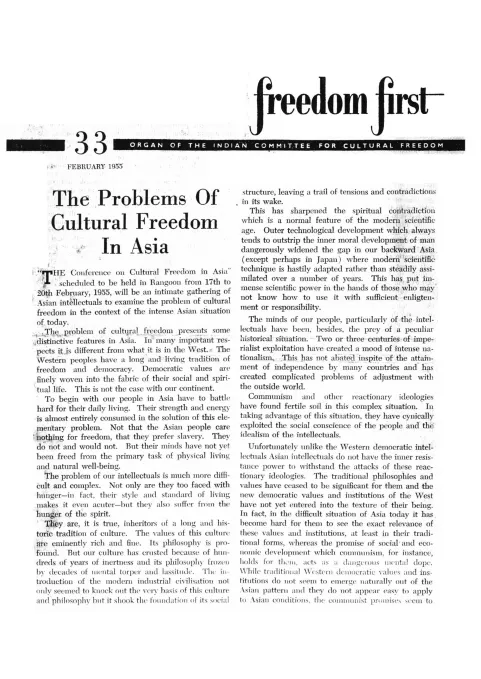
This unsigned lead article (signed at the end by Prabhakar Padhye) previews the Conference on Cultural Freedom in Asia, to be held in Rangoon from 17-20 February 1955. It argues that cultural freedom poses distinctive problems in Asia compared with the West: Asian peoples lack a long lived tradition of democratic values, are consumed by the struggle for basic subsistence, and their intellectuals suffer a ‘hunger of the spirit’ compounded by the erosion of traditional culture under colonial-era industrialisation. The essay contends that communism has found fertile ground in this vacuum not because it is intellectually superior but because of the absence of positive democratic alternatives, and that the Movement for Cultural Freedom must offer such alternatives — reviving indigenous democratic and philosophical traditions (citing Gandhism, Radical Humanism, and Decentralised Socialism in India, and Buddhist Socialism in Burma) — rather than relying solely on anti-communist critique.
- Frames the Rangoon Conference on Cultural Freedom in Asia (17-20 Feb 1955) as the first serious attempt to bring Asian intellectuals together on cultural freedom questions.
- Argues Asian conditions differ from Western ones: subsistence struggle and ‘hunger of the spirit’ among intellectuals, alongside a culture ‘crusted’ by centuries of inertness.
- Claims communism succeeds in Asia through default — absence of positive democratic alternatives — not intellectual superiority.
- Calls for developing positive, indigenous democratic approaches rather than mere exposure of totalitarian pretensions.
- Cites Revolutionary Gandhism, Radical Humanism, and Decentralised Socialism in India, and Buddhist Socialism in Burma as examples of such alternatives.
The Problems Of Cultural Freedom In Asia
By Prabhakar Padhye
A multi-item ‘Notes’ column of short editorial commentary. It praises Nehru’s inaugural address to the Indian Science Congress in Baroda for its liberal-democratic insistence that scientists resist government and nationalistic pressure and preserve values even amid scientific progress. It reports with sympathy on the trials in Yugoslavia of Milovan Djilas and Vladimir Dedijer, framing Djilas’s dissent (advocating a two-party system and criticizing Yugoslav communism) as a tragic case of a once-brilliant experiment in decentralisation curdling into orthodoxy. It criticizes Rajagopalachari’s public appeal urging the United States to unilaterally scrap its atomic arsenal as naive, arguing deterrence prevents Soviet aggression given Russia’s conventional military superiority, and quotes President Eisenhower’s State of the Union framing of the Cold War as a struggle over ‘the true nature of man.’ It relates dancer Mrinalini Sarabhai’s account of being confined and restricted during a tour of East Germany, questioning the sincerity of Soviet-bloc ‘cultural freedom.’ It notes reports of Chinese labourers being sent to the Soviet Union to relieve a Russian manpower shortage, questioning whether this treats ‘men… as chattels.’ Finally it responds to J. J. Singh’s call (in a New York Times letter) for a new India-America cultural society, agreeing in principle but warning against propagandistic, showmanship-driven cultural delegations of the kind associated with Soviet-bloc exchanges.
- Praises Nehru’s Indian Science Congress address for insisting scientists resist political pressure and hold to values.
- Covers the Yugoslav trials of Djilas and Dedijer as a tragic sign that the Yugoslav decentralisation experiment has become an ideological manoeuvre rather than a genuine break from Stalinism.
- Criticizes Rajagopalachari’s appeal for unilateral US nuclear disarmament as impractical, citing Eisenhower’s framing of the Cold War as a struggle over the nature of man.
- Relates Mrinalini Sarabhai’s restricted, surveilled experience touring East Germany as evidence against Soviet-bloc claims of cultural freedom.
- Reports transfers of Chinese labourers to the USSR amid a Soviet manpower shortage, questioning the ethics of treating workers as movable chattel.
- Responds to J. J. Singh’s proposal for an India-America cultural society, endorsing genuine long-term cultural engagement over showy, propagandistic delegations.
Notes (Scientific Spirit; Yugoslav Experiment; Rajaji’s Appeal; Freedom in East Germany; Chinese Labourers for Soviet Russia; Cultural Delegations?; Cultured Pearls)
A brief news report announcing the Conference on Cultural Freedom in Asia, to be held in Rangoon from 17-20 February 1955, organized jointly by the Congress for Cultural Freedom and Burma’s Society for the Extension of Democratic Ideals. It lists sponsoring figures (including Madame Aung San, Jayaprakash Narayan, Dr. Lin Yutang, and Dr. Sampurnanand) and the topics to be discussed: the New Resurgence in Asia, the situation of the Asian intellectual, the impact of the West, planning versus freedom, and totalitarian threats to cultural freedom. It names India’s six-person delegation — Jayaprakash Narayan, M. R. Masani, Asoka Mehta, Eric da Costa, Ram Singh, and Laxmanshastri Joshi — and notes several Indian intellectuals invited to submit papers, with Prabhakar Padhye serving as the Conference’s General Secretary.
- Announces the Rangoon Conference on Cultural Freedom in Asia (17-20 Feb 1955), jointly organized by the Congress for Cultural Freedom and Burma’s Society for the Extension of Democratic Ideals.
- Lists sponsoring intellectuals from across South, South-East, and East Asia.
- Names India’s six-member delegation: Jayaprakash Narayan, M. R. Masani, Asoka Mehta, Eric da Costa, Ram Singh, and Laxmanshastri Joshi.
- Identifies discussion topics: economic development and democratic method, planning and freedom, totalitarian threats, and the State-Individual relation.
- Notes Prabhakar Padhye as General Secretary of the Conference, already in Rangoon for arrangements.
Conference On Cultural Freedom In Asia
In two short humorous ‘Notes’ items, the column reports that Bihar’s government has begun training police constables in dance, drama, and music to make them ‘culture-minded’ as part of an anti-crime drive, wryly imagining a constable interrogating suspects through classical raag performance, and speculating that Sherlock Holmes might have prevented more crime as a violinist than a detective.
- Reports Bihar government’s initiative to train police constables in classical dance, drama, and music to build ‘a mass-consciousness against crime.’
- Satirizes the scheme by imagining an interrogation conducted through classical raag performance.
- Closes with a wry aside about Sherlock Holmes possibly being a mediocre violinist.
The Historical Position Of Communist China: Doctrine And Reality
By Karl A. Wittfogel
Karl A. Wittfogel’s essay examines whether Communist China, having declared itself on a path to socialism following the 1949 revolution, can be understood through the developmental scheme (slavery, feudalism, capitalism, socialism) that Chinese Communist doctrine claims to derive from Marx and Lenin. Wittfogel argues that this official Chinese Communist doctrine — treating Chinese history as passing through slavery and feudalism into a ‘semi-feudal, semi-colonial’ phase before a 1949 leap toward socialism aided by the USSR — radically distorts what Marx, Engels, and even the early Lenin actually believed. In the rendered pages, Wittfogel traces how the mature Marx (after settling in England and studying the classical economists) rejected a unilineal developmental scheme in favor of a distinct ‘Asiatic’ or ‘Oriental’ society, characterized by a despotic state managing large-scale irrigation (‘hydraulic’) works and a ‘dispersed’ peasantry, a category Marx and Engels applied not only to China but even to Tsarist Russia (‘Semi-Asiatic’). Wittfogel shows that Lenin held this Asiatic-restoration concept as late as 1906-07 (in his debate with Plekhanov) and continued to fear an ‘Asiatic restoration’ of despotic bureaucratic rule through 1917, only to suppress this analysis after the Bolshevik seizure of power in favor of the simpler unilineal escalator scheme. He documents Lenin’s own later admissions (in 1921, after Kronstadt) of anxiety about the ‘non-proletarian’ bureaucracy that had captured the Soviet state, and Lenin’s veiled 1921 remark contrasting capitalism, socialism, and ‘a bureaucracy connected with dispersed small producers’ as an implicit acknowledgment of Asiatic-restoration dynamics inside the USSR itself. Wittfogel’s conclusion, reached in the essay’s final sections, is that Communist China is neither a socialist nor proto-socialist society in the Marxian sense but a new type of ‘Oriental’-derived ‘monopoly bureaucracy’ or managerial apparatus state — one that, unlike classical Oriental despotism, aspires to total (not merely political but also social and intellectual) control over an industrializing society, and that both the USSR and Communist China are moving toward a modern, industrial version of ‘general (state) slavery,’ a term Wittfogel borrows from Marx’s own description of Asiatic society.
- Argues Chinese Communist official doctrine (slavery-feudalism-capitalism-socialism) is not authentically Marxist but a later Cominform/Comintern-derived scheme.
- Shows the mature Marx (post-1849, in Das Kapital-era writings) held a multilineal view of history featuring a distinct ‘Asiatic’/‘Oriental’ society based on state-managed hydraulic works and dispersed peasant communities.
- Documents that Marx and Engels applied the ‘Asiatic’/‘Semi-Asiatic’ category even to Tsarist Russia, and that Lenin held an ‘Asiatic restoration’ fear through 1917 before suppressing this view after the Bolshevik revolution.
- Cites Lenin’s own 1921 post-Kronstadt anxieties about a ‘non-proletarian’ Soviet bureaucracy as an implicit, veiled admission of an Asiatic-restoration dynamic within the USSR.
- Concludes Communist China is neither socialist nor proto-socialist but a new ‘monopoly bureaucracy’/apparatus-state form, more totalizing than classical Oriental despotism because it seeks full social and intellectual as well as political control.
- Frames both the USSR and Communist China as moving toward what Wittfogel calls a modern ‘system of general (state) slavery,’ borrowing Marx’s own term for Asiatic society.
- Extensively footnotes primary Marx, Engels, and Lenin texts (Das Kapital, Grundrisse, Gesammelte Schriften, Collected Works) to substantiate the argument that Soviet and Chinese ideologists suppressed inconvenient elements of Marxist theory.
A Journal Of Arts And Ideas: ‘Quest’
By Nissim Ezekiel
Nissim Ezekiel, writing as editor, announces the launch of Quest, a new bi-monthly journal of arts and ideas to be sponsored by the Indian Committee for Cultural Freedom, intended to succeed Freedom First’s house-magazine function with a more ambitious, specifically literary and cultural publication. Ezekiel explains that Quest will cover the internal problems of the arts and creative life, publish translations from Indian languages, and maintain the ‘hard-hitting, provocative politics’ tradition established by Freedom First, while prioritizing Indian, then Asian, then international concerns in that order.
- Announces Quest, a new bi-monthly arts-and-ideas journal sponsored by the Indian Committee for Cultural Freedom, edited by Nissim Ezekiel.
- Frames Quest as succeeding Freedom First’s house-magazine role with a more ambitious literary/cultural mandate.
- States priorities: Indian concerns first, then Asian, then international, aiming for authenticity over vague ‘international’ posturing.
- Notes Quest will publish translations from Indian languages and maintain a distinct political viewpoint rather than false ‘impartiality.‘
C. C. F. News
A news column reporting on Congress for Cultural Freedom activities internationally: an Ernst Reuter memorial lecture series in Berlin featuring speakers including Clement Attlee, Raymond Aron, Arthur Koestler, and Michael Polanyi; Swedish Committee lectures by Victor Vinde and James T. Farrell; German Arciniegas’s lecture tour of Chile and Uruguay; a Preuves meeting in Paris where composer Andrzej Panufnik and writer Czeslaw Milosz gave testimony on artistic repression in Communist Poland; and a Mexican Book Fair exhibit that drew a hostile press campaign from the Diego Rivera-Siqueiros group.
- Reports the Ernst Reuter memorial lecture series in Berlin, with speakers including Attlee, Aron, Koestler, Polanyi, and Silone.
- Notes Swedish Committee lectures by Victor Vinde and American novelist James T. Farrell.
- Covers German Arciniegas’s Latin American lecture tour (Chile, Uruguay).
- Details a Paris Preuves meeting where Andrzej Panufnik and Czeslaw Milosz testified about artistic repression in Poland.
- Reports a Mexican Book Fair exhibit by the Mexican Committee that provoked a Communist press attack led by the Diego Rivera-Siqueiros group.
Reviews (Burma under the Japanese; Heritage of Buddha; McCarthy and the Communists; Marxism: Past and Present)
By V.B.K.; Madan Lal Sharma; Faiz Noorani; Gopal Krishna
A book reviews section covering four titles. V.B.K. reviews U Nu’s Burma Under the Japanese (translated sketches on wartime Japanese occupation), praising its picturesque freshness and its warning against political ‘Pied Pipers’ understood as a reference to communist propagandists. Madan Lal Sharma reviews Celina Lu Zanne’s novel Heritage of Buddha, a fictionalized biography of the Buddha, judged sincere though marked by factual ignorance of Indian life. Faiz Noorani reviews James Rorty and Moshe Decter’s McCarthy and the Communists, an American Committee for Cultural Freedom-sponsored analysis that dissects Senator McCarthy’s career and warns against demagoguery even while opposing communism. Gopal Krishna reviews R. N. Carew Hunt’s Marxism: Past and Present, praising its scholarly dissection of Marx, Engels, Lenin, and Stalin and its thesis that Soviet practice is the logical outcome of Marxist doctrine rather than a democratic deviation from it.
- U Nu’s Burma Under the Japanese (reviewed by V.B.K.) is praised for vivid, firsthand sketches of wartime Japanese occupation and its warning against political ‘Pied Pipers.’
- Celina Lu Zanne’s Heritage of Buddha (reviewed by Madan Lal Sharma) is judged a sincere, if factually imperfect, fictionalized life of the Buddha.
- Rorty and Decter’s McCarthy and the Communists (reviewed by Faiz Noorani) is described as a scholarly, unemotional dissection of Senator McCarthy’s career, useful for opposing both communism and demagoguery.
- R. N. Carew Hunt’s Marxism: Past and Present (reviewed by Gopal Krishna) argues Soviet practice is the faithful logical outcome of Marxist doctrine, not a democratic betrayal of it.
Letters to the Editor (Call Of The Hour; Real Wages In Soviet Russia)
By J. K. Kotewal; J. Dubashi
Two letters to the editor. J. K. Kotewal of Bombay defends the Committee’s anti-communist activities against a correspondent’s suggestion to focus purely on ‘creative vitality,’ arguing that in a ‘life and death struggle’ against a mortal threat to freedom and culture, anti-communist vigilance cannot be relaxed. J. Dubashi of Bombay disputes the accuracy of a previous ‘Real Wages in Soviet Russia’ article’s statistics on Soviet consumer costs, to which the editor replies defending the figures (clarifying a units error, ‘hours’ for ‘minutes’) and citing further corroborating data from Thought magazine and industrialist S. L. Kirloskar on the high cost of living in Soviet Russia.
- J. K. Kotewal’s letter defends the Committee’s continued anti-communist ‘propaganda’ work as an urgent duty, not a distraction from cultural stimulation.
- J. Dubashi’s letter challenges the accuracy of a prior article’s Soviet real-wage/cost-of-living statistics.
- The editor’s reply clarifies a units printing error (‘hours’ should read ‘minutes’) and defends the underlying methodology.
- The editor cites additional corroborating evidence (Thought magazine’s British Food Fair analysis; industrialist S. L. Kirloskar’s account) on the high cost of living in the USSR.
With Many Voices
The closing page, ‘With Many Voices,’ collects short topical quotations attributed to public figures from January 1955 press sources: Rajagopalachari on the cost of Soviet-style planning, Stalin on political purges, Cuban ambassador Santiago Claret on Russian imperialism, Gilbert Murray on the incompetence of proletarian rule, S. Radhakrishnan on British institutions, Joseph Stalin, N. C. Chatterjee on India’s foreign-policy contradictions, Vinoba Bhave on Congress overreach, Henry Cabot Lodge on Chinese paranoia, H. V. Kamath on unequal treatment of Indian politicians, a Statesman comment on Jayaprakash Narayan’s Bhoodan commitment, the Pope on Cold War paralysis, and S. A. Dange on Congress’s ‘State Capitalism’ resolution, closing with Phillip Spratt’s line that ‘the C.P.I. may be a joke, but Communism is a danger.’
- A curated page of topical public quotations from January 1955 Indian and international press.
- Features Rajagopalachari, Stalin, Radhakrishnan, Vinoba Bhave, N. C. Chatterjee, Henry Cabot Lodge, H. V. Kamath, the Pope, S. A. Dange, and Phillip Spratt among others.
- Touches on themes of Soviet planning costs, purges, Cold War paranoia, and Indian party politics.
Generated by the v1.5 extraction pipeline. Awaiting editorial review.
Essay 10
No summary was extracted for this article. Listed for completeness.
Metadata and summary are AI-extracted from the source PDF and reviewed for editorial accuracy. The original work is available via the Read PDF tab above (where present); paragraph-level citation inside the PDF is deferred to a future engagement.