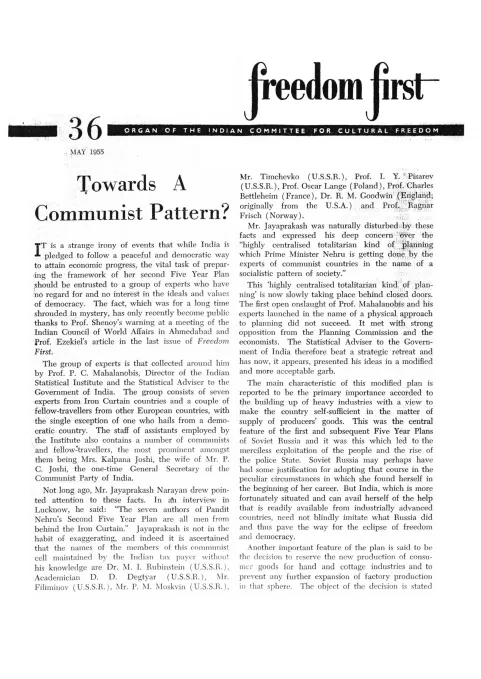
periodical issue
Freedom First
By Prof. Hannan Ezekiel, Sir John Latham, S.D.N., Martin S. Dworkin, N.E., M.B.S., Ved Prakash Luthera, V.B.K.
Edited by V. B. Karnik; printed & published by Prabhakar Padhye at The Kamada Press, 109 Parsi Bazzar Street, Bombay 1. Issued by The Indian Committee for Cultural Freedom, 148 Mahatma Gandhi Road, Bombay 1. · Bombay · 1955
12 pages
Freedom First
Summary
This is the April 1955 issue (No. 35) of Freedom First, the monthly organ of the Indian Committee for Cultural Freedom, edited by V. B. Karnik. The issue is organised around anti-communist and pro-democratic themes typical of the Congress for Cultural Freedom network: a lead article by Prof. Hannan Ezekiel warns that Mahalanobis-style ‘physical planning’ threatens to import Soviet-style centralised direction of the economy into India’s Five Year Plan; a reprinted message by Sir John Latham (President of the Australian Committee for Cultural Freedom) on the conflict between freedom and authority; an editorial ‘Notes’ section covering the Congress Party’s defeat of the Communists in the Andhra elections, a forthright anti-communist speech by Sir Mirza Ismail, commentary on the newly released Yalta records, criticism of a Bombay Film Seminar, and a rebuke of Kingsley Martin (New Statesman) for urging a communist vote in Andhra; a report on the booklet ‘Treatment of British Prisoners of War in Korea’ describing Chinese communist mistreatment and political ‘re-education’ of POWs; C.C.F. News on the forthcoming Milan conference on ‘The Future of Freedom’ and an Italian Association event; a review-essay on the animated film of Orwell’s Animal Farm by Martin S. Dworkin, reprinted from the New Leader; a Reviews section covering Manes Sperber’s novel Journey Without End, C. Groves Haines’s The Threat of Soviet Imperialism, a critical review of a Sochi Raut Roy poetry translation, Karl Barth’s Against the Stream, Leslie Lipson’s The Great Issues of Politics, and S. S. Bankeshwar’s pamphlet Conspiracy in Kashmir; I.C.C.F. News on a Bombay members’ meeting addressed by Masani and Purshottam Tricumdas; and a closing page of miscellaneous quotations (‘With Many Voices’) from public figures including Churchill, Attlee, Ambedkar, Dulles, and Niebuhr on communism and the Cold War. The volume’s argumentative centre is a consistent anti-communist, anti-centralised-planning, pro-liberal-democratic line, characteristic of Freedom First’s Cold War-era cultural-freedom politics.
Key points
-
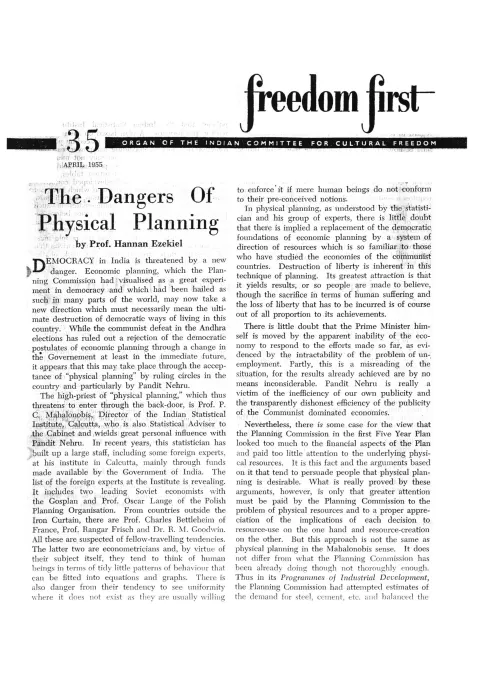
Prof. Hannan Ezekiel’s lead essay, “The Dangers Of Physical Planning,” warns that P. C. Mahalanobis’s ‘physical planning’ model for the Second Five Year Plan carries an inherently totalitarian tendency, citing D. R. Gadgil’s fear that the National Sample Survey could ‘exterminate all parallel agencies.’
-
Sir John Latham, President of the Australian Committee for Cultural Freedom, argues in “The Free Spirit Of Man” that tolerance of opposing opinion is essential to progress, since any regime claiming infallibility treats dissent as heresy leading to labour camps and liquidation.
-
A ‘Notes’ section welcomes Congress’s defeat of the Communist Party in the Andhra elections despite the Communists retaining 31.6% of the vote, reports Sir Mirza Ismail’s speech on communist infiltration, and rebukes New Statesman editor Kingsley Martin for saying he would have voted communist in Andhra.
-
An unsigned report on a British Ministry of Defence booklet, “Communist China And Prisoners Of War,” documents the mistreatment and ‘re-education’ of 978 British POWs held by Communist China during the Korean War, noting only 40 were judged genuine converts.
-
Martin S. Dworkin’s “George Orwell On The Screen,” reprinted from the New Leader, criticises the Halas and Batchelor animated film of Orwell’s Animal Farm for its Disney-influenced style and ‘heavy’ narration, judging it more effective propaganda for Europeans unfamiliar with Soviet history than for readers of the book.
-
Reviews cover Manes Sperber’s novel Journey Without End on Jewish resistance in a doomed Polish village (N.E.), C. Groves Haines’s The Threat of Soviet Imperialism featuring George F. Kennan (M.B.S.), and Karl Barth’s Against the Stream, whose ‘narrow path between Moscow and Rome’ the reviewer judges untenable given Soviet capacity for terror.
-
C.C.F. News previews the Congress for Cultural Freedom’s Milan conference on ‘The Future of Freedom’ (September 1955) and a Paris exhibition of paintings by Indian artist Laxman Pai.
-
I.C.C.F. News reports the Committee’s new Bombay office and a members’ meeting at which M. David Rousset described evidence of slave labour camps in Communist China and plans for an Asian tribunal of inquiry.
-
‘With Many Voices’ includes Ambedkar’s remark comparing the Constitution to a temple now occupied by ‘devils’ and Salvador de Madariaga’s warning that ordinary Russians, not the regime, hold the moral claim on Western sympathy.
Essays
The Dangers Of Physical Planning
By Prof. Hannan Ezekiel
Prof. Hannan Ezekiel warns that Indian democracy faces a new danger in the form of ‘physical planning’, associated with Prof. P. C. Mahalanobis of the Indian Statistical Institute, Calcutta, who wields great influence with Pandit Nehru. The article argues that physical planning — direction of resources in physical rather than value terms, decided by a small group of planners rather than through price signals reflecting popular wishes — carries an inherently totalitarian tendency, citing the concentration of data-gathering power in the National Sample Survey under Mahalanobis’s control and Prof. D. R. Gadgil’s warning that the NSS could exterminate parallel data-gathering agencies. The author distinguishes this from the Planning Commission’s existing (defensible) attention to physical resource constraints, and closes by urging Nehru not to entrust the country’s future to planners bent on such centralisation.
- Frames ‘physical planning’ (associated with P. C. Mahalanobis) as a back-door route to Soviet-style centralised direction of the Indian economy.
- Notes Mahalanobis’s Indian Statistical Institute employs foreign economists including Soviet Gosplan officials and Oscar Lange, contrasted with ‘suspect’ fellow-travelling Western econometricians.
- Argues physical planning replaces democratic input into resource allocation with decisions by a small planning elite.
- Cites D. R. Gadgil’s criticism of the National Sample Survey as tending to ‘exterminate all parallel agencies’.
- Concedes some legitimate case for more attention to physical resource constraints in the First Five Year Plan, but distinguishes this from full Mahalanobis-style physical planning.
- Warns Nehru against handing India’s future to planners the author considers determined to destroy the value of liberty.
The Free Spirit Of Man
By Sir John Latham
Sir John Latham, President of the Australian Committee for Cultural Freedom, argues that the conflict between freedom and authority cannot be resolved by any mechanical absolute rule, and that voluntary obligations (e.g., a minister bound by church doctrine) differ fundamentally from compulsory ones. He surveys historical examples of compulsory belief — Roman emperor-worship, persecution of Arians — and (continuing on page 11) argues that maximum freedom of the human spirit requires tolerance of opposing opinion, since any individual or party that believes itself infallible will treat opposition as heresy or treason, a path that leads to corrective labour camps, mass trials, and liquidation of dissidents. He closes by affirming the Australian Committee’s commitment to resisting encroachment on the free spirit of man despite members’ varying opinions.
- Freedom versus authority cannot be settled by a single mechanical rule; obligations freely assumed (e.g., church membership) differ from compulsion.
- Cites historical compulsory-belief regimes: Roman emperor-worship and persecution of the Arians.
- Argues all developed societies have some restriction on individual liberty (e.g., treason/sedition laws), but distinguishes this from ideological conformity.
- Warns that a ruler or party claiming infallibility treats all opposition as heresy or treason, leading to corrective labour camps, mass trials, and liquidation.
- States that tolerance of opposing opinion is a condition of real human progress and civilisational health.
- Notes the Australian Committee for Cultural Freedom unites members of varying opinions around resisting encroachments on intellectual and artistic freedom.
Notes (Andhra Elections; A Forthright Speech; ‘The Truth Shall Make Ye Free’; Film Seminar; Kingsley Martin’s True Colours; A Noble Example; The Wages Of ‘Friendship’; Guts Vs. Goondaism)
The unsigned ‘Notes’ section covers several items: the Congress Party’s decisive electoral victory over the Communist Party in Andhra (146 of 196 seats versus 15 for the Communists, though the Communists still polled 31.6% of votes), warning against complacency about continued communist strength; a ‘forthright speech’ by Sir Mirza Ismail identifying international communism as the chief threat to Indian democracy through infiltration, subversion, and internal revolution, and describing China’s need for territorial expansion into South and South-East Asia; commentary on the newly released Yalta conference records exposing Roosevelt’s naivety in dealing with Stalin; criticism of a poorly organised Bombay Film Seminar; and a sharp rebuke of New Statesman editor Kingsley Martin for declaring in a Delhi press conference that he would vote communist if he were an Andhra voter, contrasted with the Andhra electorate’s rejection of the Communist Party.
- Congress won 146/196 contested seats in the Andhra elections against a Communist Party that contested 169 and won only 15, though the Communists retained 31.6% of the vote share.
- Sir Mirza Ismail’s Bangalore speech identifies international communism, via infiltration, subversion, and internal revolution, as the central threat to Indian democracy, and frames China’s demographic pressure as driving territorial expansion into South and South-East Asia.
- The newly released Yalta ‘Big Three’ records are welcomed as exposing President Roosevelt’s misplaced trust in Stalin (‘Uncle Joe’).
- A Bombay Film Seminar is criticised as hastily organised and of limited intellectual impact, though some practical suggestions (subsidies for educational films, censorship liberalisation) are noted approvingly.
- Kingsley Martin, editor of the New Statesman, is criticised for stating he would have voted communist in the Andhra elections; the piece contrasts this with the electorate’s rejection of the Communist Party.
Communist China And Prisoners Of War
By S.D.N.
An unsigned sports commentary (‘Guts vs. Goondaism’) describes a Russian football team’s tour of India, in which the Russian captain Netto’s arrogant conduct toward an Indian referee (Utchil) during a Bombay match is presented as emblematic of Soviet ‘blonde superiority complex’ and poor sportsmanship, contrasted favourably with the referee’s firmness and thirty-five thousand Indian spectators’ disapproval.
- Soviet football team’s India tour is used as an allegory for Soviet arrogance and poor sportsmanship.
- Russian captain Netto disputed a decision by Indian referee Utchil and was ordered off the field in a Bombay international match.
- Thirty-five thousand spectators are said to have roared disapproval of the Russian captain’s conduct.
- The piece frames the episode as ‘guts against goondaism’, with referee Utchil standing firm.
C.C.F. News
An unsigned report summarises the UK Ministry of Defence booklet ‘Treatment of British Prisoners of War in Korea’, detailing the mistreatment of 978 British POWs held by Communist China during the Korean War. It describes the Chinese division of prisoners into ‘progressives’ and ‘reactionaries’ in violation of the Prisoners-of-War Convention, the ‘re-education’ regime of lectures, informer networks, and eventual recourse to physical coercion and torture, and notes that only 40 of 978 prisoners were judged genuine converts and only one elected to remain in North Korea — taken as evidence of the individual British soldier’s resistance. The report also describes the role of communist and fellow-travelling journalists (including Alan Winnington, Michael Shapiro, Wilfred Burchett, Jack Gaster, and Monica Felton) who visited the camps and allegedly tried to bribe or blackmail British prisoners.
- 978 British POWs were held by Communist China during the Korean War (China entered the war on 20 October 1950).
- Prisoners were divided into ‘progressives’ and ‘reactionaries’, with the ‘Lenient Policy’ reserved for those willing to denounce their own governments — a violation of Article 16 of the Prisoners-of-War Convention.
- Re-education included lectures, study classes, informer networks, and ultimately psychological pressure, manipulation of welfare conditions, corruption, threats, segregation, force, and torture.
- Only 40 of 978 prisoners were counted as genuine converts and only one chose to remain in North Korea.
- Communist and fellow-travelling journalists — named as Alan Winnington, Michael Shapiro, Wilfred Burchett, Jack Gaster, and Monica Felton — allegedly tried to bribe and blackmail prisoners during camp visits.
- The piece concludes the booklet gives only a partial picture since American prisoners suffered similar or worse treatment not covered by the booklet.
George Orwell On The Screen
By Martin S. Dworkin, in the New Leader
The C.C.F. News column reports on the Congress for Cultural Freedom’s forthcoming international conference on ‘The Future of Freedom’ in Milan (12-17 September 1955), listing prominent invited economists and social scientists, and on recent activities of the Italian Association for Cultural Freedom (debates on ‘The Work of Art’ and a film festival on the Italian Resistance) and a Paris exhibition of Indian painter Laxman Pai’s work organised by the Congress for Cultural Freedom.
- The Congress for Cultural Freedom will hold an international conference on ‘The Future of Freedom’ in Milan, 12-17 September 1955.
- Invited participants include Colin Clark, Raymond Aron, Sumitro Djojohadikusumo, Hugh Gaitskell, Sidney Hook, Lionel Robbins, Arthur Lewis, F. Hayek, and Michael Polanyi.
- The Italian Association for Cultural Freedom organised debates on ‘The Work of Art’ featuring Ignazio Silone, Venturi, Calogero, and Ungaretti, plus a film festival on the Italian Resistance.
- The Congress for Cultural Freedom organised a Paris exhibition of paintings by 28-year-old Indian artist Laxman Pai at the Galerie Marcel Bernheim.
Reviews: Journey Without End (Manes Sperber)
By N.E.
Martin S. Dworkin’s essay, reprinted from the New Leader, critically reviews the British animated feature film of George Orwell’s Animal Farm (produced by Halas and Batchelor, presented by Louis de Rochemont). Dworkin argues the film’s Disney-influenced style undercuts Orwell’s satirical intent, that the film’s slow, over-literal, and ‘heavy’ narration makes it tedious compared to the book’s economical prose, and questions whether the film is effective propaganda for any audience, suggesting it may work better for European audiences unfamiliar with Soviet history than for readers already versed in it.
- Animal Farm the novel is described as tactical counter-propaganda directly targeting the Russian Revolution’s capture by the Communists.
- The 1954 animated film adaptation by Halas and Batchelor (presented by Louis de Rochemont) closely follows the book’s plot but adopts a Disney-influenced visual style Dworkin finds unsuited to satire.
- Dworkin criticises the film’s ‘heavy’ narration and unimaginative animation style as undermining the satirical economy of Orwell’s prose.
- The film is judged to run too long (just under 90 minutes) relative to its content, making its point ‘long before the half-way mark’.
- Dworkin concludes the film may be more effective as propaganda for European audiences unfamiliar with communist history than for readers already convinced by the book.
Reviews: The Threat of Soviet Imperialism (C. Groves Haines)
By M.B.S.
Reviews column, initialled N.E., praising Manes Sperber’s novel Journey Without End (part of an epic trilogy following The Burned Bramble and The Abyss) as a literary, rather than merely political, achievement depicting Jewish resistance in a doomed Polish/Wolyna village against Nazi and Communist forces, with a tragic, contemplative vision embodied in protagonist Doino Faber.
- Journey Without End is the third novel in Manes Sperber’s trilogy, following The Burned Bramble and The Abyss.
- The review argues ex-communist novelists like Sperber achieve real literary craft but struggle to reach non-politically-conscious readers.
- Andre Malraux is cited praising a chapter of the novel as ‘one of the great chronicles of Israel’.
- The novel depicts the Jewish village of Wolyna facing annihilation, divided between resistance and waiting for divine intervention.
- The review frames Sperber’s vision as tragic, closing on the protagonist’s despairing line that ‘there’ll be no peace’.
Reviews: The Boatman Boy and Forty Poems (Sochi Raut Roy)
By N.E.
A review, initialled M.B.S., of C. Groves Haines’s edited volume The Threat of Soviet Imperialism (Johns Hopkins Press, 1954), a collection of conference papers from a 1953 Washington conference on ‘the Problem of Soviet Imperialism’ featuring contributors including George F. Kennan. The reviewer welcomes the book as a timely corrective to complacency about Soviet ‘peaceful coexistence’ propaganda and notes it should be of particular interest to Asian countries given the Soviet focus on ‘liberating’ countries in the East, while flagging a factual error regarding M. N. Roy’s presence in China.
- The Threat of Soviet Imperialism collects papers from a 1953 Washington conference organised by the School of Advanced International Studies.
- George F. Kennan, former US Ambassador to the USSR and author of the ‘Containment Policy’, is named among the contributors.
- The reviewer argues the book is especially relevant to Asian/Indian readers given Soviet interest in South Korea, Indo-China, Formosa, Nepal, Burma, Kashmir, and India.
- The review flags a factual error in the book: M. N. Roy is said to have been in China in 1937, when in fact he was there in 1927.
- The reviewer regrets the absence of a paper on the fundamental postulates of Marxian philosophy.
Reviews: Against the Stream (Karl Barth)
By N.E.
A sharply critical review, initialled N.E., of The Boatman Boy and Forty Poems, Harindranath Chattopadhyaya and B. Sinha’s English translation of Oriya poet Sochi Raut Roy’s poetry (Modern Review, Calcutta), calling the translation embarrassingly unreadable and mocking both the translated verse and Dr. Kalidas Nag’s laudatory introduction to the volume’s accompanying symposium.
- The Boatman Boy and Forty Poems translates Oriya poet Sochi Raut Roy’s work via Harindranath Chattopadhyaya and B. Sinha.
- The reviewer finds the English translation ‘embarrassingly unreadable’, quoting several lines as examples.
- Dr. Kalidas Nag’s introduction to an accompanying symposium is mocked for its effusive, uncritical praise.
- The reviewer notes Harindranath Chattopadhyaya’s own prose (‘Translator’s Notes’) is judged as bad as his verse translation.
Reviews: The Great Issues of Politics (Leslie Lipson)
By Ved Prakash Luthera
A review, initialled N.E., of Karl Barth’s Against the Stream (Philosophical Library), a collection of his shorter post-war writings edited by Ronald Gregor Smith. The reviewer examines Barth’s controversy with Emil Brunner over refusing to condemn communism as he had condemned Nazism, and argues Barth’s theological ‘narrow path between Moscow and Rome’ is untenable given communism’s capacity for physical extermination of dissent, drawing an analogy to the impracticality of Gandhi’s advice that Nazi Germany’s Jews use passive resistance.
- Against the Stream collects Karl Barth’s shorter post-war writings (1946-1952), including his 1948 Hungary journey and the ensuing controversy with Emil Brunner.
- Barth refuses to give communism the same political condemnation he gave Nazism, arguing the Church should stand ‘quietly aloof from the present conflict’ along a path ‘midway between Moscow and Rome’.
- The reviewer argues this stance collapses because Moscow’s power permits no genuinely neutral middle path, and physical extermination has no spiritual answer.
- The reviewer compares Barth’s position to Gandhi’s advice that Nazi-persecuted Jews use passive resistance, calling both impractical given the brutal realities of totalitarian power.
- The review concludes that Barth’s stance, though equivocal, still exposes a deeper flaw in his theological framework.
Reviews: Conspiracy in Kashmir (S. S. Bankeshwar)
By V.B.K.
A brief review by Ved Prakash Luthera of Leslie Lipson’s The Great Issues of Politics (Prentice-Hall, 1954), praising it as an excellent, well-documented study of fundamental issues in political science, beginning with the individual and ranging through family, group, state, society, and the international order.
- The Great Issues of Politics by Leslie Lipson covers fundamental political-science issues from the individual through to the international order.
- The book draws on George Catlin’s framing of politics as the study of the control of man.
- The reviewer praises the book’s documentation, sub-heads, graphs, and tables as adding clarity.
I.C.C.F. News
A brief review, initialled V.B.K., of S. S. Bankeshwar’s pamphlet Conspiracy in Kashmir (Society for Defence of Democracy, Bangalore), which the reviewer credits with drawing attention to communist influence over the Bakshi government in Jammu and Kashmir amid public sympathy for Kashmiris caught between India and Pakistan.
- Conspiracy in Kashmir describes communist infiltration and influence over the Bakshi government in Jammu and Kashmir.
- The reviewer frames this as an under-recognised new danger facing Kashmir beyond the India-Pakistan dispute.
- The pamphlet is credited with drawing pointed attention to the danger, despite being described only as a short pamphlet.
With Many Voices (quotations column)
The I.C.C.F. News column reports that the Indian Committee for Cultural Freedom has secured a new office at Army & Navy Building, Bombay, and summarises a 10 March meeting of Bombay committee members chaired by Purshottam Tricumdas, at which Mr. Masani reported on the Congress for Cultural Freedom’s Paris executive meeting, Mr. Padhye reported on a Rangoon cultural-freedom conference, and M. David Rousset described evidence of slave labour camps in Communist China and plans for an Asian tribunal of inquiry.
- The Indian Committee for Cultural Freedom has secured a new office at Army & Navy Building (3rd floor), 148 Mahatma Gandhi Road, Bombay.
- A Bombay members’ meeting on 10 March was presided over by Purshottam Tricumdas.
- Masani reported on the Congress for Cultural Freedom’s International Executive meeting held in Paris in January.
- Padhye reported on a Conference on Cultural Freedom in Asia held in Rangoon.
- M. David Rousset, founder of the International Commission Against Concentration Camp Practices, described evidence of slave labour camps in Communist China and plans for an Asian tribunal of inquiry.
Essay 15
The closing page, ‘With Many Voices’ (edited by V. B. Karnik), collects short quotations from public figures and newspapers on communism, the Cold War, and Nehru’s foreign policy, drawn from sources dated January-March 1955, including Churchill, Attlee, Ambedkar, Dulles, Reston, Niebuhr, and Salvador de Madariaga, alongside a subscription form for the Indian Committee for Cultural Freedom.
- Compiles brief quotations on communism and Cold War diplomacy from a range of contemporary public figures and periodicals (Jan-March 1955).
- Includes Dr. B. R. Ambedkar’s remark comparing the Indian Constitution to a temple now occupied by ‘devils’ that must be burned down.
- Includes Salvador de Madariaga’s warning that ‘Let’s talk to Russia’ rhetoric obscures that ordinary Russians, not the regime, hold the moral claim on Western sympathy.
- Notes contradictions in Nehru’s foreign-policy statements as ‘the comfort of the Communists’ (quoting ‘Vivek’ in the Bombay Chronicle).
- Includes a membership subscription form for the Indian Committee for Cultural Freedom (annual fee Rs. 3/-).
Generated by the v1.5 extraction pipeline. Awaiting editorial review.
Metadata and summary are AI-extracted from the source PDF and reviewed for editorial accuracy. The original work is available via the Read PDF tab above (where present); paragraph-level citation inside the PDF is deferred to a future engagement.