periodical issue
Freedom First
By Franz Borkenau, Richard Mowrer
Edited, printed & published for the Democratic Research Service by V. B. Karnik at The Kanada Press, 109 Parsi Bazar Street, Bombay 1. · Bombay · 1956
12 pages
Freedom First
Summary
This is issue No. 47 of Freedom First (April 1956), the monthly journal of the Democratic Research Service / Indian Committee for Cultural Freedom, edited by V. B. Karnik. The issue is dominated by anti-communist commentary in the wake of the 20th Congress of the CPSU: an unsigned editorial (“Stalin: A Vindication”) reads Khrushchev’s de-Stalinisation as belated proof of the journal’s own long-standing critique of Stalin, while V. B. Karnik’s signed piece “Wait And Watch” offers a more measured analysis arguing the Congress rejected Stalinism but retained Leninism, and counsels scepticism about whether the change is substantive or tactical. Two reprinted pieces from international outlets address Cold War flashpoints: Franz Borkenau’s “How Mao Bluffed Dulles” (from the New Leader) argues the Formosa crisis was a diversionary bluff masking Mao’s internal collectivisation drive, and Richard Mowrer’s “The Soviet Woos Franco Spain” documents Soviet efforts to draw Franco’s Spain into trade relationships with the Eastern bloc. The “Notes” section covers Jayaprakash Narayan’s induction as Honorary Chairman of the Congress for Cultural Freedom, communist involvement in Warli tribal unrest in Maharashtra, commemoration of the Masaryks by exiled Czechoslovaks, a Soviet defector’s testimony on Russian military participation in the Korean War, and British free-speech controversy over a planned protest against a Bulganin-Khrushchev UK visit. A Review section covers Nicolai Hartmann’s Ethics (reviewed by M. A. Venkata Rao), Dagobert Runes’s On the Nature of Man, a brochure on law in communist China based on Father Andre Bonnichon’s testimony, and the government publications Kurukshetra and Social Welfare in India on rural community development. A substantial Letters section reproduces a protest letter from four ICCF members over the Bombay/Maharashtra states-reorganisation controversy, with an editorial reply defending the journal’s neutrality on the issue. The issue closes with “With Many Voices,” a page of quoted press excerpts and public remarks on Cold War and domestic political themes.
Key points
-
The unsigned editorial ‘Stalin: A Vindication’ marks the third anniversary of Stalin’s death, arguing the Soviet leadership’s own denunciation of Stalin vindicates the journal’s earlier criticism while naming Khrushchev, Bulganin, Mikoyan and Molotov as his willing accomplices.
-
V. B. Karnik’s ‘Wait And Watch’ argues the 20th CPSU Congress rejected Stalinism while retaining Leninism, counselling a cautious middle path between naive trust and reflexive dismissal of Soviet reform.
-
Franz Borkenau’s ‘How Mao Bluffed Dulles,’ from the New Leader, argues the 1955 Formosa crisis was a deliberate bluff to mask Mao’s internal ‘Second Revolution’ of agrarian collectivisation, and predicts China will deal with Russia and the West on near-equal terms within a decade.
-
Richard Mowrer’s ‘The Soviet Woos Franco Spain’ documents Soviet efforts since 1954 to court Franco’s Spain via prisoner releases and trade, aiming to detach Spain from US economic dependence.
-
A ‘Notes’ section reports Jayaprakash Narayan’s election as Honorary Chairman of the Congress for Cultural Freedom alongside Bertrand Russell and Jacques Maritain, and a Soviet circus defector’s eyewitness testimony of Russian military participation in the Korean War.
-
Reviews cover M. A. Venkata Rao on Nicolai Hartmann’s Ethics, and a Hague brochure on ‘Law in Communist China’ based on Father Andre Bonnichon’s testimony describing a system where arrest itself is treated as proof of guilt.
-
Four Bombay I.C.C.F. members’ letter protests the government’s handling of the Bombay/Samyukta Maharashtra dispute; the editor replies defending the journal’s neutrality on the dispute’s merits.
Essays
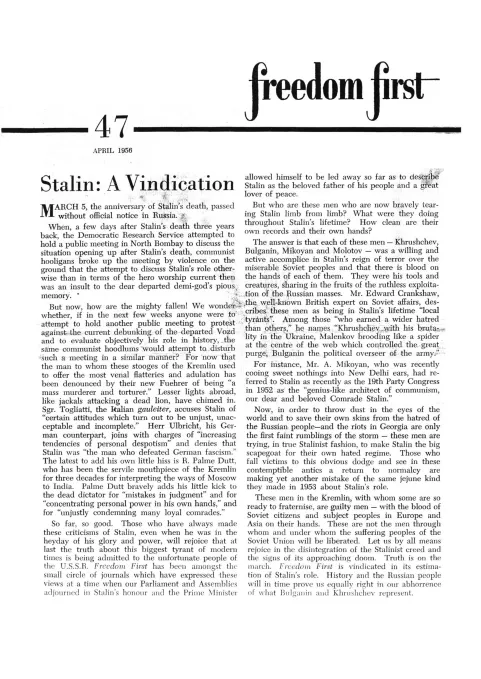
Stalin: A Vindication
An unsigned front-page editorial marking the third anniversary of Stalin’s death, arguing that the Soviet leadership’s own denunciation of Stalin (Khrushchev, Bulganin, Mikoyan, Molotov) vindicates the journal’s earlier, then-unpopular criticism of Stalin as a tyrant. It accuses the same men of having been willing accomplices in Stalin’s terror who are now scapegoating him to save themselves, citing Edward Crankshaw’s characterisation of them as Stalin’s former “local tyrants,” and closes by welcoming the disintegration of the Stalinist creed while distrusting the men now disowning it.
- The anniversary of Stalin’s death passed without official notice in Russia, in contrast to communist-organised suppression of anti-Stalin discussion in India three years earlier.
- Foreign communist leaders (Togliatti, Ulbricht, Palme Dutt) have begun echoing criticism of Stalin that non-communists made throughout his lifetime.
- The editorial names Khrushchev, Bulganin, Mikoyan and Molotov as complicit tools of Stalin’s terror, quoting Edward Crankshaw’s description of them as his lifetime ‘local tyrants’.
- Mikoyan is noted to have praised Stalin as recently as the 19th Party Congress (1952) as the ‘genius-like architect of communism’.
- The piece frames the de-Stalinisation campaign as a bid to deflect blame and reassure the world, rather than a genuine reckoning.
- It closes welcoming the ‘disintegration of the Stalinist creed’ while stating history will vindicate the journal’s original judgment of Stalin.
Notes
The ‘Notes’ section is a set of short unsigned items: Jayaprakash Narayan’s election as Honorary Chairman of the Congress for Cultural Freedom alongside figures like Bertrand Russell and Jacques Maritain; communist instigation behind unrest among Warli tribal people in Dahanu Taluka amid the Samyukta Maharashtra agitation; exiled Czechoslovaks’ commemoration of Thomas and Jan Masaryk; a Soviet circus defector’s eyewitness testimony of Russian military participation in the Korean War; the discontinuation of Gandhi’s journal The Harijan, with commentary on the growth of the Indian state beyond what Gandhi would have sanctioned; and British controversy over denial of a public hall to protest a Bulganin-Khrushchev visit to the UK.
- JP Narayan, a former Marxist now seen as the leading exponent of Gandhian thought, was elected Honorary Chairman of the Congress for Cultural Freedom alongside Bertrand Russell, Karl Jaspers, Reinhold Niebuhr, Salvador de Madariaga and Jacques Maritain.
- The Communist Party is blamed for stoking unrest among Warli Adivasis in Dahanu Taluka, tied to the Samyukta Maharashtra (Bombay-into-Maharashtra) linguistic agitation.
- Exiled Czechoslovaks marked the 106th birth anniversary of Thomas Masaryk and recalled his son Jan Masaryk’s suicide rather than live under communist control.
- A Soviet circus performer and army defector, Victor Semenovich Ilyinsky, gave the first direct eyewitness evidence of active Soviet military participation in the Korean War, describing Soviet pilots flying Chinese-marked planes.
- Geoffrey Tyson’s comments on the closure of Gandhi’s paper The Harijan are used to argue that Nehru-era India has drifted from Gandhi’s vision of minimal government toward a state ‘omni-competent’ in all spheres of life.
- A UK controversy is reported in which organisers of a protest against a Bulganin-Khrushchev visit were denied public halls, framed as a test of British free-speech tradition.
Wait And Watch
By V. B. Karnik
V. B. Karnik’s signed analysis of the 20th Congress of the CPSU argues for a cautious middle path between naive trust in Soviet reform and reflexive dismissal. He notes the Congress revised dogma on the inevitability of war and the parliamentary road to socialism, but stresses that it rejected Stalinism while fully retaining Leninism, tracing Stalin’s tyranny to foundations Lenin himself laid. Karnik weighs several forces that might be driving genuine change — popular fatigue with terror, the rise of a new managerial/bureaucratic class wanting security, pressure from a strengthened and united free world, and fear of nuclear war — while cautioning that the Congress proceedings themselves were conducted in classic Stalinist style, with no real dissent voiced. He concludes it is too early to say if the shift is tactical or substantive, and that the correct posture is to ‘wait and watch’ rather than either drop Western defences or refuse to see change.
- The 20th CPSU Congress revised dogma on the inevitability of war and the possibility of a parliamentary path to socialism.
- The Congress denounced ‘the cult of personality’ targeting Stalin, but Karnik argues this rejected Stalinism while keeping Leninism intact, since Stalin’s dictatorial methods were built on foundations Lenin left behind.
- Karnik lists possible drivers of real change: exhaustion with terror among ordinary Russians, a new managerial/bureaucratic class seeking security and comfort, the strengthened unity of the free world, and fear of nuclear war.
- He notes the changes were themselves announced in classic Stalinist fashion, with the Congress delegates offering no dissent.
- Karnik’s conclusion counsels a ‘wait and watch’ posture — neither naive trust nor rigid dismissal of the possibility of genuine change.
How Mao Bluffed Dulles
By Franz Borkenau
Franz Borkenau’s reprinted essay (abridged from the New Leader) argues that Mao Zedong’s 1955 Formosa crisis was a deliberate bluff designed to paralyse Western attention while Mao launched a ‘Second Revolution’ — rapid agrarian collectivisation and nationalisation of urban business within China. Borkenau contends Dulles mistook the bluff for a genuine invasion threat and panicked into brinkmanship, unwittingly serving Mao’s real goal of internal transformation. He argues the timing of the two campaigns — the Formosa crisis and the Second Revolution — tallies too precisely to be coincidence, and warns that within a decade China’s vastness and fanaticism will let it deal with both Russia and the West on near-equal terms.
- Borkenau argues Mao never genuinely intended to invade Formosa; the crisis was a bluff to distract world attention from a domestic ‘Second Revolution.’
- The Second Revolution, announced in a Mao speech to the Party Central Committee (published in the Peking People’s Daily), planned total agrarian collectivisation within roughly two years and nationalisation of urban business within five.
- Dulles is portrayed as having panicked by threatening use of the H-bomb, mistaking Mao’s feint for a real invasion threat.
- Borkenau credits the Kuomintang’s own misrule, alongside Mao, for driving Chinese peasants and intellectuals toward communism.
- He predicts that within ten years China will be able to deal with both Russia and the West on a level of practical equality of power, given its population and fanaticism, even lacking comparable economic development.
The Soviet Woos Franco Spain
By Richard Mowrer
Richard Mowrer’s reprinted piece (from the New Leader) documents the Soviet Union’s efforts since 1954 to court Franco’s Spain despite the absence of diplomatic relations, through prisoner releases, favourable trade arrangements with Eastern bloc states, and diplomatic overtures at the UN. Mowrer lists three structural reasons the USSR is well-placed to lure Spain economically: Moscow’s large Spanish gold reserves from the Civil War, Spain’s textile export crisis, and Spanish dissatisfaction with the level of US economic aid. He concludes the Soviet aim is to detach Spain from US economic dependence and lure it back toward neutrality, undermining the American Iberian bases project.
- Since spring 1954 the USSR has released Spanish ‘Blue Division’ prisoners and developed favourable trade exchanges between Spain and Eastern bloc states (Hungary, Czechoslovakia, Poland).
- Soviet Foreign Minister Molotov signalled at the UN in fall 1955 that a proposed European security pact would welcome Spanish participation.
- Moscow holds roughly $400 million in gold shipped by the Spanish Republic to Odessa during the Civil War — four-fifths of Spain’s 1938 gold holdings — giving it leverage via a possible partial return, as it recently did with Persia’s gold.
- Spain’s textile industry is in crisis from rising costs and Japanese competition, creating demand for new export markets the USSR could offer.
- Spain is described as dissatisfied with US economic aid, a sentiment echoed in the state-controlled press (e.g., the Falangist paper Arriba), which the Soviets can exploit to detach Spain from US dependence.
Review
The Review section carries four items. M. A. Venkata Rao reviews Nicolai Hartmann’s three-volume Ethics, describing Hartmann’s attempt to ground moral values in insight into felt experience rather than metaphysical or religious assumption, surveying Greek, Christian, and Nietzschean strands of value theory. An unsigned (signed ‘A.A.’) review covers Dagobert Runes’s On the Nature of Man, an essay in ‘primitive philosophy’ questioning Darwinian evolution’s implications for human uniqueness and dividing mankind into opportunists, men of conscience, and ‘the many.’ A review of a Hague-published brochure on ‘Law in Communist China,’ based on Father Andre Bonnichon’s testimony after his 1953 arrest and expulsion, describes an omnipotent, textless communist state in which the accused must simply confess and implicate others. Finally, an item (signed M.B.S.) reviews two Government of India publications, Kurukshetra and Social Welfare in India, on the National Extension Service and Community Projects, praising their aims but arguing they fail to analyse root causes of rural stagnation, attributing it to an other-worldly philosophy that has bred fatalism over reason and self-effort.
- M. A. Venkata Rao’s review of Hartmann’s Ethics frames it as an attempt to rehabilitate objective moral values without heavy metaphysical or religious commitments, surveying Platonic, Aristotelian, Christian and Nietzschean value-strands.
- The review of Runes’s On the Nature of Man highlights his scepticism toward treating human evolutionary continuity as settled fact and his tripartite division of mankind into opportunists, ‘men of conscience,’ and ‘the many.’
- The review of the ICJ brochure on communist Chinese law, based on Father Andre Bonnichon’s testimony, describes a system with no fixed legal texts, where arrest itself is treated as proof of guilt and the accused must confess and implicate others.
- The review of Kurukshetra and Social Welfare in India praises the Community Projects/National Extension Service programme’s democratic aims but argues it fails to address the deeper philosophical causes — an other-worldly attitude that breeds fatalism — of India’s rural economic stagnation.
I.C.C.F. News
A Letter to the Editor signed by four Bombay members of the Indian Congress for Cultural Freedom (R. B. Joshi, W. L. Kulkarni, G. B. Gramopadhye, A. A. Kanekar) protests the journal’s editorial stance on the Bombay/Samyukta Maharashtra states-reorganisation controversy, arguing the Government and Congress party have acted undemocratically — deploying police, overriding the Bombay Corporation’s verdict, and banning meetings — while denying the Maharashtrian public a genuine democratic hearing. The editor’s appended reply defends Freedom First’s neutrality on the merits of the reorganisation dispute, stating the journal’s notes were meant only to warn against violence, not to take sides for the Government or Congress High Command.
- Four ICCF members argue the Government and Congress High Command behaved undemocratically over Bombay’s inclusion in Maharashtra: stationing police pre-emptively, overriding the Bombay Corporation’s vote, banning meetings and processions.
- The letter argues violence by protestors (acknowledged as wrong) is only ‘foam on the sea’ atop a deeper popular restlessness, quoting Jayaprakash Narayan’s framing.
- It disputes the claim that reorganisation should follow administrative convenience, arguing administration should be adjusted to suit the people, not vice versa.
- The editor’s reply insists Freedom First takes no sides on the substantive merits of the States Reorganisation controversy and only meant to warn against violent methods.
Letter to the Editor
By R. B. Joshi, W. L. Kulkarni, G. B. Gramopadhye, A. A. Kanekar
The closing page, ‘With Many Voices,’ is a compilation of short quoted remarks from Indian and international press and public figures on Cold War and domestic political topics, framed by an epigraph from Tennyson. Quotes include Nehru on capitalism and corruption, Khrushchev’s warnings against expecting a ‘Red conversion,’ commentary on Kerala political stability, and several aphoristic lines from M. A. Sreenivasan on insurance nationalisation and the dangers of over-broad anti-communist remedies.
- The page collects short quotations from named public figures and periodicals, including Nehru, Khrushchev, Anthony Eden, and M. A. Sreenivasan.
- Recurring themes include distrust of claimed Soviet moderation, warnings about executive corruption, and debates over Indian states reorganisation.
- M. A. Sreenivasan is quoted arguing against nationalisation of insurance and for proportionate anti-communist measures.
- The section closes with subscription information for Freedom First and publication details (edited by V. B. Karnik, printed at The Kaneda Press, Bombay).
Generated by the v1.5 extraction pipeline. Awaiting editorial review.
Metadata and summary are AI-extracted from the source PDF and reviewed for editorial accuracy. The original work is available via the Read PDF tab above (where present); paragraph-level citation inside the PDF is deferred to a future engagement.