periodical issue
Freedom First
Edited, printed & published for the Democratic Research Service by V. B. Karnik at The Kanada Press, 109 Parsi Bazar Street, Bombay 1. · Bombay · 1956
12 pages
Freedom First
Summary
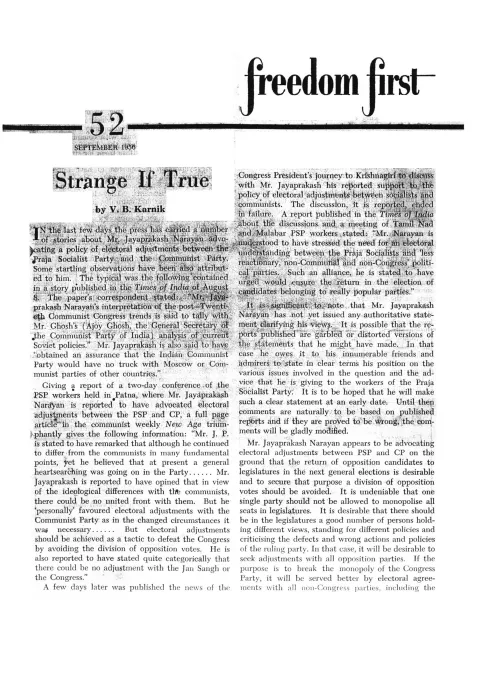
This is the September 1956 issue (No. 52) of Freedom First, the monthly periodical of the Democratic Research Service, edited by V. B. Karnik and published from Bombay. In the rendered pages, the issue opens with Karnik’s own column questioning Jayaprakash Narayan’s reported openness to electoral adjustments with the Communist Party, then moves through a “Notes” section covering Chinese incursions into Burma, the communist-infiltrated coalition in Laos, a controversial Christian missionary activities report in Madhya Pradesh, C. D. Deshmukh’s resignation as Finance Minister over cabinet functioning, and a warning about communist infiltration of a Calcutta University-funded students’ welfare project. It carries an unsigned report on the aftermath of Indonesia’s first general elections and the fraught coalition politics between the Masjumi, Nationalist Party, and Communists (P.K.I.), M. A. Venkata Rao’s piece questioning the Communist-front character of an upcoming Asian Writers’ Conference, an unsigned item on the Helsinki international journalists’ conference as a suspected communist front, Eugene Lyons’s open letter to American novelist Howard Fast confronting fellow-travellers with the implications of Khrushchev’s “secret speech” on Stalin’s crimes, M. A. Venkata Rao’s review of Klaus Mehnert’s book Stalin versus Marx, and the recurring “With Many Voices” column of quoted press and parliamentary statements. The volume’s argumentative center, in the rendered pages, is a sustained anti-communist and anti-fellow-traveller polemic: distrust of Soviet and Chinese intentions in Asia, suspicion of ostensibly cultural or professional international bodies as communist fronts, and use of the Khrushchev revelations to press domestic Indian sympathizers and neutralists to reconsider their positions.
Key points
-
V. B. Karnik’s ‘Strange If True’ argues that even limited electoral ‘adjustments’ between the PSP and Communist Party would inevitably escalate into a united front, invoking the 1930s Congress Socialist Party precedent and Burma’s AFPFL experience as cautionary parallels.
-
A ‘Notes’ section reports Chinese incursion into Burmese territory, criticises the Madhya Pradesh Niyogi Committee report on Christian missionaries as ‘reckless,’ and reveals C. D. Deshmukh’s resignation disclosures on unconstitutional cabinet decision-making over Bombay’s reorganisation.
-
An unsigned report traces Indonesia’s post-election cabinet formation, in which the Communist Party (P.K.I.) became Asia’s second-largest despite ultimately being excluded from the resulting government.
-
M. A. Venkata Rao’s piece on the planned Asian Writers’ Conference questions whether a unified ‘Asian Mind’ exists, arguing the Moscow-aligned sponsors intend the Delhi conference as a communist ‘Front’ or ‘communication belt.’
-
Eugene Lyons’s ‘An Open Letter To A Fellow-Traveller,’ addressed to novelist Howard Fast, presses him to recognise his response to Khrushchev’s revelations as ‘a cry for help’ rather than a genuine break from communism.
-
M. A. Venkata Rao reviews Klaus Mehnert’s Stalin versus Marx, concluding Soviet ideology’s shift to national conservatism amounts to ‘a new Fascism — a strange meeting of extremes.’
-
‘With Many Voices’ quotes Nehru saying no one in a communist country can raise their head against Party decisions, and K.P.S. Menon noting India has ‘followed your (Soviet) example’ economically.
Essays
Strange If True
By V. B. Karnik
In “Strange If True,” V. B. Karnik examines press reports that Jayaprakash Narayan has been advocating electoral adjustments between the Praja Socialist Party and the Communist Party ahead of coming elections. Karnik notes JP has not issued any authoritative clarification and treats the reports cautiously, but argues that even if only ‘adjustments’ are intended, such arrangements inevitably develop into common campaigns, joint activity, and eventually a de facto united front, opening the PSP to communist infiltration and subversion as happened with the Congress Socialist Party in the 1930s. He rejects the idea that communists are ideologically closer to the PSP than the Hindu Mahasabha or Jana Sangh, calling communists ‘the obedient tools of a foreign Power,’ and closes by citing Burma’s experience with the communist-infiltrated Anti-Fascist Peoples’ Freedom League as a cautionary parallel for Indian socialists.
- JP Narayan reported to favor electoral adjustments between PSP and Communist Party but has not clarified his position publicly
- Karnik argues adjustments inevitably escalate into united fronts and joint campaigns
- Claims communists are more dangerous allies than communal parties like Hindu Mahasabha or Jana Sangh, despite ideological distance from the latter
- Invokes the 1930s Congress Socialist Party precedent as a warning against repeating the experiment
- Points to Burma’s AFPFL and U Nu’s disillusionment with communists as a warning to Indian socialists
Essay 2
The unsigned “Notes” section gathers several short editorial items. It reports on a border clash between Chinese and Burmese troops and Chinese incursion into Burmese territory, tying this to concerns that communist guerrillas within Burma (whom former Prime Minister U Nu called ‘stooges’ and ‘agents’ of foreign powers) pose a graver internal threat than the external one, and cites disclosures about U Nu’s disillusionment with Soviet and Chinese neutrality. It covers a new agreement in Laos giving the communist Pathet Lao legal recognition and a role in government and the army, framing this as a dangerous precedent for communist advance via subversion rather than open insurrection. It also covers deadlocked Soviet-Japanese peace talks over the disputed Kuril/southern islands, harshly criticizes the Madhya Pradesh Christian Missionary Activities Committee (Niyogi Committee) report as unjust and factually reckless in its treatment of missionaries, quoting Dr. John Matthai and the Governor of Bombay in the missionaries’ defence, criticizes C. D. Deshmukh’s resignation disclosures about ‘cavalier and unconstitutional’ cabinet decision-making on Bombay’s reorganisation, praises Italian Socialist leader Pietro Nenni’s admission of the systemic (not merely personal) roots of Stalinist repression while faulting him for not renouncing collaboration with communists altogether, and closes by criticizing the Calcutta University Senate’s grant to a communist-front-linked All India Students’ Federation project.
- Chinese troops reported to have crossed into Burmese territory near the Burma Road; Burmese government voices concern
- Internal communist subversion in Burma framed as more dangerous than the external Chinese threat
- New Laos agreement grants the communist Pathet Lao legal party status and government/army roles, seen as a step toward eventual communist takeover
- Soviet-Japanese peace talks stall over Russia’s refusal to return Japanese islands seized in WWII
- Madhya Pradesh’s Niyogi Committee report on Christian missionaries criticized as unjust, ‘wild’ in its premises and ‘reckless’ in its conclusions
- C. D. Deshmukh’s resignation reveals that cabinet decisions are made unconstitutionally by a few individuals rather than collectively
- Pietro Nenni’s post-Khrushchev remarks on socialism requiring democratic guarantees are welcomed but seen as insufficient given his continued communist collaboration
- Calcutta University’s grant to an AISF-run ‘Students’ Health Home’ criticized as unwitting aid to communist infiltration of student welfare activities
The Elections And After In Indonesia
By From a Political Correspondent
This unsigned report, credited to ‘a Political Correspondent,’ analyses the formation of Indonesia’s first elected cabinet following the 1955 General Elections. It describes the surprise near-equal showing of the Masjumi and Nationalist Party (57 seats each) and the unexpectedly strong performance of the Communist Party (P.K.I.), which won 38 seats and nearly six million votes, becoming the second-largest Communist Party in Asia. The piece traces how Nationalist Party leader Ali Sastroamidjojo, despite lacking a straight majority and encountering resistance from Masjumi conscientious objections to communist cooperation and army opposition, ultimately maneuvered to form a government from which the communists were excluded, following interventions by Masjumi leader Mohammad Natsir and Nationalist figures like Wilopo and Sarino. It concludes that the resulting cabinet, while not actively anti-communist as a matter of Ali’s own personal disposition, now functions without open communist participation, with several members frankly anti-communist.
- Indonesia’s 1955 elections produced a near-tie between Masjumi and the Nationalist Party (57 seats each), with the P.K.I. (Communist Party) surging to 38 seats and becoming Asia’s second-largest Communist Party
- President Sukarno called on Nationalist Party leader Ali to form government despite no party holding a majority
- Ali’s inclination toward cooperation with, or tolerance of, communist support was constrained by Masjumi’s conscientious objection and Nationalist Party figures like Wilopo opposed to any coalition with communists
- Masjumi leader Mohammad Natsir’s return from Sumatra and his opposition to any government indirectly backed by communists disrupted Ali’s plans
- The final cabinet includes Masjumi and excludes active communist participation, despite Ali’s own non-antagonistic stance toward communists
Asian Writers’ Conference
By M. A. Venkata Rao
M. A. Venkata Rao’s “Asian Writers’ Conference” examines the planned December Delhi conference of Asian writers, convened by a preparatory committee including Mulk Raj Anand, Baharsidas Chaturvedi, and Jainendra Kumar, and addressed by V. K. Krishna Menon with reception by President Rajendra Prasad and Prime Minister Nehru. Venkata Rao questions whether there is a coherent ‘Asian Mind’ comparable to a European Mind, granting some scholarly basis for shared Buddhist-influenced traditions in China, Japan, Korea, and India (while excluding West Asia’s Islamic and Judeo-Christian affiliations), but argues the Conference’s real purpose, given its sponsors’ Moscow-aligned Asianism, is to organize Asian writers as a communist ‘Front’ or ‘communication belt’ for the Communist Movement’s political ends. He contrasts genuine cultural exchange under freedom with the enforced uniformity of communist ‘culture,’ citing Mao Zedong’s doctrine of people’s democracy’s own culture and the suppression of Confucianism, Taoism, and Buddhism in Communist China, and notes the inclusion of the Soviet Union in the proposed Secretariat as confirming the Conference’s front character.
- Asian Writers’ Conference planned for December in Delhi, preparatory committee met in late July with delegates from Burma, Korea, Nepal, China, India, and Vietnam
- Venkata Rao questions the concept of a unified ‘Asian Mind,’ granting partial validity for Buddhist-influenced East Asian traditions but excluding West Asia
- Argues the Conference, given Moscow-aligned sponsorship, is intended as a communist ‘Front’ to win writers’ sympathies and later political support
- Draws on Lenin and Stalin’s concept of ‘communication belts’ to explain the Communist strategy of using cultural fronts for political capture
- Cites Mao Zedong’s doctrine that a ‘new democracy’ or ‘people’s democracy’ requires its own culture, resulting in suppression of Confucianism, Taoism, and Buddhism in China
- Notes the Soviet Union’s inclusion in the proposed Secretariat as evidence the Conference is a front despite Russia’s implausible status as an ‘Asian’ nation
Innocents At Helsinki,
“Innocents At Helsinki,” an unsigned item, questions the credentials of the International Conference of Journalists held at Helsinki, noting reports that prominent independent liberal journalists such as Walter Lippmann and Alistair Cooke were initially listed as invitees, apparently without their consent, and ultimately did not attend. It views the Conference’s call for unity between international journalists’ organisations as paralleling earlier communist-front efforts such as the World Federation of Trade Unions’ push for a united international labour body, intended to penetrate democratic information and education channels. Continuing on page 11, the piece is skeptical of the Conference’s professed concern for press freedom and objectivity given the state-controlled press in Communist countries, and criticizes as naive its recommendations for abolishing press censorship and enabling free journalist movement, given the Soviet Union’s own rejection of reciprocal free communication (as seen during the Khrushchev-Bulganin visit to Britain).
- Credentials of the Helsinki International Conference of Journalists questioned; independent liberals like Walter Lippmann and Alistair Cooke reportedly listed as invitees without consent and did not attend
- Conference’s call for unity of international journalists’ bodies seen as paralleling communist front tactics like the World Federation of Trade Unions’ campaigns
- Article argues genuine press freedom principles are undermined by Communist countries’ own state control of the press
- Criticizes as naive the Conference’s recommendations on abolishing censorship and enabling free journalist movement, since Soviet leaders themselves rejected reciprocal free communication during their Britain visit
An Open Letter To A Fellow-Traveller
By Eugene Lyons
Eugene Lyons’s “An Open Letter To A Fellow-Traveller,” addressed to American novelist Howard Fast and reprinted in abridged form from the New Leader of New York, responds to Fast’s Daily Worker column reacting to Khrushchev’s ‘secret speech’ on Stalin’s crimes. Lyons, drawing on his own earlier disillusionment as a onetime defender of the Soviet regime while living and working there, presses Fast to recognize that his anguished self-criticism is ‘a cry for help’ rather than genuine reckoning, since Fast continues to equate flaws in free societies (like McCarthyism or occasional miscarriages of justice) with systemic, sustained Stalinist terror, forced collectivization, slave labor, and fake elections. Lyons argues Fast’s selective outrage — focused on Stalin’s persecution of Jews but silent on other atrocities — reflects an unwillingness to confront that the entire communist system, not merely Stalin’s personal qualities, produced these horrors, and invokes journalist I. F. Stone’s post-USSR-visit verdict that ‘no society is good in which men fear to think’ as testimony Fast cannot dismiss.
- Addressed to Howard Fast, prominent fellow-travelling American novelist, in response to his Daily Worker column on Khrushchev’s Stalin revelations
- Lyons draws on his own past disillusionment as a former defender of the Soviet regime while living in the USSR
- Argues Fast’s confession is a ‘cry for help’ rather than a genuine break, since his column still contains ‘childish alibis based on transparent falsehoods’
- Criticizes Fast’s equation of flaws in free societies (McCarthyism, occasional judicial error) with systemic Stalinist terror and total denial of habeas corpus
- Notes the Khrushchev speech’s selective omissions — no mention of persecution of Jews, forced collectivization, slave labor, or fake East European elections
- Cites I. F. Stone’s post-visit verdict that ‘no society is good in which men fear to think’ as independent confirmation Fast cannot dismiss
- Urges Fast to break fully from communism, framing this as still available to him unlike writers trapped inside the USSR
Review: Stalin versus Marx
By M. A. V.
No summary was extracted for this article. Listed for completeness.
Essay 6
No summary was extracted for this article. Listed for completeness.
Essay 7
M. A. Venkata Rao’s book review, signed ‘M. A. V.,’ covers Klaus Mehnert’s Stalin versus Marx (translated from German, George Allen and Unwin). The review praises the roughly 130-page book for vividly depicting the shift in Soviet ideology from Marxist radicalism to Russian national conservatism under Stalin, illustrated through the fields of historiography (the fall of historian Mikhail Pokrovsky’s Marxist interpretation of Russian history after 1930) and linguistics (Stalin’s writings on language redefined as reflecting an eternal national soul rather than class culture). The review concludes that this transformation amounts to a ‘new Fascism — a strange meeting of extremes,’ replacing Marx’s universalist dialectic with national psychology and relativism.
- Reviews Klaus Mehnert’s Stalin versus Marx, translated from German, published by George Allen and Unwin, priced 8/6d
- Book traces Soviet ideology’s shift from Marxist radicalism to Russian national conservatism under Stalin
- Illustrated through historiography: the condemnation of historian Mikhail Pokrovsky’s Marxist history after his 1930 death
- Illustrated through linguistics: Stalin’s reframing of language as expressing an eternal national soul rather than class-based culture
- Review concludes the ideological shift amounts to a ‘new Fascism — a strange meeting of extremes’
Essay 8
“With Many Voices” is the issue’s closing quotations column, gathering brief press and parliamentary statements under a Tennyson epigraph. It includes Nehru’s remark on the impossibility of dissent in a communist country, a Times of India item on the USSR’s admission of internment camps, quotes on the Suez Canal dispute, Vinoba Bhave on envy underlying egalitarian demands, comparative pay for Soviet doctors versus taxi drivers, skepticism about Soviet theatre’s reputation, Pandit G. B. Pant on Parliament and unity versus division, K.P.S. Menon’s remark on India following the Soviet economic ‘example,’ a critique of public and private monopolies as ‘dinosaurs,’ and D. K. Kunte on the rigidity of India’s party system. The page also carries a subscription coupon for Freedom First and an advertisement for a pamphlet reprinting Khrushchev’s ‘The Truth About Stalin’ speech with a foreword by V. B. Karnik.
- Quotations column featuring brief statements from Nehru, G. B. Pant, Morarji Desai, K.P.S. Menon, Vinoba Bhave, D. K. Kunte, and others
- Nehru quoted saying no one in a communist country can raise their head against Party decisions
- K.P.S. Menon, Indian Ambassador in Moscow, quoted saying India has ‘followed your (Soviet) example’ in the economic field
- Column closes with a subscription form and an advertisement for a pamphlet of Khrushchev’s ‘Truth About Stalin’ speech with foreword by V. B. Karnik
Generated by the v1.5 extraction pipeline. Awaiting editorial review.
Metadata and summary are AI-extracted from the source PDF and reviewed for editorial accuracy. The original work is available via the Read PDF tab above (where present); paragraph-level citation inside the PDF is deferred to a future engagement.